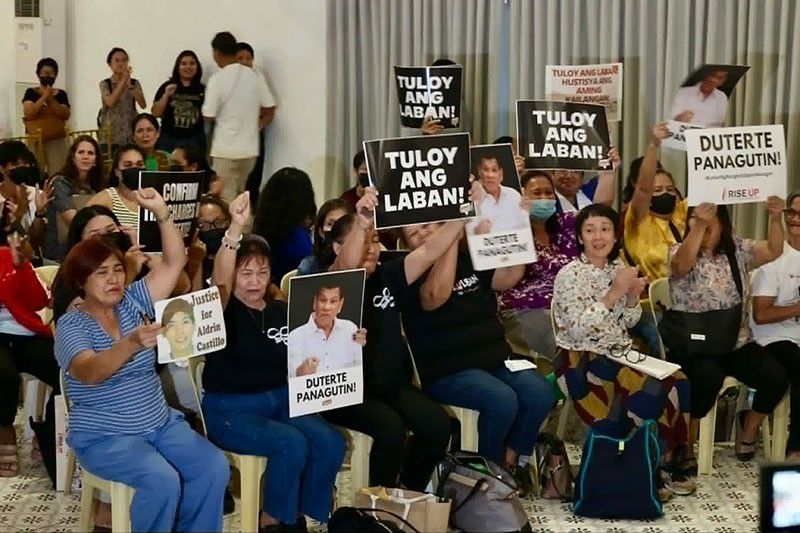
The families of victims of extrajudicial killings shouted with joy while watching the live feed of the appeals chamber of the International Criminal Court at UP Diliman, Quezon City, after the court rejected the appeal of former President Rodrigo Duterte for his release and the dismissal of his case concerning jurisdiction.
MANILA, Philippines — The International Criminal Court affirmed that it has jurisdiction to hear the case of crimes against humanity against former President Rodrigo Duterte.
The ICC Appeals Chamber on Wednesday dismissed the petitions to halt the proceedings against the former President.
In its decision, the Appeals Chamber ruled that although the Philippines withdrew from the Rome Statute in March 2019, preliminary examinations into the situation in the Philippines began in February 2018, a year before the Duterte administration sent a formal notice to withdraw from the agreement.
The majority of the Appeals Chamber rejected the four grounds raised by the defense, which argued that the Pre-Trial Chamber erred in deciding that the ICC has jurisdiction over Duterte’s case.
After rejecting the appeal, the Appeals Chamber stated that the request for the immediate release of Duterte was moot.
The decision affirmed the ICC Pre-Trial Chamber’s ruling from October 2025 that the court has authority over the case, contrary to the claims of Duterte’s lawyer Nicholas Kaufman that the Philippines was no longer part of the ICC when the Pre-Trial Chamber authorized the opening of an investigation in September 2021.
Under the Rome Statute, a country’s withdrawal only takes effect one year after the official notice is received. The Philippines formally withdrew on March 17, 2019.
Duterte was charged with three counts of crimes against humanity related to his war on drugs when he was mayor of Davao City and as president.
Due to the Appeals Chamber’s decision, the case process will continue, including the awaited ruling of Pre-Trial Chamber I on the confirmation of charges, which concluded its hearings on February 27.
UP Diliman
The University of the Philippines Diliman, located in Quezon City, is the flagship campus of the national university system, established in 1949 after moving from its original Manila site. It became a center of academic excellence and political activism, notably playing a key role in the 1986 People Power Revolution that ousted President Ferdinand Marcos. Today, it is renowned for its lush greenery, iconic Oblation statue, and vibrant campus culture.
Quezon City
Quezon City, located in the Philippines, was established in 1939 and served as the country’s capital from 1948 to 1976 before the capital was moved back to Manila. It is named after Manuel L. Quezon, the second president of the Philippines, who envisioned it as a new capital city. Today, it is the largest city in Metro Manila by population and area, known for its cultural landmarks such as the Quezon Memorial Circle and the University of the Philippines Diliman.
International Criminal Court
The International Criminal Court (ICC) is a permanent tribunal established in 2002 by the Rome Statute to prosecute individuals for genocide, war crimes, crimes against humanity, and the crime of aggression. Based in The Hague, Netherlands, it was created as a successor to ad hoc tribunals like those for the former Yugoslavia and Rwanda, aiming to end impunity for the world’s most serious crimes. As of 2024, it has faced challenges including limited jurisdiction, non-participation by major powers like the U.S., China, and Russia, and ongoing debates over its effectiveness and political independence.
Davao City
Davao City is a major urban center on the island of Mindanao in the Philippines, known for its proximity to Mount Apo, the country’s highest peak. Historically, it was a small settlement that grew under American colonial rule and later became a key hub for trade and agriculture, particularly for crops like bananas and coffee. Today, it is celebrated for its cultural diversity, vibrant festivals like Kadayawan, and its reputation as one of the safest cities in the Philippines.