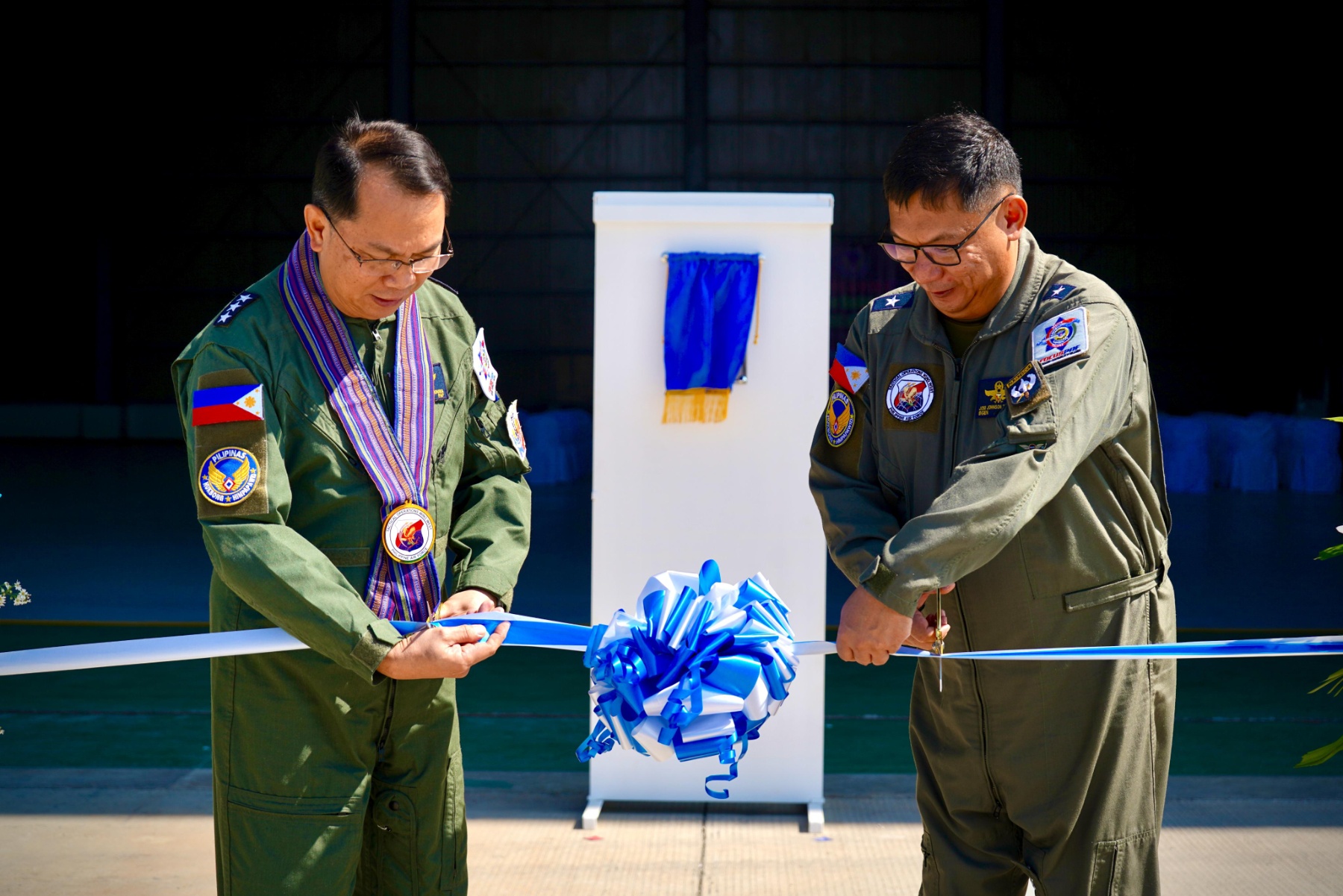
The Philippine Air Force on Thursday inaugurated the completed Basing Support System on Pag-asa Island in Palawan in a bid to boost its capability to sustain operations in the West Philippine Sea.
Philippine Air Force Commanding General Lieutenant General Arthur Cordura led the launching of the completed key basing support infrastructure and facilities.
In a statement, the Philippine Air Force said these are designed to enhance air operations and strengthen their capability to sustain operations and support strategic infrastructure in the West Philippine Sea.
The project was implemented in close coordination with the Armed Forces of the Philippines and the Palawan provincial government.
During his visit to Pag-asa Island, Cordura distributed school supplies to students of Pag-asa Elementary School as part of its commitment to community engagement and support for residents.
He added that “conditions which once limited operational tempo have now been addressed, enabling more reliable and continuous mission support.”
“This milestone highlights the Philippine Air Force’s dedication to improving operational readiness and reinforcing its presence in strategically significant areas, as it remains steadfast in its mission to protect the nation’s sovereignty and territorial integrity while contributing to regional stability and security,” the Philippine Air Force added.
Earlier this month, the Philippine Coast Guard activated the to improve access to essential government services to residents of Kalayaan town, such as education, healthcare, and even spiritual services.
The Philippine Coast Guard upgraded the existing unit into a full-fledged major district to provide more logistical support across occupied maritime features in the area.
The Philippine Coast Guard also plans to deploy dedicated assets, including vessels and aircraft, which will be used for maritime security and search and rescue operations, as well as environmental protection.
Previously in March, President Ferdinand Marcos Jr. ordered that be given to 131 Kalayaan Island Group features.
Executive Order 111 issued on March 26 tasked the National Mapping and Resource Information Authority to produce and publish updated charts and maps reflecting the official names.
China claims almost the entire South China Sea – a key conduit for more than $3 trillion in annual shipborne trade – including areas also claimed by the Philippines, Vietnam, Indonesia, Malaysia, and Brunei.
In 2016, the Permanent Court of Arbitration in the Hague ruled in favor of the Philippines over China’s claims in the South China Sea, but Beijing refused to recognize the arbitral ruling.
Pag-asa Island
Pag-asa Island, also known as Thitu Island, is the largest Philippine-controlled island in the disputed Spratly archipelago in the South China Sea. It was originally named “Rizal Island” and later renamed “Pag-asa,” meaning “hope” in Filipino, after the Philippines established a civilian and military presence there in the 1970s. The island features a small community, an airstrip, and a marine research station, reflecting the country’s efforts to assert its territorial claims while supporting local inhabitants.
Palawan
Palawan, a province in the Philippines, is renowned for its stunning natural landscapes, including pristine beaches, limestone karst formations, and the UNESCO World Heritage Site of the Puerto Princesa Subterranean River National Park. Historically, the island was a key trading hub for Chinese, Malay, and indigenous groups long before Spanish colonization in the 16th century, and it later played a role in the Philippine-American War. Today, Palawan is celebrated as a top eco-tourism destination, balancing conservation efforts with its rich cultural heritage.
West Philippine Sea
The West Philippine Sea refers to the parts of the South China Sea that are within the Philippines’ exclusive economic zone, as defined by the United Nations Convention on the Law of the Sea. It is a region of significant geopolitical tension due to overlapping territorial claims by several countries, including China, Vietnam, and others. Historically, the area has been vital for fishing, trade routes, and resource extraction, and the Philippines has asserted its sovereign rights over features like the Scarborough Shoal and the Spratly Islands.
Pag-asa Elementary School
Pag-asa Elementary School, located in the Philippines, is a public educational institution that has served its local community for decades. Its name, meaning “hope” in Filipino, reflects the aspirations of the community for the future of its children. While specific historical records may vary by branch, the school typically stands as a symbol of accessible primary education in the area.
Kalayaan
Kalayaan is a municipality in the province of Palawan, Philippines, encompassing the disputed Spratly Islands in the South China Sea. Its name means “freedom” or “independence” in Filipino, reflecting its strategic and contested nature. The area has a complex history involving territorial claims by multiple nations, with the Philippines establishing the municipality in 1978 to assert its sovereignty over the islands.
Kalayaan Island Group
The Kalayaan Island Group is a collection of islands, islets, and reefs in the South China Sea, claimed by the Philippines as part of its territory. Historically, the area has been a subject of territorial disputes due to its strategic location and rich marine resources. The Philippine government officially established the Kalayaan municipality in the 1970s to assert sovereignty, though the region remains contested by several other countries.
South China Sea
The South China Sea is a vital body of water in Southeast Asia, rich in marine resources and key shipping routes, bordered by China, Vietnam, the Philippines, Malaysia, and other nations. Historically, it has been a crucial maritime trade corridor for centuries, linking East Asia to the Indian Ocean and contributing to cultural and economic exchanges. However, in modern times, it has also become a region of territorial disputes, with multiple countries claiming sovereignty over its islands and waters.
Permanent Court of Arbitration in the Hague
The Permanent Court of Arbitration (PCA) in The Hague is an intergovernmental organization established in 1899 to facilitate arbitration and dispute resolution between states. It was created by the First Hague Peace Conference, making it one of the oldest institutions for international dispute settlement. Located in the Peace Palace, the PCA continues to serve as a key venue for arbitration, conciliation, and fact-finding in international law.