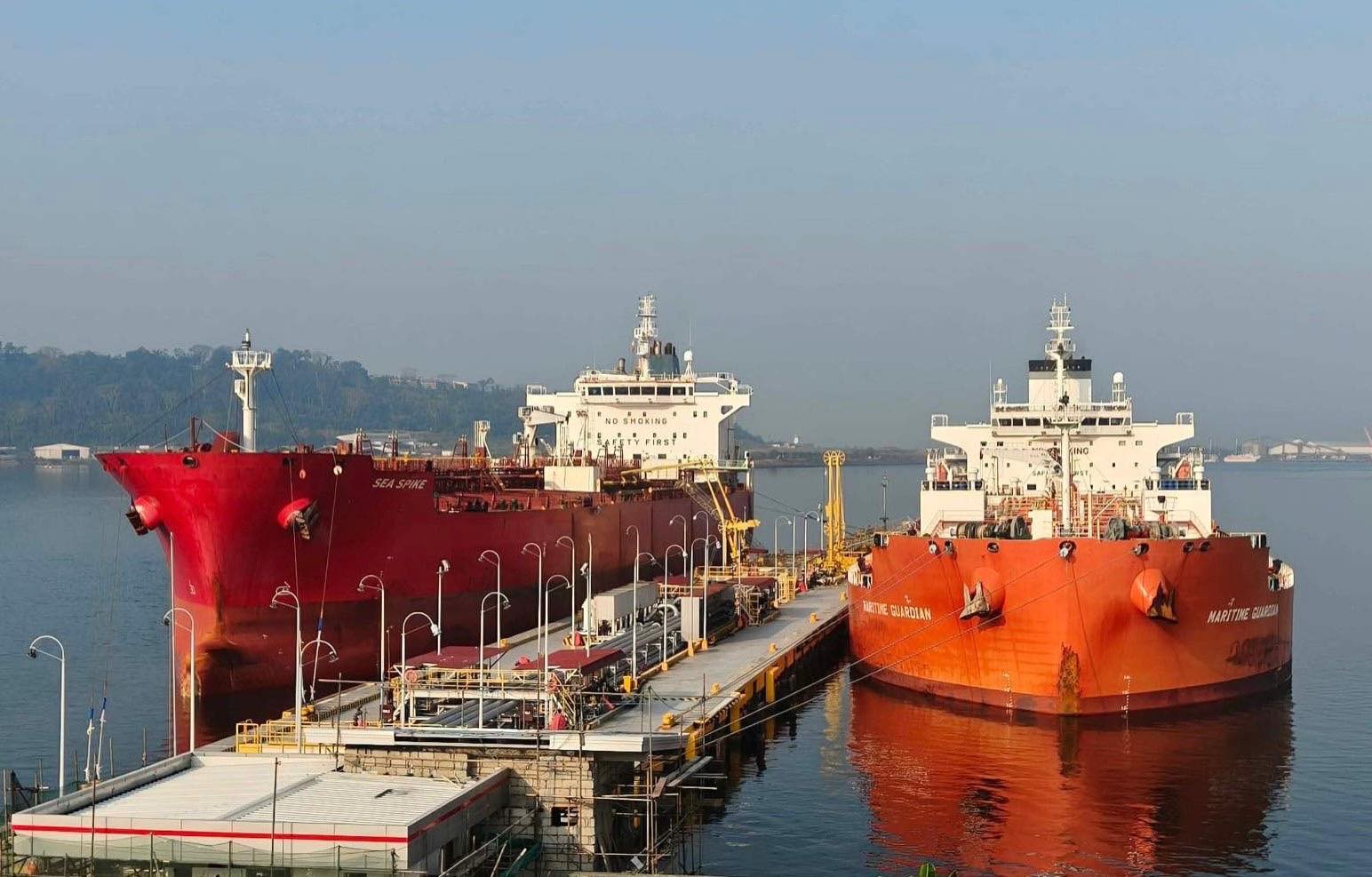
On Saturday, it was announced that over 300,000 barrels of diesel ordered by the Philippine government have arrived to boost the country’s stockpile of fuel amid the ongoing Middle East crisis.
“It has arrived!” was stated in a Facebook post.
The shipment from Malaysia totals 329,000 barrels, or over 52 million liters, of diesel.
The diesel shipment allows the government to “stock up on supply while the Middle East war is not over.”
“Such a complex world isn’t it? Someone from the Americas starts a war in the Middle East and causes suffering in Asia,” it was stated.
The shipment forms part of the 900,000 barrels of diesel set to arrive in the country this April, which will be in three batches consisting of 300,000 each.
The next two batches of diesel, meanwhile, are expected to arrive by the second and third week of this month.
The second batch will be sourced from North Asia or India while the last batch will be ordered from Oman.
The 900,000 barrels of diesel ordered by the government are also part of a larger order of 1.042 million barrels of diesel, of which 142,000 barrels arrived from Japan last March 26.
A statement said the latest delivery is also part of the government’s broader oil diplomacy pursuant to a presidential directive.
“This latest shipment from Malaysia further strengthens our supply position at a time when external risks remain and the situation in the Middle East continues to evolve,” it was stated.
“The government is taking deliberate and forward-looking steps to build up available supply, support essential sectors, and help ensure that the country remains prepared for possible disruptions in the global oil market,” it was added.
On April 3, it was reported that the country has 75.052 million liters of fuel supply which is expected to be enough for 50 days.
The country currently has 2.516 million liters (47.26 days’ worth) of diesel.
It was stated that necessary measures will continue to be pursued, including close coordination with concerned government entities and industry stakeholders, to monitor inventory levels, facilitate the timely distribution of incoming fuel volumes, and prevent supply bottlenecks that may affect transport, logistics, power generation, and other vital economic activities.
It was also reiterated that the Philippines—as a net importer of petroleum products—remains vulnerable to external developments that may affect both price and supply.
“In response, the government continues to move with urgency and discipline to reinforce fuel availability, maintain orderly market conditions, and safeguard consumer welfare,” the statement concluded.
Philippines
The Philippines is an archipelagic nation in Southeast Asia with a rich cultural history shaped by centuries of indigenous traditions, Spanish colonial rule (1565-1898), and later American influence. Its key historical sites include the Spanish-era Baroque churches, the historic city of Vigan, and the ancient Banaue Rice Terraces, which are over 2,000 years old. Today, it is known for its vibrant festivals, diverse heritage, and resilient people.
Middle East
The Middle East is a transcontinental region centered on Western Asia and Egypt, historically known as the “Cradle of Civilization” for the rise of early societies like Mesopotamia and ancient Egypt. It is the birthplace of major world religions—Judaism, Christianity, and Islam—and has been a crossroads of trade and empires for millennia, from the Persians and Ottomans to modern nation-states. Its vast history is marked by profound cultural achievements and complex geopolitical developments centered on its strategic location and resources.
Malaysia
Malaysia is a modern Southeast Asian nation formed in 1963 through the union of former British territories, though its history includes powerful ancient kingdoms like Malacca, a major hub for trade and the spread of Islam in the 15th century. Today, it is known for its vibrant multicultural society—primarily Malay, Chinese, and Indian—and iconic landmarks such as the Petronas Twin Towers in Kuala Lumpur and the historic George Town in Penang.
Americas
The term “Americas” refers to the continents of North and South America, a vast region with a complex history spanning thousands of years. It was home to diverse indigenous civilizations before the arrival of European explorers in the late 15th century, leading to widespread colonization. Today, it encompasses numerous nations with a rich blend of native, European, African, and Asian cultural influences.
Asia
“Asia” is a continent, not a single place or cultural site. It is the world’s largest and most populous continent, home to ancient civilizations like those in Mesopotamia, the Indus Valley, and China, with a history spanning thousands of years. Today, it encompasses incredibly diverse cultures, nations, and landmarks, from the Great Wall of China to the temples of Angkor Wat.
North Asia
North Asia is a vast geographical region primarily comprising Siberia, the Russian Far East, and parts of northern Central Asia. Historically, it has been inhabited by diverse indigenous peoples like the Yakuts and Buryats, but was extensively explored and incorporated into the Russian Empire from the 16th century onward. Its harsh climate and remote terrain have shaped a history defined by resource extraction, political exile, and unique cultural adaptations.
India
India is a vast and ancient civilization in South Asia, home to one of the world’s oldest continuous cultures, with roots tracing back over 5,000 years to the Indus Valley Civilization. It is renowned for its profound spiritual traditions, such as Hinduism and Buddhism, and a history marked by great empires, colonial rule, and its emergence as the world’s largest democracy. The country’s cultural landscape is defined by its incredible diversity of languages, festivals, architectural marvels like the Taj Mahal, and classical arts.
Oman
Oman is a country on the southeastern coast of the Arabian Peninsula with a rich maritime history as a powerful trading empire. Historically, it controlled a vast network stretching from East Africa to the Indian subcontinent, with its influence centered in the ancient port city of Muscat. Today, it is known for its stunning desert landscapes, historic forts, and a unique cultural heritage that blends Arabian tradition with its deep seafaring past.