
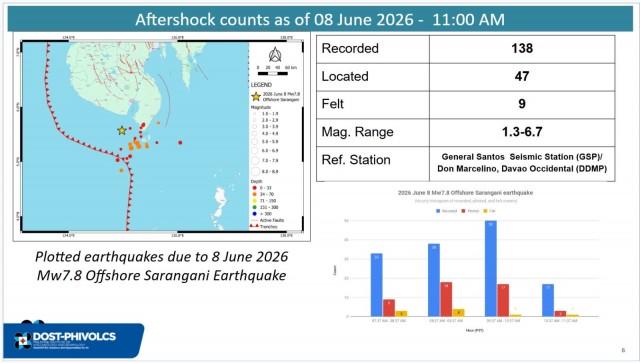
The Philippine Institute of Volcanology and Seismology (PHIVOLCS) said it has recorded 138 aftershocks as of 11 a.m. Monday following the earthquake.
According to PHIVOLCS, 47 of the aftershocks have been located, while nine were felt by residents in affected areas.
The strength of the recorded aftershocks ranged from magnitude 1.3 to 6.7.
PHIVOLCS released a plotted map of earthquakes associated with the magnitude 7.8 offshore Sarangani earthquake, using data from the General Santos Seismic Station (GSP) and the Don Marcelino Seismic Station in Davao Occidental.
Earlier, a report said residents felt the aftershocks when they rushed out of their homes and remained outdoors after the earthquake.
Sarangani
Sarangani is a province in the Philippines, located in the Davao Region of Mindanao. Its name comes from the indigenous Maguindanao word *sarang*, meaning “a place of many” or “abundant,” historically referring to the area’s rich natural resources. The province was established in 1992 after being separated from South Cotabato, and it is known for its diverse cultural heritage, including the traditions of the Blaan, T’boli, and Tagakaolo tribes.
General Santos Seismic Station
The General Santos Seismic Station is a monitoring facility located in General Santos City, Philippines, established to detect and record seismic activity in the region. It plays a crucial role in the country’s earthquake monitoring network, particularly given the area’s proximity to active fault lines and the Pacific Ring of Fire. The station contributes to early warning systems and geological research, helping to mitigate risks from earthquakes and volcanic eruptions in the southern Philippines.
Don Marcelino Seismic Station
The Don Marcelino Seismic Station, located in the Dominican Republic, is a key monitoring facility established to detect and analyze seismic activity in the Caribbean region. It was built to support earthquake early warning systems and scientific research, particularly after the devastating 1946 Dominican Republic earthquake. The station plays a vital role in improving regional disaster preparedness and understanding tectonic movements.
Davao Occidental
Davao Occidental is a province in the Philippines, created in 2013 when it was carved out of Davao del Sur. Its history is rooted in the indigenous cultures of the Lumad and Moro peoples, and it later became part of the larger Davao region’s settlement and development. The province is known for its coastal landscapes, rich biodiversity, and the city of Malita as its capital.
Philippine Institute of Volcanology and Seismology (PHIVOLCS)
The Philippine Institute of Volcanology and Seismology (PHIVOLCS) is a government agency under the Department of Science and Technology that monitors and studies volcanic eruptions, earthquakes, and tsunamis in the Philippines. Established in 1982 from the former Commission on Volcanology, it plays a crucial role in disaster preparedness and risk reduction in a country prone to frequent seismic and volcanic activity. PHIVOLCS is best known for
Sarangani
Sarangani is a province in the southern Philippines, named after the indigenous Sarangani people who originally inhabited the area. Its history includes early trade with Chinese and Muslim merchants, followed by Spanish colonization in the 19th century. Today, it is known for its rich cultural heritage, diverse ethnic groups, and natural attractions like white-sand beaches and diving spots.
General Santos Seismic Station
The General Santos Seismic Station is a monitoring facility located in General Santos City, Philippines, dedicated to detecting and recording seismic activity. Established to support the Philippine Institute of Volcanology and Seismology (PHIVOLCS) in earthquake monitoring and disaster preparedness, it plays a crucial role in studying the region’s tectonic movements due to its proximity to the Philippine Fault Zone. The station helps provide early warnings and data essential for understanding seismic risks in the area.
Don Marcelino Seismic Station
The Don Marcelino Seismic Station is a geophysical monitoring facility located in the Dominican Republic, established to detect and analyze seismic activity in the Caribbean region. It was named after a local figure or landmark and plays a key role in earthquake early warning and research, contributing to regional disaster preparedness. The station is part of a broader network that helps scientists understand tectonic movements along the Hispaniola island’s complex fault systems.
Davao Occidental
Davao Occidental is a province in the southern Philippines, established in 2013 after splitting from Davao del Sur to improve local governance and development. Its history is tied to indigenous tribes like the Blaan and Tagakaulo, and it features natural attractions such as Mount Latian and pristine beaches. The province is also known for its rich marine resources and the annual Paskuhan Festival, which celebrates its cultural heritage.
Philippine Institute of Volcanology and Seismology (PHIVOLCS)
The Philippine Institute of Volcanology and Seismology (PHIVOLCS) is a government agency under the Department of Science and Technology that monitors and studies earthquakes, volcanoes, and other geological hazards in the Philippines. Established in its current form in 1984, it evolved from earlier volcanic and seismic monitoring efforts dating back to the early 20th century, including the Commission on Volcanology (COMVOL). PHIVOLCS plays a critical role in issuing timely warnings and conducting research to mitigate the impacts of natural disasters in the seismically active and volcanically rich Philippines.
Related news

Alex Eala outlasts Rebeka Masarova in rain-delayed Birmingham Open semifinals, reaches second WTA 125 final.
Alex Eala reacts after a point during her singles ...
Resignation of NBI Chief Santiago Accepted by the Palace
NBI Director Jaime Santiago
The resignation of Nat...
Kris Aquino to undergo 6 months of preventive isolation
Filtered by: Lifestyle
Kris Aquino has revealed t...

Etihad Airways orders widebody aircraft, expects to reach pre-war capacity by June.
RIO DE JANEIRO - Etihad Airways is ordering more w...

Djokovic makes Grand Slam history with commanding US Open win.
Filtered by: Sports
Tennis - U.S. Open - Flushing ...