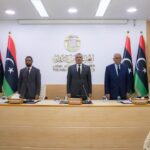
The Supreme State Council: The campaigns of doubt targeting the Libyan judiciary, led by the Supreme Court, constitute a serious assault on the principle of separation of powers.
Tripoli — The High Council of State announced its full and unconditional support for the statement issued by the Supreme Court, affirming that its content embodies a responsible national stance at a pivotal moment in defense of the Constitutional Declaration as the supreme legal framework governing public authorities and in safeguarding the independence of the judiciary.
The Council stated, “The systematic campaigns of doubt and political pressure targeting the Libyan judiciary, headed by the Supreme Court, constitute a serious assault on the principle of the separation of powers and a clear violation of the governing constitutional principles. No legislative or executive authority may infringe upon, circumvent, or reinterpret these principles outside their constitutional framework.”
The Council expressed grave concern over the continued escalation by the Presidency of the House of Representatives towards the judicial authority, and its pursuit of establishing parallel judicial entities lacking constitutional foundation, while attempting to impose political interpretations on the judiciary’s jurisdictions. It noted that this reflects a determination to manage the transitional phase with a unilateral logic that undermines the foundations of national consensus, pushes the country towards further division and instability, and threatens to dismantle what remains of the entire political process.
The High Council of State confirmed that the House of Representatives, as a temporary legislative body with limited powers as established by constitutional jurisprudence, possesses no constitutional mandate to redefine legitimacy, override the Constitutional Declaration, or challenge the jurisdictions of the judicial authority. Continuing on this path poses a direct threat to the unity of the state and practically returns Libya to the initial square of division.
The High Council of State called on the United Nations Support Mission in Libya to take a clear and responsible stance regarding these repeated violations and not to confer any political or de facto legitimacy on procedures or outcomes issued outside the framework of constitutional consensus, due to their profound effect in deepening the crisis and undermining opportunities for reaching a sustainable political solution.
The Council stressed that protecting the judiciary and respecting the Constitutional Declaration are not political options subject to bargaining or exploitation, but rather a national, constitutional, and moral commitment. Any tampering with them will only deepen chaos and prolong the transitional phase, which the High Council of State categorically rejects.
The General Assembly of the Supreme Court had expressed in a statement its profound regret and strong condemnation of the stance of the President of the House of Representatives, Counselor Aguila Saleh, towards the country’s judicial authority, represented at its apex, and the assault on the professional reputation of its head, unjustly accusing it of bias and lack of integrity, describing it as a dangerous precedent.
Tripoli
Tripoli is the capital and largest city of Libya, located on the country’s northwestern coast. Historically, it was founded by the Phoenicians in the 7th century BCE and has since been ruled by a succession of powers, including the Romans, Arabs, Ottomans, and Italians, which is reflected in its diverse architecture, such as the ancient Medina and Red Castle (Assaraya al-Hamra). Today, it serves as Libya’s major political, economic, and cultural center.
High Council of State
The High Council of State is a political body established in Libya in 2015 as part of the UN-brokered Libyan Political Agreement, intended to serve as an advisory and legislative authority alongside the Presidential Council. It was formed to include members from the former General National Congress, aiming to represent a broad spectrum of Libyan society and help steer the country’s transition following the 2011 revolution and subsequent conflicts.
Supreme Court
The Supreme Court of the United States is the highest federal court in the nation and the head of the judicial branch, established in 1789 under Article III of the U.S. Constitution. Its primary role is to interpret the Constitution and federal law, with the power of judicial review to overturn legislation or executive actions it deems unconstitutional, a principle solidified by the landmark 1803 case *Marbury v. Madison*.
Constitutional Declaration
The “Constitutional Declaration” is not a specific physical place or cultural site, but a foundational political document. Most famously, it refers to the 2011 interim constitutional charter issued by Libya’s National Transitional Council following the fall of Muammar Gaddafi, intended to guide the country’s transition to a permanent constitution. As a key legal text, its history is tied to moments of regime change and nation-building, where such declarations establish the principles and framework for a new government.
House of Representatives
The House of Representatives is the lower chamber of the United States Congress, established by the Constitution in 1789. It is composed of representatives elected from congressional districts, with representation based on state population, and it holds primary responsibility for initiating revenue bills and impeaching federal officials.
United Nations Support Mission in Libya
The United Nations Support Mission in Libya (UNSMIL) is a political mission established by the UN Security Council in 2011 following the Libyan Civil War. Its mandate is to assist Libya’s transitional authorities in restoring public security, promoting inclusive political dialogue, and supporting key governance and human rights efforts. It represents the UN’s ongoing commitment to fostering peace and stability in the country during its complex post-conflict transition.
General Assembly of the Supreme Court
The General Assembly of the Supreme Court is the highest judicial body in a nation’s court system, typically responsible for reviewing major legal cases and ensuring the uniform application of law. Historically, such assemblies often evolved from earlier judicial councils or were established by a country’s constitution to serve as the final arbiter of justice, interpreting laws and safeguarding constitutional principles.
Counselor Aguila Saleh
“Counselor Aguila Saleh” is not a place or cultural site, but a prominent Libyan political figure. He has served as the Speaker of the Libyan House of Representatives, based in the eastern city of Tobruk, since 2014, and has been a key actor in the country’s complex political landscape following the 2011 revolution.