The Presidential Council calls for including all active political and social parties and forces in any future political arrangements or initiatives.
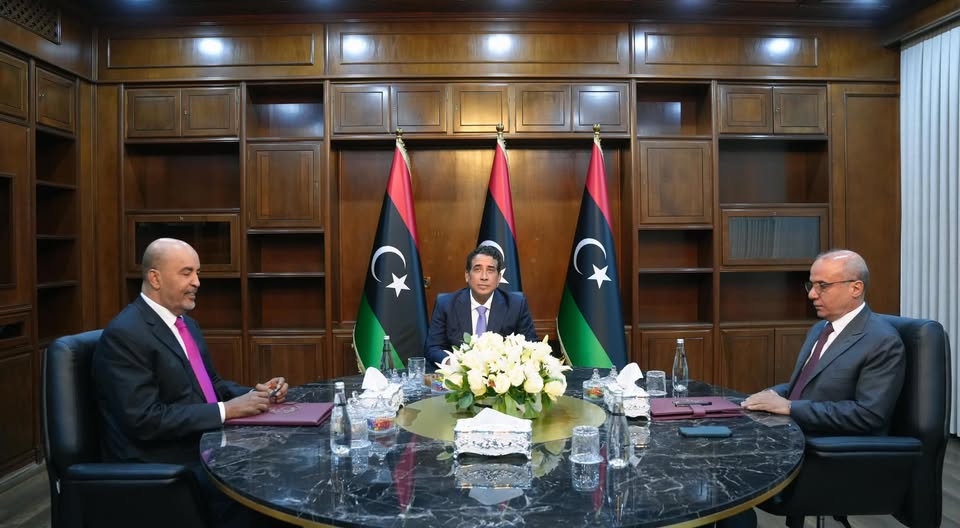
Tripoli, June 8, 2026 – The Presidential Council, chaired by Mohamed al-Menfi, called for the inclusion of all active political and social parties and forces in any upcoming political arrangements or initiatives. This aims to enhance the chances of reaching sustainable national consensus with the broadest base of national agreement and community support, contributing to the consolidation of stability and the protection of the country’s unity and institutions.
This came during the regular meeting of the Presidential Council, held yesterday, Sunday, which was dedicated to following up on the latest developments in the country’s political scene and discussing ways to advance the political process towards a comprehensive national settlement that ends the state of division and paves the way for achieving the desired national goals.
The Council stressed the importance of expanding the scope of national participation in various future political tracks and initiatives, to support opportunities for consensus among different political and social components and enhance stability in the country.
This meeting coincides with the announcement by the United Nations Support Mission in Libya of the conclusion of the work of the members of the “structured dialogue,” which was dedicated to reviewing the final recommendations aimed at creating the necessary conditions for holding national elections and unifying Libyan state institutions.
The statement quoted the head of the United Nations Support Mission in Libya, Hanna Tetteh, as confirming during the closing session that the next phase of the political process in Libya will remain based on efforts led by Libyans themselves, and that these efforts will contribute to advancing the implementation of the key recommendations and reforms produced by the structured dialogue, whether through existing institutions or during the post-election phase.
Tripoli
Tripoli, the capital of Lebanon, is a historic port city with roots dating back to the Phoenician era, later flourishing under Roman, Byzantine, and Mamluk rule. It is renowned for its well-preserved medieval architecture, including the Crusader-built Raymond de Saint-Gilles Citadel and vibrant souks. Today, the city reflects a rich cultural blend of Islamic and Christian heritage, with landmarks like the Al-Muallaq Mosque and the ancient Khan al-Masriyin.
Tripoli
Tripoli, the capital of Libya, is a historic city on the Mediterranean coast with roots dating back to the Phoenicians, who founded it as Oea in the 7th century BCE. It later flourished under Roman, Byzantine, and Islamic rule, and was known as one of the “Three Cities” of the Roman province of Tripolitania. Today, it blends ancient landmarks, such as the Arch of Marcus Aurelius, with modern urban life, though it has faced significant challenges from political instability and conflict in recent years.
Raymond de Saint-Gilles Citadel
The Raymond de Saint-Gilles Citadel, also known as the Citadel of Tripoli, is a historic fortress in Lebanon named after the Crusader count Raymond IV of Saint-Gilles, who besieged Tripoli in the early 12th century. Built on a hill overlooking the city, the site originally held a Fatimid-era fort, which the Crusaders expanded into a massive stronghold after capturing the region in 1109. Today, the citadel stands as a testament to medieval military architecture, featuring layers of construction from Crusader, Mamluk, and Ottoman periods.
Al-Muallaq Mosque
Al-Muallaq Mosque, also known as the “Hanging Mosque,” is a historic Islamic site located in Jeddah, Saudi Arabia. Its name derives from its unique architectural design, built on a raised platform above an ancient cemetery and market area. Dating back to the 16th century, the mosque has undergone several renovations, reflecting the blend of traditional Hijazi and Ottoman styles that characterize the city’s heritage.
Khan al-Masriyin
Khan al-Masriyin, also known as the “Caravanserai of the Egyptians,” is a historic market and trading hub located in the Old City of Jerusalem. Built during the Mamluk period in the 14th century, it served as a commercial center and lodging for Egyptian merchants and pilgrims traveling to the city. Today, it remains a vibrant site with shops and cafes, reflecting centuries of trade and cultural exchange.