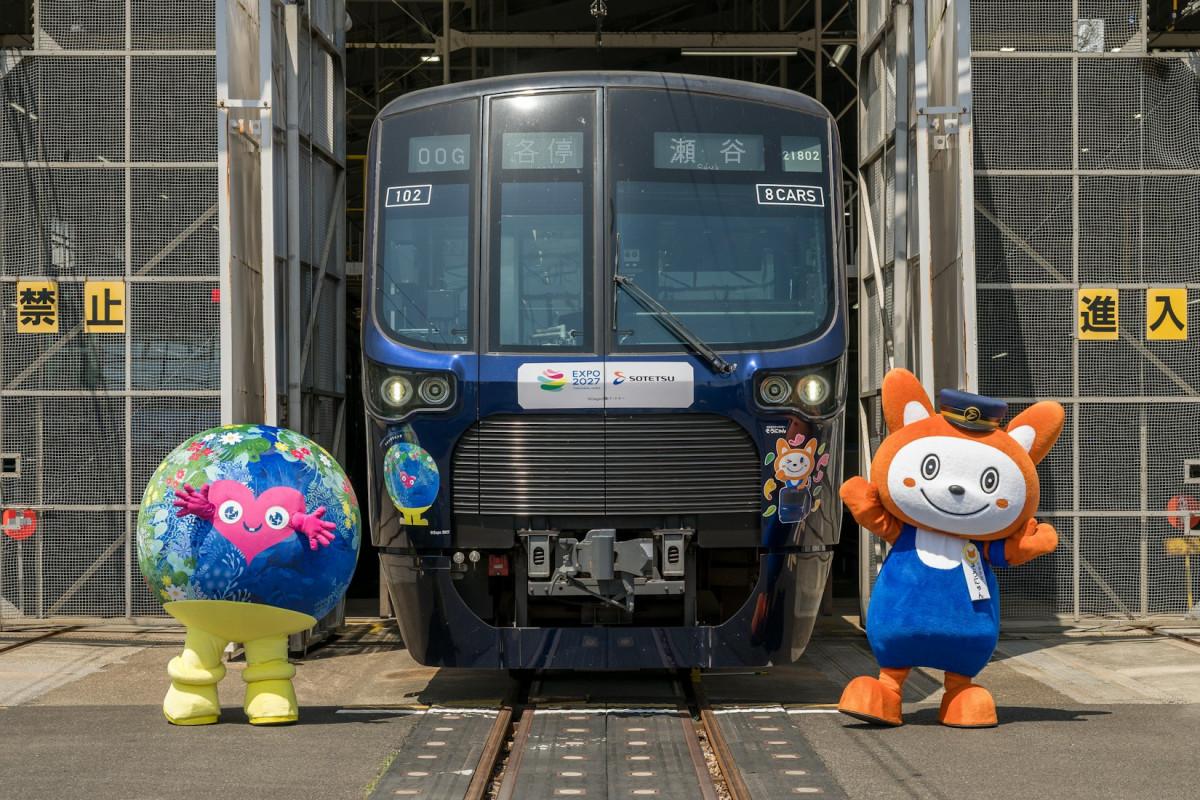
The “Let’s Go with Sotetsu!” wrapped train launches 300 days before the Yokohama Green Expo.
Photo taken at the Sagami Railway Vehicle Center on May 18, 2026
The Sagami Railway Group launched a promotional campaign for the 2027 International Horticultural Expo (GREEN×EXPO 2027) on May 20, titled “Sagami Railway Group・GREEN×EXPO 2027.” The initiative coincides with the 300-day countdown to the expo, with the first phase featuring the operation of a “Let’s go with Sagami Railway!” wrapped train.
The wrapped train is a 21000 series unit (21102×8) in the dark blue “YOKOHAMA NAVYBLUE” color that connects the Sagami Railway line to central Tokyo. The train features headmarks with the Sagami Railway mascot “Sonyan” and the official GREEN×EXPO 2027 mascot character “Tunk Tunk.” The sides depict floral and tree designs fluttering in the wind, and the station name signs for Seya Station and Mitsukyo Station, which serve as gateways to GREEN×EXPO 2027, are designed on the first car. Each car has a different wrap, expressing an invitation to “SOTETSU PARK,” which the Sagami Railway Group will exhibit at the Kids Village of GREEN×EXPO 2027.
The wrapped train will operate on all Sagami Railway lines, as well as through the Tokyu Meguro Line to the Toei Mita Line’s “Nishi-Takashimadaira Station” and the Tokyo Metro Namboku Line and Saitama Railway’s “Urawa-Misono Station,” spreading the appeal of GREEN×EXPO 2027 across the greater Tokyo area.
The Sagami Railway Group will exhibit as “SOTETSU PARK” at the Kids Village of GREEN×EXPO 2027. The concept is “Friends and Habitats,” representing a field where living creatures and nature interact and coexist harmoniously. The aim is to help children learn about familiar living things and nature, leading to actions to protect them. The area will also feature a display of the actual new “13000 series” train.
In conjunction, key visuals and a PR logo for the promotional activities have been created and will be gradually rolled out at stations, trains, and commercial facilities along the Sagami Railway line. The wrapped train is scheduled to operate until September 2027.
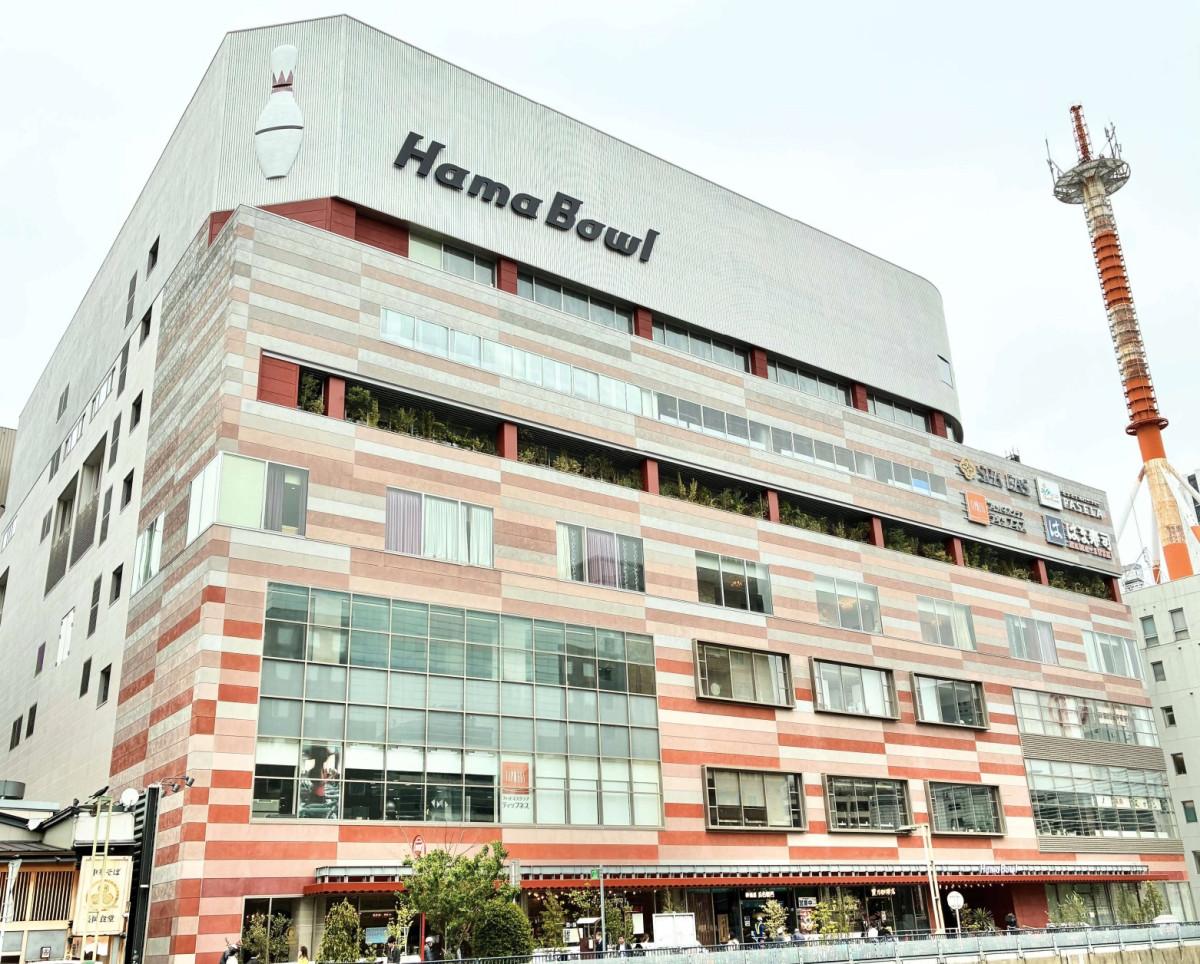
The bowling alley “Hama Bowl,” located on the 8th floor of the “Hama Ball Building” (Nishi-ku, Yokohama, Nishi-Ko 2), a mixed-use commercial facility at the west exit of Yokohama Station, will reopen on July 28 after renovation.
The Hama Ball Building is undergoing a renewal with the theme “Retreat, Living, Recreation,” updating the exterior, interior, and store composition. The dining floor opened first on April 28, and on July 28, the entire building, including the bowling alley and hot bath facilities, will be complete.
Hama Bowl has been a beloved leisure hub at the west exit of Yokohama Station for over half a century since opening as a bowling alley in 1970. When it was transformed into a mixed-use commercial facility in 2009, the facility was named “HAMABOWL EAS,” but with this renovation, the building name was changed to “Hama Ball Building.” The name “Hama Bowl,” familiar since those early days, was retained with the hope that it will continue to be loved for a long time.
In the bowling alley renovation, the entire floor will be completely renewed. The previous 20 lanes will be expanded by adding 8 lanes, making a total of 28 lanes, capable of accommodating up to 168 people. The entire 8th floor will be dedicated to the bowling area, creating an open and spacious atmosphere.
The entertainment equipment will also be completely updated. A large monitor system “Neoverse” from the global bowling equipment manufacturer QubicaAMF will be installed, displaying bowling effects and sports broadcasts on large screens. According to the company, this system will be the largest in Japan to be installed across an entire floor with 28 lanes.
Dining will also be available. B.Y.O., which operates various dining concepts, will open a new type of restaurant, “Spare11 CAFE &
<div class
Sagami Railway Vehicle Center
The Sagami Railway Vehicle Center is a maintenance and inspection facility located in Yokohama, Japan, serving the Sagami Railway (Sotetsu) network. Originally established in the 1920s, it has played a crucial role in the upkeep and modernization of the company’s rolling stock. Today, the site offers occasional public tours, allowing visitors to view train maintenance operations up close.
Sagami Railway line
The Sagami Railway line, commonly known as the Sotetsu Line, is a major private railway network in Kanagawa Prefecture, Japan, connecting Yokohama to surrounding areas. First opened in 1926, it has since expanded to include multiple routes, such as the Main Line and the Izumino Line, playing a key role in regional commuter transport. In recent years, it has undergone significant upgrades, including through-tracking with the JR East network to improve connections to central Tokyo.
Tokyu Meguro Line
The Tokyu Meguro Line is a Japanese railway line connecting Meguro Station in Tokyo to Hiyoshi Station in Yokohama, operated by the Tokyu Corporation. Originally opened in 1923 as part of the Meguro Kamata Electric Railway, it was later integrated into the Tokyu network and now serves as a vital commuter route, linking central Tokyo with southwestern suburbs. The line is known for its direct connections to the Tokyo Metro and other railways, facilitating efficient travel through the Greater Tokyo Area.
Toei Mita Line
The Toei Mita Line is a subway line in Tokyo, Japan, operated by the Tokyo Metropolitan Bureau of Transportation (Toei). It opened in 1968 and runs from Meguro Station in the south to Nishi-Takashimadaira Station in the north, connecting central Tokyo with residential suburbs. The line is known for its direct through-service connections with other rail networks, enhancing commuter accessibility across the city.
Nishi-Takashimadaira Station
Nishi-Takashimadaira Station is a railway station on the Toei Mita Line in Itabashi, Tokyo, Japan. It opened on December 25, 1976, as part of the line’s expansion to serve the growing residential area of Takashimadaira. The station’s name, meaning “West Takashimadaira,” reflects its location within the large-scale public housing development built in the 1970s.
Tokyo Metro Namboku Line
The Tokyo Metro Namboku Line is a subway line in Tokyo, Japan, that opened in 1991 and runs north-south through the city, connecting Meguro Station to Akabane-Iwabuchi Station. It was built to alleviate congestion on existing lines and improve transit in the northern and southern districts, with extensions completed in the 2000s to integrate with the Saitama Rapid Railway Line. Today, it serves as a vital transportation link, carrying millions of passengers annually and facilitating connections to major hubs like Shibuya and Ueno.
Saitama Railway
Saitama Railway, officially known as the Saitama Railway Corporation, operates the Saitama Rapid Railway Line, which connects Akabane in Tokyo to Urawa-Misono in Saitama City. The line opened in 2001 to improve commuter access between Tokyo and the growing residential areas of Saitama Prefecture, particularly to serve the Saitama Stadium area. It plays a key role in regional transit, linking with the Tokyo Metro Namboku Line for seamless travel into central Tokyo.
Urawa-Misono Station
Urawa-Misono Station is a railway station located in Sakura-ku, Saitama City, Japan, operated by the East Japan Railway Company (JR East) on the Keihin-Tōhoku Line. Opened in 1985, it was built to serve the growing residential and commercial development in the area, named after the historic Misono region and the former city of Urawa, which later merged into Saitama City. The station is known for its proximity to Saitama Stadium 2002, a major venue for the 2002 FIFA World Cup and home to the Urawa Red Diamonds football club.