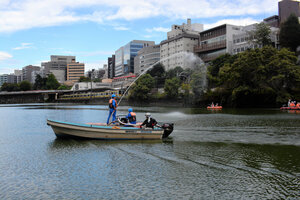
Aiming to improve the water quality of the “Sotobori” (outer moat) of the Imperial Palace, an implementation plan was announced to channel water from the Tamagawa Aqueduct and other sources. The project cost is estimated at approximately 34 billion yen, with a target completion in the mid-2030s.
The outer moat was constructed between 1604 and 1636 to surround the area, but from the Meiji period onward, the eastern side was largely filled in for railway land and other uses. The remaining canal sections on the western side are designated as a national historic site, “Edo Castle Outer Moat Ruins.”
Among these, the Tokyo Metropolitan Government identified water quality deterioration as a problem in the “Ushigome Moat,” “Shin’atsuke Moat,” and “Ichigaya Moat,” where water surfaces remain. Citing the lack of daily water inflow as the cause, the “Sotobori Purification Project” was launched in 2021 to draw water from the Tamagawa Aqueduct and the Arakawa River.
The current implementation plan outlines four projects, including installing pumps to send water from the Arakawa River, which has elevation differences, and constructing a 2-kilometer water channel from the end of the Tamagawa Aqueduct to the outer moat. The estimated construction cost accounts for rising prices, with an additional annual maintenance cost of 240 million yen.
All construction is currently in the design phase, with start dates undecided, but completion is expected within about 10 years. After completion, 500 liters of water per second will flow in, pushing old water out at the northern connection point, allowing the water in the outer moat to be replaced in about five days. The actual water flow will occur only during periods when the water temperature exceeds 20 degrees Celsius, when water quality tends to deteriorate.
Sotobori (outer moat) of the Imperial Palace
The Sotobori, or outer moat, is a historic water feature surrounding the Imperial Palace in Tokyo, originally built during the Edo period (17th century) as part of the defenses for Edo Castle. It served to protect the castle and its inner grounds from attack, with stone walls and waterways forming a formidable barrier. Today, the Sotobori remains a scenic and tranquil landmark, preserving a key element of Japan’s feudal-era architecture and offering visitors a glimpse into the country’s shogunate history.
Tamagawa Aqueduct
The Tamagawa Aqueduct is a historic water supply system built in the early Edo period (1653) to deliver clean water from the Tama River to Edo (modern-day Tokyo). Constructed under the direction of the shogunate and engineered by the brother of the famous retainer Hikobei, it spans approximately 43 kilometers, combining open channels, tunnels, and bridges. Still partially in use today, it represents a remarkable feat of pre-modern Japanese civil engineering and played a vital role in supporting the city’s growth.
Edo Castle Outer Moat Ruins
The Edo Castle Outer Moat Ruins are remnants of the defensive waterways that once surrounded Japan’s Edo Castle (now the Imperial Palace) in Tokyo. Built during the early 17th century under the Tokugawa shogunate, the moats were part of an extensive fortification system. Today, the stone walls and water-filled sections serve as a historic landmark, offering a glimpse into the city’s feudal past.
Ushigome Moat
The Ushigome Moat is a historic waterway located in Tokyo, Japan, originally constructed during the Edo period as part of the defensive fortifications of the Edo Castle. It served to protect the castle’s northwestern flank and was later integrated into the surrounding city landscape. Today, the moat remains a scenic landmark, offering a glimpse into Tokyo’s feudal past amidst the modern urban environment.
Shin’atsuke Moat
Shin’atsuke Moat is a historic waterway located in the Imperial Palace grounds in Tokyo, Japan, originally built during the Edo period as part of the castle’s defensive fortifications. Constructed in the early 17th century, it served to protect Edo Castle (now the Imperial Palace) from attack, acting as a barrier against enemy forces. Today, the moat remains a scenic and tranquil site, reflecting the area’s feudal history while being surrounded by modern Tokyo.
Ichigaya Moat
The Ichigaya Moat is a historic waterway in Tokyo, Japan, originally part of the outer defenses of Edo Castle, constructed during the early 17th century. It served as a key fortification and transportation route during the Edo period. Today, it remains a scenic landmark, bordered by cherry trees and modern buildings, reflecting the blend of Tokyo’s feudal past and contemporary urban life.
Arakawa River
The Arakawa River flows through Saitama and Tokyo, Japan, and has historically been a crucial waterway for transportation and flood control. Originally, its lower course was part of the Sumida River system, but major engineering projects in the early 20th century diverted it to prevent devastating floods. Today, it serves as an important urban river, with its banks featuring parks and cycling paths that are popular for recreation.