Home electrical repair fraud is surging in Japan, with victims lured through online ads.
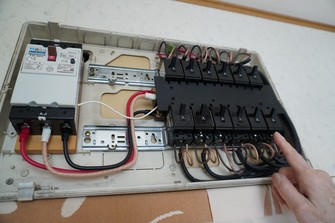
The breaker panel is seen at the woman’s home in Tokyo’s Adachi Ward, April 13, 2026. After looking at it, the fake worker demanded 380,000 yen.
Recently, damage caused by unscrupulous contractors exploiting everyday household problems has been on the rise in Japan. One of the most prominent examples is repair work involving household electrical breaker panels. It is difficult to see through a contractor’s bad intentions, and there are “traps” lurking in internet searches, too. Looking into the methods used in these scams reveals just how they work.
At the end of March 2025, a 67-year-old woman in Tokyo’s Adachi Ward was left bewildered. Perhaps because the switches were broken, the lights in her kitchen and Japanese-style room would not turn on. Her eldest daughter, 40, searched online and quickly found a repair company. Its website said, “Available 24 hours a day, 365 days a year,” and advertised that problems could be “solved by professionals the same day.” She thought it would be OK, so she called the toll-free number of the company, “Mach Denki Shuri” (Mach electric repair). An hour later, a worker arrived.
By her account, he did not seem clumsy. After looking at the lights and saying there was “nothing wrong,” the worker checked the breakers in the panel and showed the woman something like a measuring device. It displayed “130 volts.”
“That’s an abnormal reading. You should get it fixed,” he said. The cost, he told her, would be “380,000 yen” (around $2,400). The woman thought that was far too high, but the worker said, “Normally it would cost even more. I’m giving you a discount at 380,000 yen.” Having little choice, she handed over the 180,000 yen (about $1,130) she had on hand. “I’ll transfer the rest,” she said. The worker nodded, and the repair began. But she felt “something was off,” and then she suddenly recalled something.
The website of a company calling itself “Mach Denki Shuri” (Mach electric repair) is seen. It advertised that problems could be “solved by professionals the same day.”
Several years earlier, she had had the breaker panel repaired. She remembered it costing about 50,000 yen (roughly $310).
So, just to be safe, she called her husband, 66, who was at work. He agreed to the repair, but his co-workers were suspicious. “That sounds strange. You should go home right away,” they told him, so he returned with an employee from Tokyo Electric Power Company Holdings Inc. (TEPCO). The TEPCO worker listened to what had happened and said, “A normal household doesn’t get to 130 volts.” Her husband then called the police, and an officer came as well.
The T-shirt-clad worker, who had been about to finish the repair, panicked. “I’ll give it back,” he said, referring to the 180,000 yen the woman had paid. In the end, he shoved the cash into the mailbox at the woman’s home and left.
A year later, in April 2026, four men aged 21 to 31, including that worker, were arrested by police on suspicion of fraud and attempted fraud.
According to the Metropolitan Police Department’s organized crime countermeasures division, the four stood accused of trying to or actually swindling cash ranging from 100,000 yen to 520,000 yen (approx. $630 to $3,300) from people in their 20s to 50s living in Tokyo, between April and May 2025. Their tactic was to cite electrical trouble as a reason to demand the replacement of breakers.
A National Consumer Affairs Center of Japan flyer warning about scams that use breaker panel “inspection sales tactics” is seen.
From March through June 2025, they took on 246 jobs across Tokyo and six surrounding prefectures in the Kanto region, including Saitama and Kanagawa. They are believed to have made about 47 million yen (some $294,000) in sales, and there was even a case in which one victim paid 1.4 million yen (roughly $8,800).
“They don’t pick specific targets; instead, they wait for calls to come in, much like a spider spinning its web,” one investigative source said. “Once a request comes in, they play on people’s fears, do unnecessary work and slap them
<div
Adachi Ward
Adachi Ward is one of the 23 special wards of Tokyo, Japan, located in the northern part of the city. Historically, it developed as a farming area and a post town along the Nikko Kaido road during the Edo period, and later grew into a residential and industrial hub after the Great Kanto Earthquake. Today, it is known for its parks, such as Toneri Park, and the annual Adachi Fireworks Festival along the Arakawa River.
Tokyo
Tokyo, the capital of Japan, is a vibrant metropolis that seamlessly blends ultramodern skyscrapers with historic temples and shrines. Originally a small fishing village named Edo, it became the political center of the Tokugawa shogunate in the early 17th century and was renamed Tokyo (“Eastern Capital”) in 1868 after the Meiji Restoration. Today, it stands as a global hub of culture, technology, and commerce, offering visitors iconic landmarks like the Imperial Palace, Shibuya Crossing, and the historic Asakusa district.
Kanto region
The Kanto region is a major area in Japan, comprising Tokyo and its surrounding prefectures, including Kanagawa, Saitama, Chiba, Ibaraki, Tochigi, and Gunma. Historically, it rose to prominence during the Edo period (1603–1868) when the Tokugawa shogunate established its capital in Edo (modern-day Tokyo), transforming the region into Japan’s political, economic, and cultural center. Today, it remains the most populous and influential region in the country, known for landmarks such as Tokyo Tower, historic Nikko temples, and Mount Fuji views.
Saitama
Saitama is a prefecture in Japan, located just north of Tokyo, known for its blend of urban and rural areas. Historically part of Musashi Province, it was officially established in 1871 during the Meiji Restoration. Today, it is famous for sites like the ancient Omiya Bonsai Village and the modern Saitama Super Arena.
Kanagawa
Kanagawa is a prefecture in Japan, located just south of Tokyo, known for its historical and cultural significance. It was a key region during the Edo period, with the port city of Yokohama opening to foreign trade in 1859, marking Japan’s modernization. Today, Kanagawa is famous for landmarks like the Great Buddha of Kamakura and scenic spots such as Mount Fuji views from Hakone.
Metropolitan Police Department
The Metropolitan Police Department (MPD), commonly known as Scotland Yard, is the primary law enforcement agency for Greater London, England. Established in 1829 by Sir Robert Peel, it is widely regarded as the first modern police force, pioneering professional policing principles that influenced departments worldwide. Its headquarters, originally at 4 Whitehall Place with a rear entrance on Great Scotland Yard, gave rise to the iconic nickname “Scotland Yard.”
National Consumer Affairs Center of Japan
The National Consumer Affairs Center of Japan (NCAC) is a government-affiliated organization established in 1970 to protect consumer rights and provide dispute resolution, product testing, and public education. It was created in response to growing consumer issues during Japan’s rapid economic growth, including product safety concerns and unfair business practices. The center also operates a network of local consumer centers and offers a nationwide hotline for consumer complaints and advice.
Tokyo Electric Power Company Holdings Inc. (TEPCO)
Tokyo Electric Power Company Holdings Inc. (TEPCO) is a major Japanese electric utility founded in 1951, best known for operating the Fukushima Daiichi Nuclear Power Plant. The company gained global notoriety after the March 2011 earthquake and tsunami caused a catastrophic nuclear meltdown at the plant, leading to widespread contamination and a long-term decommissioning effort. Since the disaster, TEPCO has faced immense financial and regulatory challenges, including nationalization and ongoing compensation payments to affected communities.