President of Japanese soba chain Yudetaro defends hiring foreigners despite backlash.
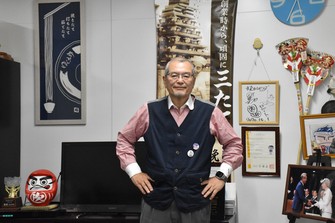
The president of Yudetaro System is seen in Tokyo’s Shinagawa Ward, March 23, 2026.
TOKYO — The president of buckwheat noodle chain operator Yudetaro System began posting on the company’s official Facebook page in late February, pushing back against criticism of its employment of foreign workers. An investigation looked into why the head of the largest soba chain in Japan, employing over 500 foreigners, started sharing what he calls “statements,” which could potentially land him in trouble.
Tomoaki Ikeda, the 68-year-old president of the company operating the Yudetaro soba buckwheat noodles chain, posts almost every day on a wide range of topics, from promoting new menu items to current issues such as spring wage negotiations and artificial intelligence (AI). While his typical posts draw 10,000 to 20,000 views, those about hiring foreign workers have recently surged to around 300,000.
The shift became noticeable after the phrase “Japanese first” started circulating during last year’s House of Councillors election. He says he received complaints such as, “You’re a traitor to the nation,” and, “You’re going to let foreigners make soba?” Ikeda revealed he “deliberately wrote about it to see how much they (the posts) would blow up.”
Foreign employees working at the Yudetaro soba chain are seen in this photo provided by the company president.
Yudetaro System operates 130 directly managed stores nationwide. It has about 160 Japanese employees and more than 500 foreign nationals, including workers from Myanmar, Vietnam and Nepal. In addition, it has roughly 1,200 part-time employees. The company is now in a state where it cannot operate without foreign workers.
Among foreign nationals working in the food service and other industries, the most common residence statuses are types (i) and (ii) of the Specified Skilled Worker visa. Introduced in 2019, the system allows foreigners with specialized knowledge or skills to work in industries facing labor shortages. While type (i) does not permit family accompaniment and is limited to five years, type (ii) allows workers to bring family members to Japan and can lead to eligibility for permanent residency.
After the coronavirus pandemic subsided, hiring conditions in the food service industry became extremely tight. Yudetaro System is among businesses that expanded its recruitment of foreign workers. It directly hires young people who obtained type (i) status in their home countries as full-time employees, and has them work while acquiring the type (ii) status and “N2,” the second-highest level of the Japanese-Language Proficiency Test. Transitioning from type (i) to type (ii) allows them to continue working long term.
The company president, third from left, visits a Japanese language school in Myanmar in this photo provided by the individual.
The company hires at a pace of 60 to 70 people a year, and the number of foreign nationals serving as store managers rose to 12 this spring. It has also introduced a scholarship program and is building a system to help as many people as possible continue working for the long term.
However, criticism of foreign workers is constantly seen on Facebook. Comparing them with Japanese workers, Ikeda carefully explains that foreign employees face stricter labor conditions and workplace environments. Still users respond with a series of rebuttals such as, “You’re not hiring Japanese people and are using foreigners cheaply just for profit,” “If you’re going to spend extra money on foreigners, you should raise wages until Japanese applicants flood in,” and, “With advances in AI, more women entering the workforce and later retirement, there can’t be an absolute labor shortage.”
Ikeda explained, “It’s unavoidable that some people dislike foreigners. But there is a significant number of people who cannot distinguish between overstayers, Specified Skilled Workers and highly skilled professionals, who seriously believe what amounts to false rumors.”
When asked why he continues making posts that are effectively like stepping into a minefield, Ikeda said, “Given the state society is in, I want both our foreign workers and our Japanese employees to understand the company’s stance.” He is deliberately taking on topics that are difficult to address and hard to speak about.
A lunch meeting with Myanmar job offer recipients is seen in this photo provided by the company president.
“Foreign workers are part of the working population who pay taxes
<h3
Shinagawa Ward
Shinagawa Ward is a historic district in Tokyo, Japan, that served as a major post station on the Tokaido road during the Edo period. Today, it is a bustling urban area known for its mix of traditional culture and modern development, including the Shinagawa Station, a key transportation hub. The ward also features historic temples, such as the Sengaku-ji, where the famous 47 Ronin are buried.
Tokyo
Tokyo, the capital of Japan, is a sprawling metropolis that seamlessly blends ultramodern skyscrapers with historic temples and shrines. Originally a small fishing village named Edo, it rose to prominence in the early 17th century when it became the seat of the Tokugawa shogunate, and was later renamed Tokyo (“Eastern Capital”) after the Meiji Restoration in 1868, when the imperial court moved from Kyoto. Today, it stands as a global hub of culture, technology, and commerce, shaped by events like the Great Kanto Earthquake of 1923 and the firebombing of World War II.
Japan
Japan is an island nation in East Asia with a rich history spanning thousands of years, from ancient imperial dynasties and samurai culture to its rapid modernization during the Meiji Restoration. Its cultural sites include historic temples and shrines like Kyoto’s Kinkaku-ji and the iconic Mount Fuji, which have shaped Japan’s unique blend of tradition and innovation. Today, Japan is known for its contributions to technology, art, and cuisine, while preserving its deep-rooted customs like tea ceremonies and martial arts.
Myanmar
Myanmar, also known as Burma, is a Southeast Asian nation with a rich history dating back to the Pagan Kingdom (9th–13th centuries), which built thousands of Buddhist temples. It was colonized by the British in the 19th century, gained independence in 1948, and experienced decades of military rule before recent political transitions. Today, the country is renowned for its ancient city of Bagan, the golden Shwedagon Pagoda, and its diverse ethnic cultures.
Vietnam
Vietnam is a Southeast Asian country with a rich history shaped by ancient civilizations, Chinese rule, French colonization, and the Vietnam War. Its cultural sites range from the UNESCO-listed Ha Long Bay and the imperial citadel of Hue to the ancient town of Hoi An, reflecting a blend of indigenous traditions and foreign influences. Today, Vietnam is known for its vibrant culture, resilient people, and rapidly developing economy.
Nepal
Nepal, a landlocked country in South Asia, is renowned for its rich cultural heritage and stunning natural landscapes, including the Himalayan mountain range and Mount Everest. Its history is marked by the unification of various kingdoms in the 18th century under the Shah dynasty, followed by periods of monarchy, a civil war, and the establishment of a federal republic in 2008. Today, Nepal is famous for its diverse ethnic groups, ancient temples, and as the birthplace of Gautama Buddha in Lumbini.
Japanese-Language Proficiency Test
The Japanese-Language Proficiency Test (JLPT) is a standardized exam that measures and certifies the Japanese language proficiency of non-native speakers, offered since 1984 by the Japan Foundation and Japan Educational Exchanges and Services. It has five levels (N1 to N5), with N1 being the most advanced, and is widely used for academic admissions, employment, and personal assessment worldwide. Over the decades, the JLPT has become a key benchmark for Japanese language learning, with hundreds of thousands of test-takers annually across multiple countries.
House of Councillors
The House of Councillors is the upper house of Japan’s National Diet, established under the post-World War II constitution in 1947. Unlike the lower house, it was designed to be a more deliberative body with longer terms and less frequent dissolution, providing stability and a check on the House of Representatives. Its members are elected through a mixed electoral system, and it plays a key role in reviewing legislation and approving treaties and budgets.