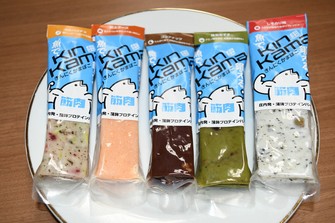
“Kinniku Kamaboko,” or muscle “kamaboko” fish cake, is pictured in the city of Tsuruoka, Yamagata Prefecture.

High school students in this northeastern Japan city have teamed up with a local fish paste manufacturer and produced an easy-to-eat protein bar named “Kinniku Kamaboko,” or muscle “kamaboko” fish cake made from minced white fish.

Aiming to help people build muscle by consuming fish rich in protein, the protein bar, known as “Kin Kama” in English, features five flavors, including “cocoa and nuts” and “Japanese ‘shiso’ basil and crunchy pickled plum.”

Five third-year students of Yamagata Prefectural Kamo Fisheries High School from the school’s fisheries department food science course were involved in the production. The idea was sparked when they heard a senior member of the school’s sumo club suggest that processed seafood products could be used as a protein source, saying he wanted something easy to eat between club activities to help build muscle.

Students who worked on the commercialization of the new fish cake are seen in this photo in the city of Tsuruoka, Yamagata Prefecture.

Starting in April last year, the students learned about the nutritional value of kamaboko from a registered dietitian, took factory tours and tried processing onboard a ship. With the cooperation of the long-established local kamaboko shop “Ryusen Takikawa,” they created prototypes for 12 different flavors. Keio University’s Institute for Advanced Biosciences located in the city also joined the project by analyzing nutritional content and other factors. In the end, they settled on five flavors, “cocoa and nuts,” “matcha and adzuki bean,” “carpaccio,” “spicy cod roe and cheese” and “Japanese ‘shiso’ basil and crunchy pickled plum.”

One of the students involved in the project said she hopes people who do not usually eat fish and the elderly will try it.

Each bar is about 11 centimeters long and 3.5 centimeters wide and is priced at 324 yen (about $2) for 60 grams. Each contains 5.52 to 8.88 grams of protein per 100 grams. The product will go on sale from May 15 at Ryusen Takikawa’s store and online shop, as well as facilities such as the Shonai Kankou Bussankan tourist and product center.

Tsuruoka

Tsuruoka is a city in Yamagata Prefecture, Japan, known for its rich cultural heritage and natural beauty. Historically, it developed as a castle town under the Sakai clan during the Edo period and is home to important sites like the Tsuruoka Hachimangu Shrine and the Zenpo-ji Temple. The city also serves as a gateway to the Dewa Sanzan, three sacred mountains that have been a center of Shugendo mountain worship for centuries.

Yamagata Prefecture

Yamagata Prefecture, located in Japan’s Tohoku region, is known for its rich cultural heritage and natural beauty, including the iconic Zao Mountains and hot springs. Historically, it thrived as a center for samurai culture and safflower trade during the Edo period, and it is home to the UNESCO World Heritage site of Yamadera Temple, founded in the 9th century. Today, it is famous for its cherries, sake, and the annual Yamagata Hanagasa Festival.

Yamagata Prefectural Kamo Fisheries High School

Yamagata Prefectural Kamo Fisheries High School is a specialized high school located in Sakata, Yamagata Prefecture, Japan, focused on marine science and fisheries education. Established in 1901 as a fisheries training school, it<div class="my-4 p-4 rounded

Tsuruoka

Tsuruoka is a city in Yamagata Prefecture, Japan, known for its rich history as a castle town during the Edo period under the Sakai clan. It is home to important cultural sites like the Chido Museum, which features a restored samurai residence, and the ancient Dewa Sanzan mountain range, a sacred pilgrimage destination for centuries. Today, Tsuruoka blends its historical heritage with natural beauty, offering visitors a glimpse into traditional Japanese culture.

Yamagata Prefecture

Yamagata Prefecture, located in the Tohoku region of Japan, is known for its rich natural beauty, including the iconic Mount Zao and its “snow monsters.” Historically, it thrived as a center for silk production and spiritual culture, with the sacred Three Mountains of Dewa (Dewa Sanzan) serving as a major pilgrimage site. Today, it is famous for its hot springs, cherries, and traditional festivals like the Yamagata Hanagasa Matsuri.

Yamagata Prefectural Kamo Fisheries High School

Yamagata Prefectural Kamo Fisheries High School is a specialized high school located in Sakata, Yamagata Prefecture, Japan, focused on marine science and fisheries education. Established in 1948, it has a history of training students in fishing techniques, marine biology, and maritime skills, contributing to the local fishing industry. The school is also known for its hands-on training vessel, which allows students to gain practical experience at sea.

Keio University’s Institute for Advanced Biosciences

Keio University’s Institute for Advanced Biosciences (IAB) is a leading research center located in Tsuruoka, Yamagata, Japan, established in 2001 to advance bioscience and biotechnology. It focuses on interdisciplinary fields such as genomics, metabolomics, and systems biology, aiming to translate fundamental research into medical and agricultural applications. The institute was founded as part of Keio University’s broader initiative to foster innovation and collaboration between academia and industry in the region.

Ryusen Takikawa

Ryusen Takikawa is a scenic waterfall located in Hokkaido, Japan, known for its stunning beauty and serene natural surroundings. The waterfall is part of the broader Takikawa area, which has historical significance as a site of early settlement and development in Hokkaido during the Meiji period. Today, it remains a popular destination for visitors seeking to experience the region’s pristine landscapes and cultural heritage.

Shonai Kankou Bussankan

Shonai Kankou Bussankan is a tourist information and souvenir center located in Tsuruoka City, Yamagata Prefecture, Japan. It showcases and sells local specialties, crafts, and products from the Shonai region, including sake, textiles, and agricultural goods. The facility serves as a gateway for visitors to explore the area’s cultural heritage, which is deeply rooted in samurai-era history and traditional industries like silk weaving.

Dewa Sanzan

Dewa Sanzan is a sacred mountain range in Japan’s Yamagata Prefecture, consisting of three peaks—Mount Haguro, Mount Gassan, and Mount Yudono—that have been a center of Shugendo, a syncretic mountain ascetic tradition, for over 1,400 years. Each mountain holds deep spiritual significance, with Mount Haguro representing birth, Mount Gassan death, and Mount Yudono rebirth, and pilgrims traditionally complete a journey through all three as a rite of purification. The site’s history is rooted in the legend of the ascetic En no Gyoja and later developed into a UNESCO-recognized cultural landscape.

Yamadera Temple

Yamadera Temple, officially named Risshakuji, is a historic Buddhist temple located in Yamagata Prefecture, Japan, founded in 860 CE by the monk Ennin. Perched on a mountainside, it is famous for its scenic beauty, steep stone steps, and panoramic views of the valley below. The temple has long been a site of pilgrimage and spiritual retreat, and was famously visited by the haiku poet Matsuo Bashō, who was inspired to write one of his most celebrated poems there.