As school absenteeism rises, Japanese fathers seek support at izakaya gatherings.
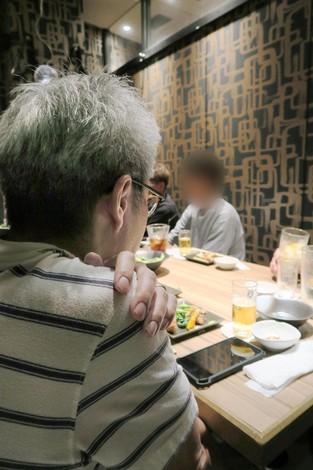
Fathers gather for an “Oyaji-no-Kai” at an izakaya pub in Ebina, Kanagawa Prefecture. (A portion of this photo has been obscured to protect privacy)
EBINA, Kanagawa — In Japan’s izakaya pubs, people drink and discuss the usual topics including sports and politics. But one group of fathers on the outskirts of Tokyo drinks beer while talking about the fact that their children don’t want to go to school.
One Saturday evening at the end of September, eight men gathered at an izakaya, each nursing a drink and taking turns telling the group the latest updates about their kids who refuse to go to school.
Called “Oyaji-no-Kai” (Dads’ Meetups), the gathering in Ebina, Kanagawa Prefecture, brings together fathers every other month to share concerns about their children and explore what a healthy family life might look like.
A record-high 353,970 primary and secondary school students in public and private schools missed 30 or more days of school in fiscal 2024, according to a survey.
It was the 12th consecutive year of increase in the number. Some are at risk of becoming “hikikomori,” or social recluses, who are estimated to have numbered 1.46 million based on a 2022 survey.
Reasons for school absence vary. In the education ministry survey, elementary, junior high, and high schools reported a total of 769,022 cases of bullying. Of these, 1,405 were classified as “serious incidents” involving physical harm or prolonged absences, marking the highest number on record for both categories.
While parent groups for these children are on the rise, most participants are mothers, with few gatherings such as Oyaji-no-Kai dedicated to fathers.
“Being able to talk about this has really broadened my perspective,” said one father. His eldest son, a middle schooler, had begun resisting going to school in the upper grades of elementary school and eventually stopped attending altogether.
At work, the father had switched departments and was coming home every day exhausted due to unfamiliar tasks and difficult relationships with co-workers. At home, his son would avoid him.
“I felt like there was nowhere I could relax, whether at home or outside,” he said, adding that whenever he sees children his son’s age, he worries about the future. “Time is just passing by while he’s unable to go to school.”
When he joined the fathers’ group, he was able to vent his frustrations. The more he shared, the more open he became to other perspectives, and gradually he was able to start thinking about his son.
“It might seem trivial, but recently, my son responded for the first time in a year with something like filler words,” he told the group. Some participants offered words of encouragement, saying, “I guess something must have gotten through,” and “You’ve done a great job.”
As the drinks flowed, the other dads began to tell their own stories.
One said he is torn between leaving his child alone and offering to listen to their worries. Another said, “My whole family is on edge, and I don’t know what to do.”
A 70-year-old man who helps school absentees and hikikomori in Kanagawa started the group two years ago. He limited members to men so they could open up without worrying about what their families might think.
“The home is also a closed-off space,” he said. “For men, who often find it hard to show vulnerability, having an excuse to drink might make it easier to air their frustrations.”
The unburdening can be cathartic. Sometimes members break down in tears.
“For children who can’t attend school, home is a vital place to recharge, and parents also need an environment where they can gather their thoughts,” he said.
Meanwhile, learning about other families’ struggles can expand the range of options for dealing with their own challenges, he said.
“I hope places where people can share their concerns will spread across the country.”
Ebina
Ebina is a city located in Kanagawa Prefecture, Japan, which historically developed as a post-station town along the important Tokaido road during the Edo period. Today, it is primarily known as a modern residential and commercial suburb of the greater Tokyo-Yokohama metropolitan area, with key attractions including the Sagami River and the Ebina Service Area, a famous highway rest stop.
Kanagawa Prefecture
Kanagawa Prefecture is a major coastal region in Japan’s Kanto area, historically home to the influential port city of Kamakura, which served as the nation’s political capital during the Kamakura Shogunate (1185–1333). Today, it is a dynamic urban hub containing the international port of Yokohama, the ancient Great Buddha of Kamakura, and the hot spring resort town of Hakone near Mount Fuji.
Tokyo
Tokyo, originally a small fishing village called Edo, rose to prominence after becoming the seat of the Tokugawa shogunate in 1603. It was renamed Tokyo (“Eastern Capital”) when the emperor moved there in 1868, beginning the Meiji Restoration. Today, it is a vast, modern metropolis and Japan’s political, economic, and cultural center, known for seamlessly blending ultramodern districts with historic temples and gardens.
izakaya
An izakaya is a casual Japanese pub-style eatery where people gather to drink and share small plates of food. Originating in the Edo period (1603-1868) as simple sake shops where customers could drink on the premises, they evolved into full-service establishments offering a wide variety of dishes. Today, they are a cornerstone of Japanese social life, known for their relaxed atmosphere and extensive menus of drinks and tapas-like fare.
Oyaji-no-Kai
“Oyaji-no-Kai” is not a specific place or cultural site, but a Japanese term (親父の会) for a “Fathers’ Association” or social group, typically formed by fathers connected through their children’s school or local community. These informal groups aim to foster camaraderie and support among fathers, often organizing social events and sometimes volunteering for school activities. Their history is rooted in the late 20th century as a grassroots response to promote greater paternal involvement in child-rearing and community life, contrasting with the traditional salaryman model.
hikikomori
“Hikikomori” is not a physical place or cultural site, but a modern Japanese sociocultural phenomenon describing individuals, typically adolescents or young adults, who withdraw from social life and isolate themselves in their homes for extended periods (often six months or more). It emerged as a recognized issue in Japan in the 1990s, linked to societal pressures, academic stress, and changing family structures, and has since been observed in other countries as well.
education ministry
The term “education ministry” typically refers to a government department responsible for national education policy, rather than a specific cultural site. Historically, such ministries emerged in the 19th century as nations began to standardize public schooling systems. Their primary role is to oversee curriculum, funding, and standards for schools and higher education institutions.
Kanagawa
Kanagawa is a coastal prefecture in Japan, best known internationally for the city of Yokohama, a major port that opened to foreign trade in 1859 after centuries of national isolation. Its history is deeply tied to this opening, symbolized by sites like the historic Yokohama Port and the Sankeien Garden, and it is also home to the iconic Great Buddha of Kamakura, a 13th-century bronze statue from when Kamakura was the nation’s political capital. Today, it is a dynamic region blending modern urban centers, historical landmarks, and traditional hot spring resorts.