At the Utoro Fishing Port in Shari Town, Hokkaido, just after 1:00 PM on April 23.
Family members of the passengers offered a moment of silence facing the calm sea.
For the first time, they marked this hour at the port where the “KAZU I” departed.
(Father of Takahiro Koyanagi) “I realized that the ship sank at this time four years ago. Until now, I heard about it inside a building (at memorial services), but hearing it at Utoro Port, where it actually set sail, brings back the situation vividly.”
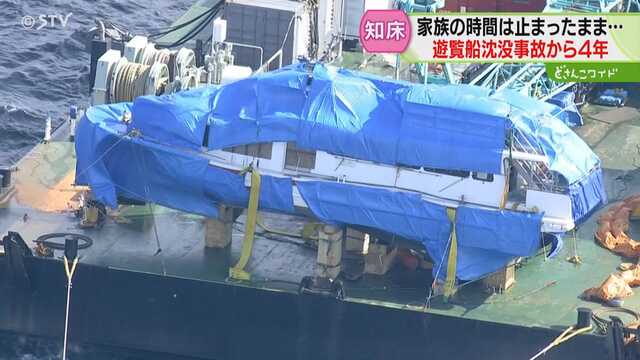
On April 23, 2022, the sightseeing boat “KAZU I” sank off the coast of Shiretoko.
In this accident, 20 passengers and crew members died, and 6 people remain missing.
Takahiro Koyanagi is one of the missing persons.
He worked at a restaurant in Cambodia and was involved in the accident while temporarily returning home.
Takahiro’s father arrived at the airport on the 23rd, wearing his son’s backpack and down jacket.
(Father of Takahiro Koyanagi) “I’m coming with the joy of being able to see my son. I want to say ‘I’m here’ to the sea where my son is.”
Regarding this accident, the president of the operating company, Seiichi Katsurada, is charged with professional negligence resulting in death, and a verdict is scheduled for June.
Additionally, a lawsuit by the passengers’ families seeking approximately 1.5 billion yen in damages is ongoing.
At a flower stand set up at a facility in the town, flowers with the name of the operating company were offered.
However, there were no flowers in the name of President Katsurada, and he did not appear at the memorial service in 2026 either.
It is said that time has stood still for the families of the passengers since that day.
(Man with missing family member) “I still have the feeling of not wanting to believe it, so it feels like four years have just passed like that.”
(Father of Takahiro Koyanagi) “It’s cold, you know.”
Back then, passengers were thrown into this cold sea.
(Father of Takahiro Koyanagi) “Even if told to jump in here, normally you wouldn’t jump in. Everyone suffered painful experiences. It’s cruel.”
To ensure that such a tragedy never repeats—
Takahiro’s father expresses his thoughts on the accident.
(Father of Takahiro Koyanagi) “Such an accident should never happen, because I don’t want anyone else to experience this sadness. I hope those involved act with that feeling in mind.”
Four years have passed since the accident that suddenly took away a loved one.
In the never-healing sorrow, the remaining families once again turn their thoughts to the sea of Shiretoko this year.
Utoro Fishing Port
Utoro Fishing Port is a small harbor located on the Shiretoko Peninsula in Hokkaido, Japan, serving as a key gateway for fishing and tourism in the area. Historically, it developed as a base for coastal fisheries, particularly for salmon and squid, and later became a departure point for sightseeing cruises along the dramatic, rugged coastline of the Shiretoko National Park. The port also holds significance as a site of post-World War II development, reflecting the region’s efforts to rebuild its local economy through marine resources.
Shari Town
Shari Town, located in Hokkaido, Japan, is a gateway to the Shiretoko Peninsula, a UNESCO World Heritage site known for its pristine wilderness and abundant wildlife. Historically, the town developed as a fishing and logging community in the late 19th and early 20th centuries, with its name derived from the Ainu word for “place where reeds grow.” Today, it is a popular base for tourists exploring Shiretoko’s dramatic coastlines, hot springs, and drift ice in the Sea of Okhotsk.
Hokkaido
Hokkaido, Japan’s northernmost island, was historically known as Ezochi and largely inhabited by the indigenous Ainu people before becoming a formal part of Japan in the late 19th century. The Meiji government promoted large-scale colonization and development, transforming the region into a center for agriculture, mining, and tourism. Today, Hokkaido is famous for its stunning natural landscapes, ski resorts, and cities like Sapporo, which hosts the annual Snow Festival.
KAZU I
KAZU I is a historic village in Georgia’s Kazbegi Municipality, nestled in the Caucasus Mountains and known for its proximity to the iconic Gergeti Trinity Church. The area has a rich history as a key stop along the ancient Georgian Military Road, a trade and military route connecting Georgia and Russia. Today, it serves as a cultural and tourist hub, offering visitors stunning alpine scenery and a glimpse into traditional mountain life.
Shiretoko
Shiretoko is a remote and rugged peninsula in northeastern Hokkaido, Japan, known for its pristine wilderness and abundant wildlife, including brown bears and deer. Its name comes from the Ainu language, meaning “end of the earth,” reflecting its isolated location. Designated a UNESCO World Heritage Site in 2005, the area preserves unique ecosystems and was historically a vital fishing and hunting ground for the indigenous Ainu people.
Cambodia
Cambodia is a Southeast Asian nation known for its rich history and cultural heritage, most famously home to the ancient Angkor Wat temple complex, a UNESCO World Heritage site built in the 12th century. Once the heart of the powerful Khmer Empire, the country endured French colonial rule and a tragic period under the Khmer Rouge regime in the 1970s. Today, Cambodia is rebuilding its identity, blending its ancient traditions with modern development.