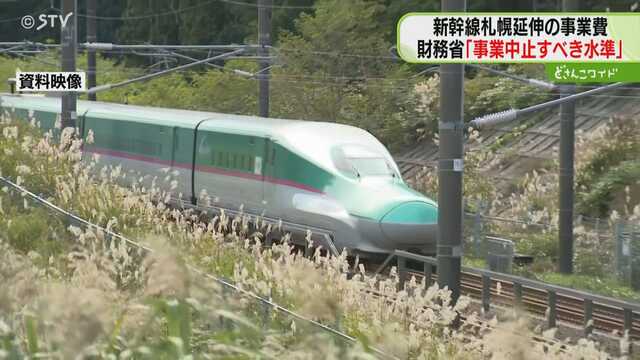
The cost of extending the Shinkansen to Sapporo is expected to increase significantly, and the Ministry of Finance has published estimates showing that the cost-benefit ratio has reached a level that should lead to the project being abandoned.
The construction costs for the Hokkaido Shinkansen, between Shin-Hakodate-Hokuto and Sapporo, could potentially increase by up to 1.2 trillion yen due to delays in the opening.
The Ministry of Finance announced that, based on the cost increase, a profitability estimate shows the overall cost-benefit ratio has fallen from the initial 1.1 to 0.6, below the benchmark of 1 for profitability.
According to the standards of the Ministry of Land, Infrastructure, Transport and Tourism, this is considered a level that should lead to the project being canceled.
Governor Suzuki stated during a press conference on April 23:
(Governor Suzuki) “Promoting the development of the Hokkaido Shinkansen is essential. It is important to work toward the early completion of the Hokkaido Shinkansen, and we will firmly demand that from the national government.”
The Ministry of Finance is urging the Ministry of Land, Infrastructure, Transport and Tourism to secure revenue, such as by increasing the lease fees paid by JR companies to the government.
Shinkansen
The Shinkansen, or “bullet train,” is Japan’s high-speed rail network, which began operations in 1964 with the Tokaido Shinkansen line connecting Tokyo and Osaka. It revolutionized travel in Japan by drastically reducing journey times and is known for its punctuality, safety, and advanced technology. The network has since expanded to cover most of the country, becoming a symbol of Japan’s post-war economic resurgence and modern engineering.
Sapporo
Sapporo is the capital city of Hokkaido, Japan’s northernmost island, and is known for its modern urban design and annual Snow Festival featuring massive ice sculptures. The city was originally developed in the late 19th century, with its grid-like layout inspired by Western planning, and it grew rapidly after the Hokkaido Development Commission established it as a regional center. Today, Sapporo is famous for its beer, skiing, and as the host of the 1972 Winter Olympics, blending a rich frontier history with contemporary culture.
Hokkaido Shinkansen
The Hokkaido Shinkansen is a high-speed rail line connecting Tokyo to Shin-Hakodate-Hokuto in Hokkaido, Japan. It began operations in March 2016, extending the Shinkansen network through the undersea Seikan Tunnel, which had opened in 1988. The line significantly reduced travel time between Honshu and Hokkaido, marking a major milestone in Japanese railway history.
Shin-Hakodate-Hokuto
Shin-Hakodate-Hokuto is a railway station located in Hokuto City, Hokkaido, Japan, that opened in 2016 as the southern terminus of the Hokkaido Shinkansen high-speed line. It was built to replace the former Hakodate Station as the primary Shinkansen stop in the area, connecting Hokkaido to the rest of Japan via the Seikan Tunnel. The station’s name combines “Shin” (meaning “new”) with the city names Hakodate and Hokuto, reflecting its role as a modern transportation hub for the region.
Shinkansen
The Shinkansen, or “bullet train,” is Japan’s high-speed rail network, which began operations in 1964 with the Tokaido Shinkansen line connecting Tokyo and Osaka. It was developed to meet the country’s growing transportation needs and revolutionized travel by drastically reducing journey times while maintaining excellent safety and punctuality. Today, the Shinkansen network spans much of Japan, symbolizing the nation’s technological innovation and efficiency.
Sapporo
Sapporo is the capital city of Hokkaido, Japan’s northernmost island, and is known for its planned urban layout and the annual Sapporo Snow Festival. Originally developed in the late 19th century as a government-planned city, it grew rapidly due to agricultural development and the construction of the Hokkaido University. Today, it is a major cultural and economic hub, famous for its beer, ramen, and winter sports.
Hokkaido Shinkansen
The Hokkaido Shinkansen is a high-speed rail line in Japan that connects the northern island of Hokkaido to the main island of Honshu via the Seikan Tunnel. Its first section, linking Shin-Aomori to Shin-Hakodate-Hokuto, began operation in March 2016, marking the first time shinkansen services reached Hokkaido. The line is a key part of Japan’s ongoing efforts to improve transportation links, with an extension to Sapporo currently under construction and expected to open by 2030.
Shin-Hakodate-Hokuto
Shin-Hakodate-Hokuto is a major railway station in Hokuto City, Hokkaido, Japan, that opened in 2016 as the southern terminus of the Hokkaido Shinkansen high-speed line. It replaced the historic Hakodate Station as the primary bullet train stop, connecting Hokkaido to the main island of Honshu via the Seikan Tunnel. The station’s name combines “Shin” (new) with the nearby city of Hokuto, reflecting its role as a modern gateway to the region.
Seikan Tunnel
The Seikan Tunnel is a 53.85-kilometer railway tunnel in Japan, connecting the islands of Honshu and Hokkaido beneath the Tsugaru Strait. Construction began in 1971 and was completed in 1988, making it the longest undersea tunnel in the world at the time. It was built to improve transportation safety and reliability, replacing ferry services that were vulnerable to harsh weather conditions.
Hakodate Station
Hakodate Station is a major railway station in Hakodate, Hokkaido, Japan, serving as a key transportation hub since its opening in 1902. The station originally marked the terminus of the Hakodate Main Line and played a vital role in the development of the city as a port and commercial center. Today, it remains an important gateway for travelers exploring southern Hokkaido, with its iconic Western-style architecture reflecting the region’s historical ties to foreign trade.
Hokuto City
Hokuto City, located in Yamanashi Prefecture, Japan, is a historically rich area known for its scenic beauty and cultural heritage. It was formed in 2004 through the merger of several towns and villages, and is home to ancient sites like the Kiyosato Plateau, which was developed by American missionary Paul Rusch in the early 20th century. The city also features traditional thatched-roof farmhouses and offers a glimpse into Japan’s rural past.
Tokyo
Tokyo is the bustling capital of Japan, originally a small fishing village named Edo before becoming the political center of the Tokugawa shogunate in the early 17th century. Renamed Tokyo (“Eastern Capital”) after the Meiji Restoration in 1868, it rapidly modernized and rebuilt itself following devastating events like the 1923 Great Kanto Earthquake and World War II bombings. Today, Tokyo is a global metropolis known for blending ultra-modern skyscrapers and technology with historic temples, gardens, and a rich cultural heritage.