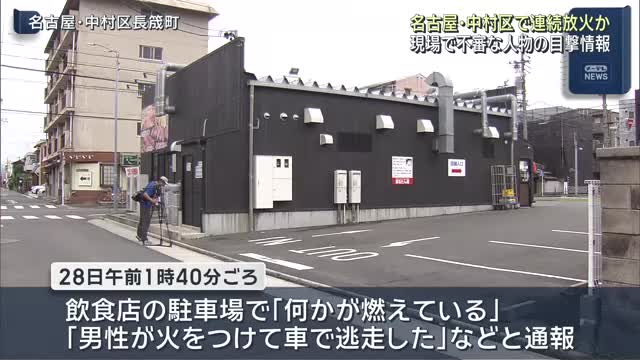
Early on the 28th, a fire broke out in a cardboard box in the parking lot of a restaurant in Nakamura Ward, Nagoya City. Shortly before that, a suspicious fire occurred nearby, and police are investigating the possibility of a series of arsons.

According to police, around 1:40 a.m. on the 28th, a nearby resident called 119 reporting that something was burning in the parking lot of a restaurant in Nagao-cho, Nakamura Ward, and that a man had set it on fire and fled by car.

When firefighters arrived, the fire had already gone out, leaving behind traces of burnt material resembling cardboard.

No injuries were reported.

“It was a person in their 20s. They were wandering around holding a phone. I thought they had left and felt relieved, so I went back to my room. (Then) when I looked outside, it was blazing.”

About 30 minutes earlier, a suspicious fire also occurred in the parking lot of a restaurant in Iwatsuka-hondori, Nakamura Ward, about 1 kilometer away, where something like trash had burned. Police are investigating the possibility of a series of arsons.

Nakamura Ward

Nakamura Ward is one of the four wards of Nagoya City, Japan, known for its historical significance as the birthplace of the legendary samurai Toyotomi Hideyoshi, who unified Japan in the late 16th century. The area features the Toyokuni Shrine and the preserved Nakamura Park, which honors his legacy. Today, it serves as a vibrant residential and commercial district, blending its rich history with modern urban life.

Nagoya City

Nagoya City, located in central Japan, is a major industrial and cultural hub with a history dating back to the early 17th century, when Nagoya Castle was built by the Tokugawa shogunate. The city grew as a key post town on the Tōkaidō road and later became a center for manufacturing, particularly ceramics and automobiles. Today, it is known for blending modernity with tradition, offering attractions like the castle, Atsuta Shrine, and the Nagoya City Science Museum.

Nakamura Ward

Nakamura Ward is one of the wards of Nagoya City in Aichi Prefecture, Japan. It is historically significant as the birthplace of the renowned samurai and shogun Tokugawa Ieyasu, who unified Japan in the early 17th century. Today, the area features the Tokugawa Ieyasu Birthplace Shrine and serves as a major transportation hub, home to Nagoya Station.

Nagoya City

Nagoya City, located in central Japan, is a major industrial and cultural hub with a history dating back to the early 17th century when Nagoya Castle was built by the Tokugawa clan. The city flourished as a key post town on the Tokaido road and later became a center for manufacturing, particularly in ceramics and automobiles. Today, it blends modern attractions like the Nagoya TV Tower with historic sites such as Atsuta Shrine, one of Japan’s most important Shinto shrines.

Toyokuni Shrine

Toyokuni Shrine is a Shinto shrine located in<div class="my-4 p-4 rounded-lg shadow-md bg-blue-

Toyokuni Shrine

Toyokuni Shrine is a Shinto shrine in Kyoto, Japan, dedicated to Toyotomi Hideyoshi, the powerful 16th-century feudal lord who unified Japan. Originally built in 1599 by Hideyoshi’s son, the shrine was later destroyed by the Tokugawa shogunate but was rebuilt in the late 19th century. It is notable for its striking vermilion-lacquered gate and its role in honoring Hideyoshi’s legacy, with the site also housing a museum displaying artifacts from his life.

Nakamura Park

Nakamura Park is a public park located in Nagoya, Japan, named after the Nakamura district where it resides. Historically, the area is notable as the birthplace of Toyotomi Hideyoshi, a significant samurai and daimyo of the Sengoku period who unified Japan. Today, the park features a memorial hall and monuments dedicated to Hideyoshi’s legacy, alongside recreational spaces for visitors.

Nagoya Castle

Nagoya Castle, originally built in 1612 by the Tokugawa shogunate, was a key strategic fortification in Japan’s Owari Province. Though largely destroyed during World War II, the main keep was reconstructed in 1959, now serving as a museum and symbol of Nagoya’s heritage, with ongoing debates about restoring its original wooden structure.

Atsuta Shrine

Atsuta Shrine is one of Japan’s most important Shinto shrines, located in Nagoya. It is renowned for housing the sacred sword Kusanagi-no-Tsurugi, one of the three Imperial Regalia of Japan, and has a history spanning over 1,900 years. The shrine was originally founded to protect this treasured artifact and remains a major spiritual and cultural site, attracting millions of visitors annually.

Nagoya City Science Museum

The Nagoya City Science Museum in Nagoya, Japan, is one of the largest science museums in the world, renowned for its striking spherical planetarium with a diameter of 35 meters. Opened in 1962 and extensively renovated in 2011, the museum features interactive exhibits on astronomy, physics, and technology, including a massive fog display and a real-time weather observation station. Its history reflects Nagoya’s commitment to public science education, evolving from a modest facility to a cutting-edge institution that attracts millions of visitors annually.

Tokugawa Ieyasu Birthplace Shrine

The Tokugawa Ieyasu Birthplace Shrine, located in Okazaki, Aichi Prefecture, Japan, is a Shinto shrine dedicated to Tokugawa Ieyasu, the founder of the Tokugawa shogunate. It marks the site where Ieyasu was born in 1543, and the adjacent Okazaki Castle served as his childhood home. The shrine was established to honor his legacy and remains a popular destination for those interested in Japan’s feudal history.

Nagoya Station

Nagoya Station is a major transportation hub in central Japan, originally opened in 1886 and rebuilt several times, with the current iconic twin-tower complex completed in 1999. It serves as a key junction for the Shinkansen (bullet train), JR lines, and subways, and is surrounded by a bustling commercial district. The station’s modern architecture and underground shopping malls make it a vibrant gateway to the city of Nagoya.

Nagoya TV Tower

Nagoya TV Tower is a prominent broadcasting and observation tower located in Nagoya, Japan, completed in 1954. It was the first full-scale steel tower built in Japan, inspired by the Eiffel Tower, and originally served as a television and radio transmission hub. Today, it remains a popular tourist attraction, offering panoramic views of the city and standing as a symbol of post-war reconstruction and modernism.

Related news

中部電力浜岡原子力発電所の工事で不適切な手続き…取引先への精算金数十億円が支払われず副社長ら2人が辞任へ Based on the user’s request, I need to process this Japanese news title by removing all mentions of authors/editors/sources, preserving the core meaning, and translating it to natural English. First, I check the original title for any author/source mentions. The title appears to be a pure news headline without any bylines or source attributions, so no removal is needed there. The core information contains several key elements: – Company: 中部電力 (Chubu Electric Power) – Location: 浜岡原子力発電所 (Hamaoka Nuclear Power Plant) – Issue: 不適切な手続き (improper procedures) – Financial aspect: 取引先への精算金数十億円が支払われず (billions in settlement payments to business partners not paid) – Consequence: 副社長ら2人が辞任へ (two executives including vice president to resign) For the translation, I need to make it sound natural in English while maintaining all these key elements. The Japanese title uses ellipses and quotation marks that might not translate directly, so I’ll adjust the phrasing for natural English flow. The final translation should convey all the essential information: the company, location, nature of the problem, financial impact, and personnel consequences, while sounding like a natural English news headline.

Two vice presidents are set to resign. Chubu Elect...
交通情報

Nagoya Expressway: High Needle IC to Blow West IC (Both Directions) Closure Lifted

The Nagoya Expressway was closed in both direction...