The extension of the ceasefire between the United States and Iran has been reported, with President Trump stating that it is expected to last “three to five days.” The impact is now being felt across all aspects of our daily lives, including food, clothing, and shelter. Today, we focus on “fish.”
“We are at a supermarket in Ichinomiya City, Aichi Prefecture. Take a look at the fresh fish section! Beautiful sea bream! And excellent horse mackerel. Both look delicious. Even these fresh fish are being affected by the situation in the Middle East.”
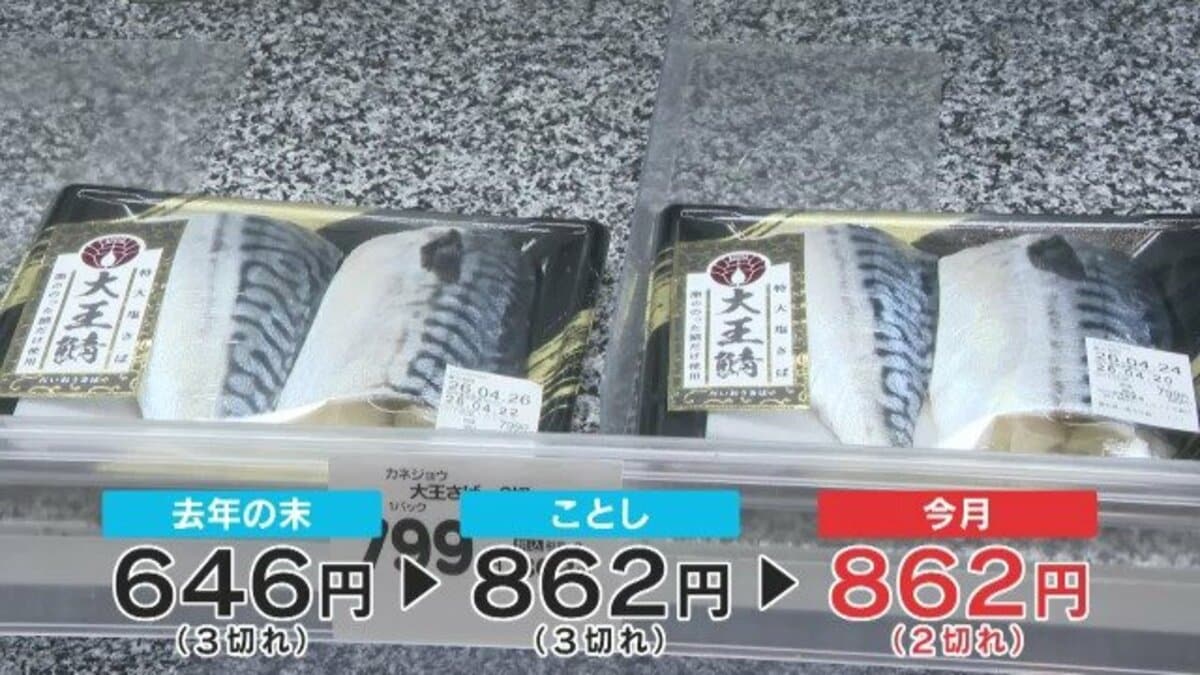
“This Norwegian salted mackerel now costs about the same as the purchase price a few months ago.”
At the end of last year, three pieces of salted mackerel were sold for 646 yen, but this year the price has risen to 862 yen. Starting in April, two pieces cost 862 yen.
Ichinomiya City
Ichinomiya City, located in Aichi Prefecture, Japan, is historically significant as the home of Masumida Shrine, one of the oldest and most important Shinto shrines in the region, from which the city derives its name (“Ichinomiya” meaning “first shrine”). The city flourished during the Edo period as a post town on the Minoji road and later became a major textile production center in the 20th century. Today, Ichinomiya is known for its textile and machinery industries, as well as its rich cultural heritage and annual festivals.
Aichi Prefecture
Aichi Prefecture is located in central Japan and is historically significant as the homeland of the samurai warlord Tokugawa Ieyasu, who unified the country in the early 17th century. It is also home to Nagoya, a major industrial and cultural hub, and the famous Nagoya Castle, built in 1612. Today, Aichi is known for its automotive industry, particularly Toyota, and for hosting the 2005 World Exposition.
United States
The United States is a vast, diverse nation in North America, founded on July 4, 1776, with the Declaration of Independence from Great Britain. Its history includes westward expansion, the Civil War over slavery and states’ rights, and its rise as a global superpower in the 20th century. Key cultural sites range from the Statue of Liberty and the Grand Canyon to the Lincoln Memorial and Silicon Valley.
Iran
Iran, historically known as Persia, is a country in West Asia with a rich cultural heritage dating back over 2,500 years. It was the center of the ancient Persian Empire, renowned for its art, architecture, and contributions to science and philosophy. Today, Iran is known for its Islamic traditions, Persian poetry, and historic sites like Persepolis and Isfahan’s Naqsh-e Jahan Square.
Middle East
The Middle East is a historically and culturally significant region spanning parts of Western Asia and North Africa, often considered the cradle of civilization. It is home to ancient empires such as Mesopotamia, Persia, and the Ottoman Empire, as well as the birthplace of major religions including Judaism, Christianity, and Islam. Today, the region is known for its rich cultural heritage, diverse societies, and geopolitical importance due to its vast oil reserves and historical trade routes.
Norway
Norway is a Scandinavian country known for its stunning fjords, mountains, and rich Viking history. Once home to Norse seafarers during the Viking Age (c. 800–1050 AD), it later became part of the Kalmar Union and was under Danish and Swedish rule before gaining full independence in 1905. Today, Norway is a modern constitutional monarchy with a strong cultural heritage and high standard of living.