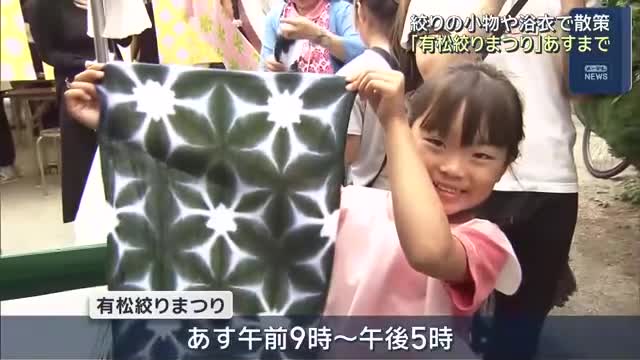
A festival celebrating the charm of “Arimatsu Shibori” is being held in the Midori Ward of Nagoya City.
This festival takes place in the Arimatsu district of Midori Ward, the birthplace of the traditional craft “Arimatsu-Narumi Shibori,” which has a history of over 400 years. On the 6th, the area was bustling with people dressed in yukata.
The venue features Arimatsu Shibori yukata and folding fans, as well as tote bags created in collaboration with the soccer team “Nagoya Grampus.”
Visitors also enjoyed experiencing the culture of craftsmanship by dyeing hand towels.
The event will continue until 5:00 p.m. tomorrow.
Arimatsu Shibori
Arimatsu Shibori is a traditional Japanese tie-dye technique that originated in the town of Arimatsu, near Nagoya, during the Edo period (early 17th century). It was developed when a local craftsman introduced a unique method of resist-dyeing using intricate binding, stitching, and folding to create elaborate patterns on fabric. Today, Arimatsu Shibori is recognized as an Important Intangible Cultural Property of Japan, and the town still preserves this art form through workshops and a historic district dedicated to its craft.
Nagoya City
Nagoya City, located in central Japan, is a major industrial and cultural hub with a history rooted in the 17th century, when the powerful Owari branch of the Tokugawa clan built Nagoya Castle. The city grew as a key post town on the Tokaido road and later became a center for manufacturing, particularly ceramics and automobiles, including the headquarters of Toyota. Despite heavy damage during World War II, Nagoya was rebuilt and now blends historical sites like the reconstructed castle with modern attractions such as the Nagoya City Science Museum.
Midori Ward
Midori Ward is a residential and commercial district located in the city of Nagoya, Japan. Originally developed as part of Nagoya’s expansion in the mid-20th century, it was officially established as a ward in 1963. Today, it is known for its suburban atmosphere, parks, and local shopping areas, offering a quieter alternative to the city center.
Arimatsu district
The Arimatsu district, located in Nagoya, Japan, is famous for its historic tie-dyeing technique known as *Arimatsu Shibori*, which dates back over 400 years. This craft originated in the early 17th century when local artisans began producing intricately patterned indigo-dyed fabrics for samurai and commoners alike. Today, the district preserves its traditional streetscape and workshops, offering visitors a glimpse into this living cultural heritage.
Arimatsu-Narumi Shibori
Arimatsu-Narumi Shibori is a traditional Japanese tie-dye technique that originated in the Arimatsu and Narumi areas near Nagoya during the Edo period (17th century). It became famous for its intricate, hand-crafted patterns created by tightly binding, stitching, or folding fabric before dyeing it with indigo, resulting in unique white-on-blue designs. Today, it is recognized as an Important Intangible Cultural Property of Japan, with workshops and museums preserving this centuries-old craft.
Nagoya Grampus
Nagoya Grampus is a professional football club based in Nagoya, Japan, competing in the J1 League. Founded in 1939 as the club of the Toyota Motor Corporation, it was originally called Toyota Motor SC before rebranding to Nagoya Grampus Eight in 1992, later shortening its name. The club has won multiple domestic cups and the J1 League title in 2010, and it is known for its distinctive grampus (dolphin-like creature) mascot.