The Ministry of Agrarian Affairs and Spatial Planning/National Land Agency (ATR/BPN) recorded that the number of houses of worship in Banten Province is 24,910 plots.
Of that number, only about 9,148 plots, or approximately 36.72%, have been certified. This means there are still 15,762 waqf lands that do not yet have certificates.
The Minister stated that various breakthroughs are continuously being implemented, ranging from inter-agency collaboration and the establishment of waqf verification hearings to the creation of special waqf service counters at Land Offices.
This is done to accelerate the registration of all waqf lands in Indonesia.
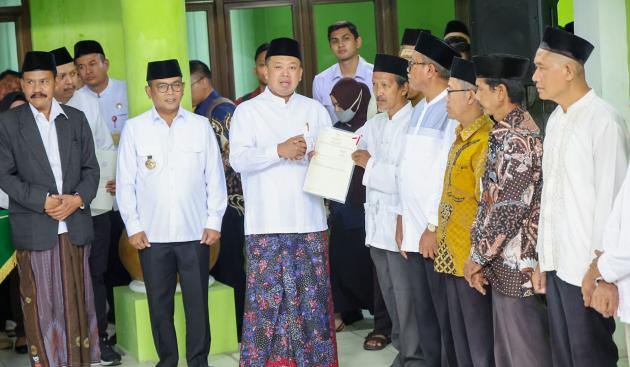
“This is what we must push for together. The process of establishing mosques, prayer rooms, and other houses of worship continues, so the certification of waqf land must also be accelerated to align with the needs of the community,” he said while handing over 13 waqf land certificates in Banten Province.
Not only from the government side, it was also requested that religious institutions and other religious organizations collaborate in accelerating waqf land certification to provide legal certainty for community assets.
“This waqf belongs to the Muslim community. It is a transfer from individual rights to the public, to the community. Therefore, the state is present to ensure waqf land has legal certainty through certification. I ask that we tackle this together,” he said.
The Governor of Banten expressed appreciation for the presence of the Minister of ATR/BPN at the event.
According to him, the Banten Provincial Government will strengthen synergy with the Regional BPN Office, the Ministry of Religious Affairs Office, and district/city governments, including involving community leaders and religious scholars, to accelerate the data collection and certification of waqf land throughout the Banten region.
“We hope public awareness to immediately register and certify waqf land will increase, so that waqf assets in Banten are legally protected and provide benefits for education, health, community economics, and other social activities,” he said.
Following up on directives regarding accelerating waqf certification, a memorandum of understanding was signed on the same occasion between all Land Offices and the Branch Administrations of Nahdlatul Ulama throughout Banten Province.
“In the future, similar MoUs will be conducted with other religious organizations,” said the Head of the Banten Provincial Regional BPN Office.
Banten Province
Banten Province is a region on the western tip of Java, Indonesia, historically significant as the seat of the powerful Banten Sultanate, a major Islamic kingdom and a thriving pepper trade port from the 16th to early 19th centuries. Today, it is a modern province established in 2000, known for the UNESCO-listed ruins of the Surosowan Palace and the Great Mosque of Banten, which stand as testaments to its illustrious past. The province also features popular coastal destinations like Anyer Beach and the Ujung Kulon National Park, a World Heritage Site and the last refuge of the Javan rhinoceros.
Ministry of Agrarian Affairs and Spatial Planning/National Land Agency (ATR/BPN)
The Ministry of Agrarian Affairs and Spatial Planning/National Land Agency (ATR/BPN) is the Indonesian government institution responsible for land policy, agrarian reform, and spatial planning. It was established to implement the nation’s foundational agrarian law and manage land registration, evolving from historical bodies to address land rights and equitable distribution. Its work is central to Indonesia’s development and management of its territorial resources.
Regional BPN Office
The Regional BPN Office (Kantor Wilayah Badan Pertanahan Nasional) is a local Indonesian government agency responsible for land administration and agrarian affairs. Historically, these offices were established following the formation of the National Land Agency (BPN) in 1988 to implement national land reform policies and manage land registration at the provincial level. Their primary function is to ensure legal certainty over land rights, resolve land disputes, and oversee spatial planning within their respective regions.
Ministry of Religious Affairs Office
The Ministry of Religious Affairs Office is a governmental institution responsible for regulating and overseeing religious activities, organizations, and harmony within a nation. Its history is typically tied to the modern formation of the state, often established to formalize the relationship between government and diverse religious communities, ensuring policy implementation and interfaith dialogue. The specific founding date and historical role vary significantly by country, reflecting each nation’s unique approach to secular governance or state religion.
Nahdlatul Ulama
Nahdlatul Ulama (NU) is the largest independent Islamic organization in Indonesia, founded in 1926 to defend traditional Sunni Islam and the practices of local *pesantren* (Islamic boarding schools). It played a crucial role in Indonesia’s independence movement and continues to be a major social, religious, and political force promoting moderate Islam, nationalism, and humanitarian work.
Banten Provincial Government
The Banten Provincial Government is the administrative authority of Banten province in Indonesia, a region established in 2000 after its separation from West Java. Historically, the area was the center of the powerful Banten Sultanate (16th-19th centuries), a major Islamic kingdom and a thriving international port for the spice trade. Today, the provincial government manages the modern region, which encompasses both the industrial and urban areas near Jakarta and sites of significant historical heritage like the ruins of the Surosowan Palace in Old Banten.
district/city governments
District or city governments are local administrative bodies responsible for managing public services, infrastructure, and regulations within their specific urban or regional jurisdictions. Historically, such local governance structures have evolved from ancient municipal systems, like those in Roman cities or medieval European towns, into modern, elected councils that implement national laws and address community needs. They play a crucial role in daily civic life, from education and transportation to urban planning and public safety.
Land Offices
The Land Offices, often known as Land Registry or General Land Office buildings, were government institutions established to manage the surveying, sale, and registration of public lands. Historically, they played a crucial role in the settlement and development of territories, particularly in countries like the United States during the 19th-century westward expansion. Today, their functions are typically carried on by modern land title or cadastral agencies, preserving property records and legal ownership history.