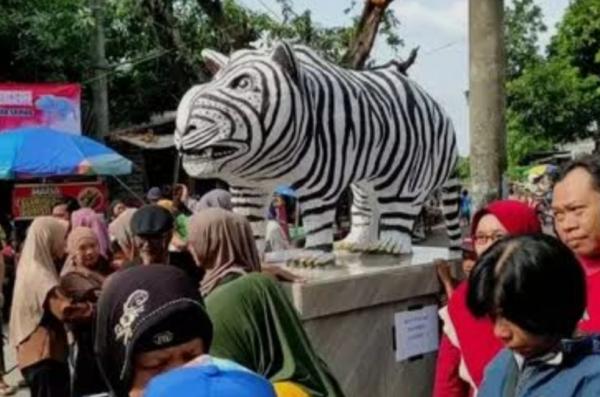
A statue with a unique appearance has suddenly captured public attention. It’s not because of its towering size or majestic design, but because its form is considered adorable and unusual.
The statue, standing in Balongjeruk Village, Kunjang District, has now gone viral on social media and is widely referred to by netizens as ‘Macan Putih Gemoy’ (Cute White Tiger).
Behind the buzz, not many know that the statue was born from a combination of a local artist’s dream and a legendary story that has lived on for generations within the village community. This story makes the White Tiger not just a work of art, but a symbol of the local community’s identity and beliefs.
The Balongjeruk White Tiger statue stands simply in a corner of the village. However, since photos and videos of it circulated widely on TikTok and Instagram, this location has turned into a new visitation point. Residents from various areas, from Surabaya to Malang, are willing to travel just to see the viral village icon firsthand and capture it in selfies.
Various comments have accompanied the statue’s virality. Some netizens judge its form to be far from the typical depiction of a tiger. Others joke that its appearance resembles a zebra or even a hippopotamus. The nickname “cute tiger” has stuck, describing the statue’s figure which looks funny and brings a smile.
Inspired by a Dream and Legend
The village head explained that the White Tiger statue was not created without meaning. Its name and symbol come from a folk tale long believed by the residents. In the local legend, the White Tiger is believed to be a guardian spirit that protects the community from various dangers.
The idea for building the statue emerged from a village deliberation involving community leaders, religious figures, and youth. The residents agreed to present a symbol representing the village’s history, beliefs, and identity in the form of a work of art.
The statue’s creation process was entrusted to a local artist who has been involved in the world of sculpture since the 1980s. Interestingly, before starting work, the artist claimed to have had a dream about the figure of the White Tiger. That inner experience then became the main inspiration for his creative process.
For about 19 days, the artist worked on the statue alone. Although the result has garnered mixed reactions, he still views the work as part of the cultural expression and beliefs of the Balongjeruk community.
Amid public scrutiny, questions arose regarding the statue’s construction budget. The village head emphasized that this project did not use village funds or government budgets. The entire cost of creation came from his personal funds, totaling approximately 3.5 million Indonesian Rupiah.
The breakdown shows about 2 million Rupiah was used for labor costs, while 1.5 million Rupiah was allocated for materials. This fact has softened some netizens’ stance, with many now offering constructive criticism rather than harsh condemnation.
The village government is also responding openly to the various inputs. The village head stated they plan to rearrange and refine the design so the White Tiger statue is closer to the original concept and appears more aesthetically pleasing.
A New Icon and Hope for the Village Economy
Despite the controversy over its form, the presence of the White Tiger statue has brought tangible impacts to the village. Visits from residents outside the area have begun to stir local economic activity. Coffee stalls, snack sellers, and even impromptu photo services are also feeling the benefits of the influx of visitors.
This phenomenon shows that a simple icon, if packaged with a strong story and supported by social media, can become a new tourism spark. The White Tiger statue is now not just a selfie backdrop, but also a symbol of hope for the people of Balongjeruk to develop the village’s potential for culture-based tourism.
The viral story of the ‘Macan Putih Gemoy’ in Kediri reflects how art, local legend, and the power of social media can converge and create a broad impact. From a small village, a story about dreams, belief, and local creativity has now transformed into public conversation. Moving forward, with more mature planning, the Balongjeruk White Tiger has the potential to become a proud cultural icon as well as a source of prosperity for the local