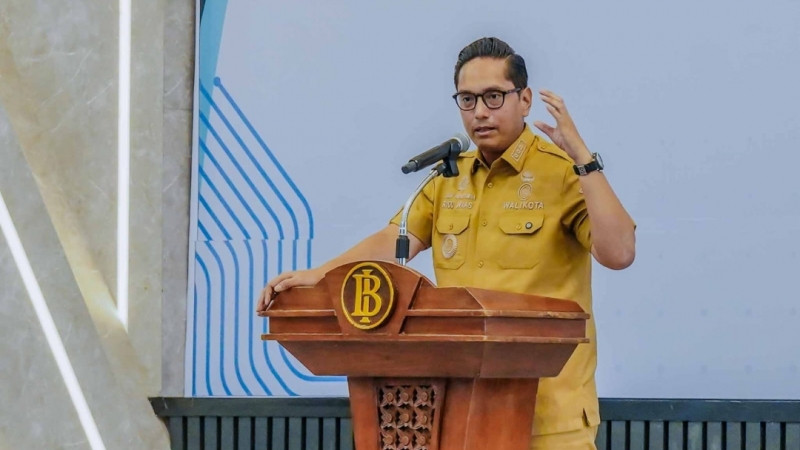
The Mayor of Medan, Rico Tri Putra Bayu Waas, emphasized the importance of digitalization in distributing social assistance to end the classic problem of inaccurate targeting.
He stated this while opening the Socialization and Technical Guidance for Using the Perlinsos Portal Application as part of the digitalization of social assistance in Medan, on Monday, May 25, 2026, at the Bank Indonesia Kuala Deli Room.
In his speech, Rico Waas highlighted complaints that often arise among the public regarding unfairness in receiving social assistance. He said this situation occurs because the data is not yet valid and remains vulnerable to subjectivity in the field.
“We often hear people asking why they didn’t get help, while their neighbors who are considered well-off actually receive it. This happens because our data is not yet fully valid and transparent,” he said.
According to him, the only solution to this problem is through digitalization. With an integrated data-based system, the government can provide credible, accountable, and publicly justifiable information.
Rico Waas also stated that Medan is one of 42 districts and cities in Indonesia designated as a location for implementing social assistance digitalization, after it was previously applied in Banyuwangi. He considered this momentum should be used to build a more professional data collection system.
“In the future, there should no longer be ‘like or dislike’ data. Not because someone is liked or disliked, then they are included as a beneficiary. Everything must be based on real and verified data,” he asserted at the event, which was attended by several regional apparatus leaders, sub-district heads, village heads, and community figures directly involved in the data collection and social assistance process in Medan.
On that occasion, Rico Waas also highlighted the importance of using Digital Population Identity as the main foundation for digitalization. He even directly checked the readiness of the attending village heads regarding their possession of Digital Population Identity and asked those who did not have it to activate it immediately.
Furthermore, Rico Waas revealed that the Medan City Government has prepared 5,080 social assistance agents from various elements, including the Family Welfare Program and village officials. These agents are tasked with collecting data and verifying approximately 792,000 heads of families in Medan.
He set an ambitious target, namely each agent collecting data on at least 5 heads of families per day. With this scheme, all population data is targeted to be validated within one month.
Rico Waas also reminded that the data validation process could present a “bitter reality,” such as an increase in the number of residents who actually need assistance. However, according to him, this condition is better than inaccurate data.
“If it turns out that more people are in need, we must face it honestly. With valid data, we can find the right solution,” he said.
Meanwhile, the Director of Population Administration and Civil Registration Development at the Directorate General of Population and Civil Registration of the Ministry of Home Affairs, Erliani Budi Lestari, stated that social assistance digitalization is part of a national transformation towards more effective and integrated governance.
She explained that through this system, the entire process, from registration, biometric-based verification, to determining the eligibility of social assistance recipients, will be carried out transparently and in real-time.
“Medan is one of the important locations in expanding the implementation of social assistance digitalization nationally because it is considered to have a well-prepared government ecosystem,” she said.
In line with that, the Deputy Head of the Bank Indonesia Representative Office for North Sumatra Province, Didit Widiana, said that social assistance digitalization will strengthen data accuracy while expanding access to services for the community.
He added that the portal application to be used will simplify the registration and verification process and ensure beneficiary data is always updated.
“We hope this digitalization makes the distribution of social assistance more targeted, accountable, and inclusive,” he said.
Bank Indonesia Kuala Deli Room
Bank Indonesia Kuala Deli Room
Medan
Banyuwangi
Indonesia
North Sumatra Province
De J
Related news

Deli Serdang Council Chairman Attends Attorney General’s Cup 2025 Shooting Tournament
Geofest 2026 Launched in Medan, Collaboration of Raja Ampat–Kaldera Toba–Lenggong Geoparks

Look Again at the Demonstration in Medan Demanding Justice for Affan Kurniawan
Victim of Abuse in Batu Islands, Mikhaeli Bilham Duha Seeks Justice from Nisel Police Chief to National Police Chief