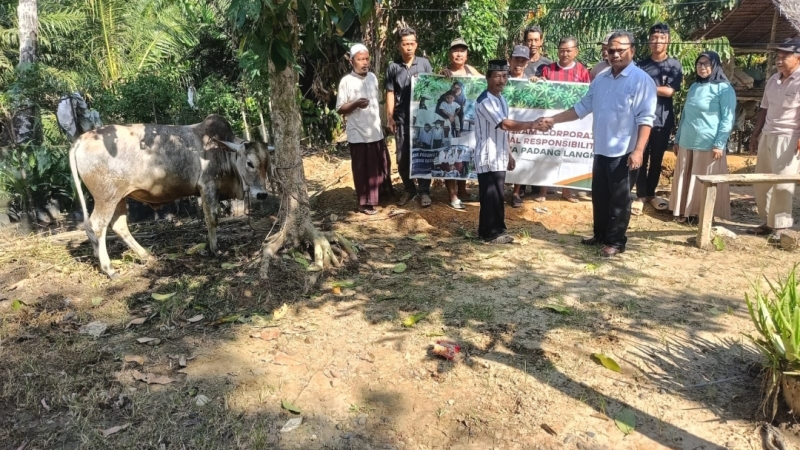
Palm oil company PT Raya Padang Langkat (Rapala) once again held a social action in celebration of Eid al-Adha 1447 H. This social action was carried out by distributing sacrificial cows to residents living around the plantation operations, both in Langkat Regency and Aceh Tamiang.
The handover of sacrificial animals in Langkat Regency was led by the Manager of PT Rapala Batang Serangan Estate to residents in Sei Musam Village, Batang Serangan District, Langkat Regency. A total of 200 families benefited from the sacrificial meat, which was symbolically received by the Village Head of Sei Musam, Elianto.
“We handed over the sacrificial animals to the residents of Sei Musam Village as part of the company’s CSR program for the community. As a company that complies with regulations, we always distribute CSR assistance to communities in our operational areas,” said the Manager of Batang Serangan Estate, Bonar Hutabarat, on Wednesday (27/5/2026).
In addition to Sei Musam Village, the distribution of sacrificial animals also took place in Padang Langkat Village, Gebang District, Langkat Regency, symbolically received by the Village Head of Padang Langkat, Muhammad Andika. The distribution of sacrificial cows received appreciation from the benefiting residents.
“We express our gratitude to PT Rapala for distributing sacrificial animals to the residents. Hopefully, this company will continue to thrive and its leaders will always receive blessings from Allah SWT,” said Muhammad Andika.
Meanwhile, the handover of sacrificial animals was also carried out by PT Rapala’s Aceh Tamiang estate in Cinta Raja Village, with a population of 315 families, in Bendahara District, Aceh Tamiang. The Estate Manager, Slamet, represented the company’s management in the handover of the sacrificial animals.
“In Aceh Tamiang, the handover of sacrificial animals was also carried out. This handover was directed by our leader, Mr. Paul Baja Siahaan, who always instructs that our presence should always bring benefits to the community,” he concluded.
Langkat Regency
Langkat Regency is a region in North Sumatra, Indonesia, known for its historical significance as part of the Sultanate of Langkat, a powerful Malay kingdom that thrived in the 19th century. The area was a major center for the rubber and palm oil industries during the Dutch colonial era, and it features cultural landmarks like the Istana Darul Aman palace. Today, Langkat is recognized for its diverse natural attractions, including the Gunung Leuser National Park, and its blend of Malay, Batak, and colonial heritage.
Aceh Tamiang
Aceh Tamiang is a regency in the province of Aceh, Indonesia, located on the eastern coast of Sumatra. Historically, the area was part of the ancient Tamiang Kingdom, which was known as a center for Hindu-Buddhist culture before the spread of Islam in the region. Today, it is recognized for its diverse natural resources, including oil and gas, as well as its unique cultural blend of Malay and Acehnese traditions.
Sei Musam Village
Sei Musam Village is a traditional village located in the Riau Islands province of Indonesia, known for its rich Bugis and Malay cultural
Istana Darul Aman
Istana Darul Aman is the official royal palace of the Sultan of Kedah, located in Alor Setar, Malaysia. Built between 1939 and 1941, it was commissioned by Sultan Badlishah to replace the older Istana Kuning as the main residence. The palace features a blend of traditional Malay and Islamic architectural styles, and it remains a significant symbol of Kedah’s monarchy and cultural heritage.
Gunung Leuser National Park
Gunung Leuser National Park, located in northern Sumatra, Indonesia, is a UNESCO World Heritage Site and part of the Tropical Rainforest Heritage of Sumatra. Established in 1980, it covers over 7,900 square kilometers and is one of the last refuges for critically endangered species like the Sumatran orangutan, tiger, and rhinoceros. The park’s history includes efforts to protect its vast, biodiverse ecosystems from deforestation and poaching, making it a vital conservation area.
Sultanate of Langkat
The Sultanate of Langkat was a Malay Islamic monarchy located in present-day North Sumatra, Indonesia, established in the 17th century. It rose to prominence in the 19th century under Sultan Musa al-Muazzam Shah, largely due to the booming rubber and palm oil industries. The sultanate was dissolved in 1946 after the Indonesian Revolution, and its former royal palace, Istana Darul Aman, now serves as a museum.
Tamiang Kingdom
The Tamiang Kingdom was an ancient Islamic sultanate located in what is now Aceh, Indonesia, on the island of Sumatra. It emerged as a significant pepper-trading hub and maritime power between the 13th and 16th centuries, often interacting with neighboring kingdoms like Samudera Pasai. The kingdom eventually declined and was absorbed into the expanding Aceh Sultanate, leaving behind archaeological remnants and a legacy in local folklore.
Langkat Regency
Langkat Regency is a region in North Sumatra, Indonesia, known for its historical significance as a center of the Sultanate of Langkat, a Malay kingdom established in the 19th century. The area features notable cultural sites, including the Istana Maimun and the Great Mosque of Azizi, reflecting its royal heritage and Islamic influences. Today, Langkat is recognized for its natural landscapes, such as palm oil plantations and the Gunung Leuser National Park, blending history with biodiversity.
Aceh Tamiang
Aceh Tamiang is a regency in the Aceh province of Indonesia, located on the eastern coast of Sumatra. Historically, the area was part of the ancient Tamiang Kingdom, a Hindu-Buddhist polity that later converted to Islam in the 14th century, influenced by the nearby Samudera Pasai Sultanate. Today, it is known for its cultural diversity, natural resources like oil and palm oil, and traditional customs that blend Malay and Acehnese heritage.
Sei Musam Village
Sei Musam Village is a traditional settlement in Aceh, Indonesia, known for preserving the ancient megalithic culture of the Aceh people. The village features a collection of large stone structures, including menhirs, stone tables, and statues, which date back to the 12th century and are believed to have been used for ancestral worship and social rituals. Its history reflects a blend of indigenous animistic traditions and later Islamic influences, though the site remains a significant cultural heritage location in the region.
Padang Langkat Village
Padang Langkat Village is a historic settlement in North Sumatra, Indonesia, known for its deep-rooted Malay cultural heritage and its role as the former seat of the Langkat Sultanate. The village features traditional wooden architecture and the remnants of the sultanate’s palace, reflecting its past as a center of power and trade in the region. Today, it serves as a cultural tourism destination, offering visitors a glimpse into the history and traditions of the Langkat Malay community.