(special)
Medan. The legal perspective in the PTPN asset trial leads to the conclusion that the conversion of Cultivation Rights (HGU) into Building Rights (HGB) and the land management scheme implemented do not meet the elements of a criminal act of corruption.
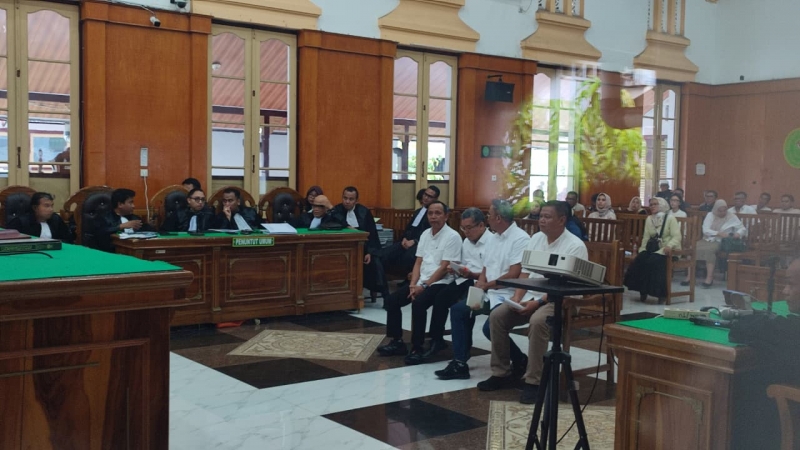
This was revealed during the continuation of the trial concerning the sale of PTPN assets to Ciputra Land at the Medan District Court on Monday (April 20, 2026), which presented Criminal Law Expert Dr. Chairul Huda and State Administrative Law Expert Dr. Dian Puji.
Chairul Huda explained that in the Anti-Corruption Law, there is a material element that must be proven, especially regarding state losses and personal benefits obtained by the perpetrator.
“In the Anti-Corruption Law, there is a material offense and the consequences of corrupt actions. The elements in this case are what consequences are prohibited in this article. In this case, it is state financial loss. Other elements, such as benefiting oneself and using agreements through position,” said Chairul.
He added that the element of corruption must also be proven by the personal benefit obtained by the defendant. “If this is a corruption case, ask the defendants how much money they received. If there is none, it is not corruption. Unless they obtained personal benefit and used their power to enrich themselves. If not, it is not a corrupt act,” he added.
According to Chairul, in this case, there was an effort by the parties to fulfill the obligation to hand over 20 percent of the land to the state. However, its implementation was hindered by the absence of technical regulations.
“Logically, there is no consequence yet. If there is no consequence, there is no act committed. And, if we look at why it hasn’t been handed over to the state, it is because there are no regulations yet established by the state. There should be a mechanism to determine someone’s guilt, clearly and concretely,” said Chairul.
He emphasized that this condition cannot be categorized as an abuse of authority. According to Chairul, in this case, there is no error of authority because the authorized party is the ministry as the holder of authority.
“In this case, there is no error of authority, because the authorized party is the ministry as the holder of authority, but there are no regulations, so this is not a matter of abuse of authority,” stated Chairul.
According to Chairul, in corruption cases, the malicious intent of the defendants must also be proven. Chairul argued that there was no malicious intent in this case to harm the state. Therefore, he said, there is no crime without malicious intent as the basis for demanding accountability.
Meanwhile, state administrative law expert Dian Puji explained that the inbreng mechanism used in the land transfer is legally valid.
“After the inbreng, the land became the property of PTPN’s subsidiary, namely NDP. So, the subsidiary received the land, while PTPN received shares. After the release, the asset was written off. In the evidence, there is a write-off of the land and it was given to the inbreng recipient,” said Dian.
He also mentioned that changing the rights to the land does not require approval from the Minister of Finance, but only through the relevant technical ministry. Dian also highlighted the aspect of calculating state losses, which he said must be done by an authorized institution.
“Regarding state losses, state institutions should be used. Only the BPK (Supreme Audit Agency) can conduct financial audits. If a party or public accounting consultant conducts an audit without authority, it cannot be done. Unless it is done on behalf of the BPK,” said Dian.
He added that the audit of state losses must be conducted accurately and involve related parties. “Is the audit based only on the investigation report? Of course not, because responses must be sought from the relevant parties. So, there are stages to confirm state losses. If the auditor does not have the capacity, authority, and accuracy, it should be null and void by law,” said Dian.
Dian argued that the case involving the defendants cannot be categorized as a criminal act of corruption, considering