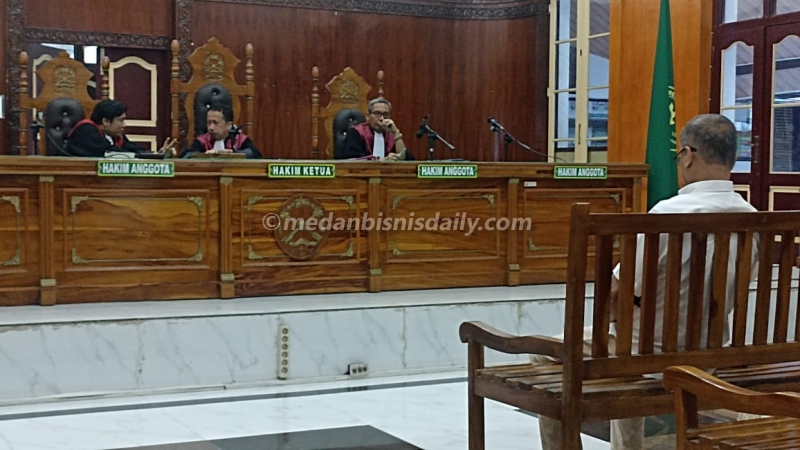
The defendant in the alleged corruption case involving the sale of aluminum alloy by PT Indonesia Asahan Aluminium (Inalum), Dante Sinaga, expressed disappointment over the interlocutory decision of the Corruption Court Panel at the Medan District Court, which declared the objection or exception he filed as inadmissible.
The disappointment primarily concerns the lack of consideration regarding the issue of tempus delicti, or the time frame of the alleged crime, which was a key point of objection in the exception submitted by his legal team.
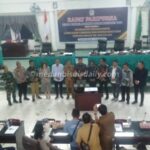
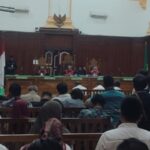
The interlocutory decision was read out by the Panel of Judges, chaired by A’sad Rahim Lubis, in the Cakra Utama Room of the Medan District Court, Wednesday (June 3, 2026).
Through his legal counsel, Kasmin Sidauruk, SH MH, Dante Sinaga stated that his team considers the indictment from the public prosecutor (JPU) to be inaccurate because it includes a time frame for the alleged crime from 2018 to 2024, while his client only served until April 2020 and entered retirement in July of the same year.
“We are very disappointed. Because what we raised in the exception was not about the main case, but rather the inaccuracy of the indictment, including the tempus delicti, which we believe is unclear,” said Kasmin after the hearing.
According to him, the objection regarding the time frame in the indictment is a fundamental issue that should have received attention in the interlocutory decision.
“Our client served from 2018 to April 2020. However, the indictment mentions a time frame for the events up to 2024. That is what we are questioning, and we believe it was not considered by the panel of judges in the interlocutory decision,” he said.
In addition to the tempus delicti issue, the legal team also believes that several other legal arguments, including a Constitutional Court decision deemed relevant to the case, were not addressed in the panel’s considerations.
Kasmin explained that the panel of judges held that the various objections raised by the legal team had entered into the main case and would therefore be examined and considered further during the evidentiary phase.
Nevertheless, he emphasized that the panel did not reject the exception filed, but rather declared it inadmissible.
“This is not rejected, but inadmissible. That means, according to the panel of judges, the matters we raised will be reconsidered after the examination of witnesses, experts, and evidence in the main case,” he said.
His team confirmed that they will present various pieces of evidence at the next hearing, including documents related to Dante Sinaga’s tenure while serving as Senior Executive Vice President of Business Development at PT Inalum.
“We will present various evidence, including the decree or SK showing our client’s term of office. We will prove that in court,” said Kasmin.
Additionally, they will also submit evidence and arguments regarding the alleged losses mentioned in the case. According to Kasmin, there are still ongoing billing and bankruptcy processes, so the aspect of losses as charged still needs to be further proven.
“This issue is still related to the billing and bankruptcy process. Therefore, we will prove everything in court,” he said.
Meanwhile, Dante Sinaga emphasized that his main objection from the start concerns the accusations that, according to him, occurred after he was no longer serving at PT Inalum.
“All the accusations made outside my term of office, that is my objection,” said Dante.
He believes the prosecutor’s indictment is inaccurate because it links him to the time frame of the alleged crime up to 2024, even though he stopped serving in April 2020.
ALSO READ:
In this case, the prosecutor has charged four defendants: Dante Sinaga as Senior Executive Vice President of Business Development at PT Inalum in 2019, Djoko Sutrisno as President Director of PT PASU, Oggy Achmad Kosasih as Managing Director of PT Inalum for the 2019-2021 period, and Joko Susilo as Head of the Sales