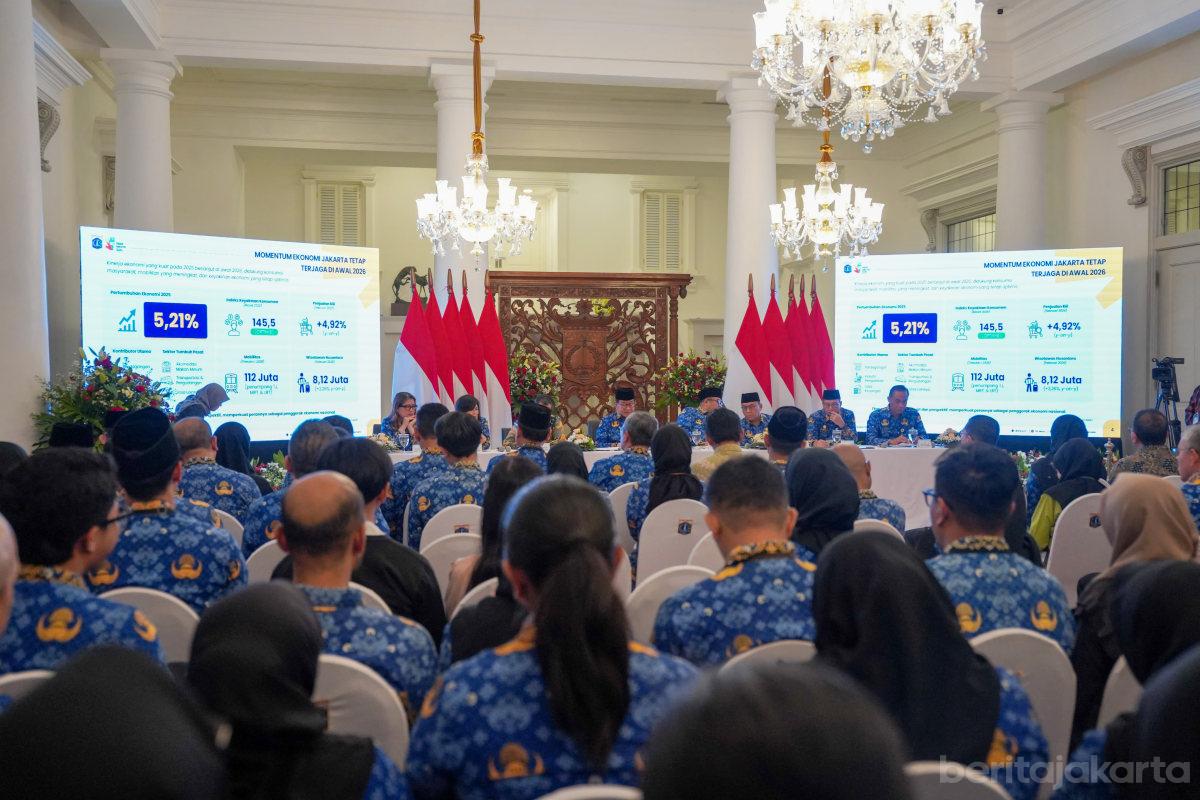
Jakarta Governor Pramono Anung stated that the acceleration of the 2026 Regional Budget is fully focused on speeding up the implementation of various priority regional programs. This is being carried out to improve the welfare of Jakarta residents.
Of the total Jakarta Regional Budget ceiling of Rp81.32 trillion, the Jakarta Provincial Government recorded regional spending absorption as of March 31, 2026, at 13.97 percent, or Rp10.38 trillion.
Meanwhile, financing receipts amounted to 58.92 percent, or Rp5.82 trillion, and the realization of financing expenditures reached Rp243.2 billion, or 3.45 percent.
“The surplus calculation is Rp4.77 trillion,” he said on Friday, April 17.
Pramono also stated that 94,798 procurement packages had been completed. Therefore, he instructed his staff to expedite the completion of procurement packages to maintain healthy and efficient regional budget performance.
Furthermore, Jakarta’s economic conditions are also showing a positive trend. Last year, Jakarta’s economic growth was recorded at 5.21 percent, surpassing the national growth rate of 5.11 percent.
“In March 2026, the Consumer Confidence Index under these geopolitical conditions has very high optimism at 145.5,” he added.
Pramono assessed that this figure demonstrates high public optimism amidst global geopolitical dynamics. In the transportation sector, the use of the budget for public facilities is beginning to yield results.
The public transportation campaign received a positive response, with the number of passengers reaching 112 million people throughout the first quarter of this year.
“Currently, the number of passengers using public transportation in the first quarter has reached 112 million,” he stated.
For information, the Jakarta Provincial Government has established several priority programs for 2026, including improving competitive human resources; increasing productivity and economic competitiveness; creating decent livelihoods; transforming governance; improving city infrastructure; optimizing low-carbon development; and creating mobility and transit-oriented areas.