The layered UKK mechanism allows PKB Depok to screen leadership candidates at the regional level.
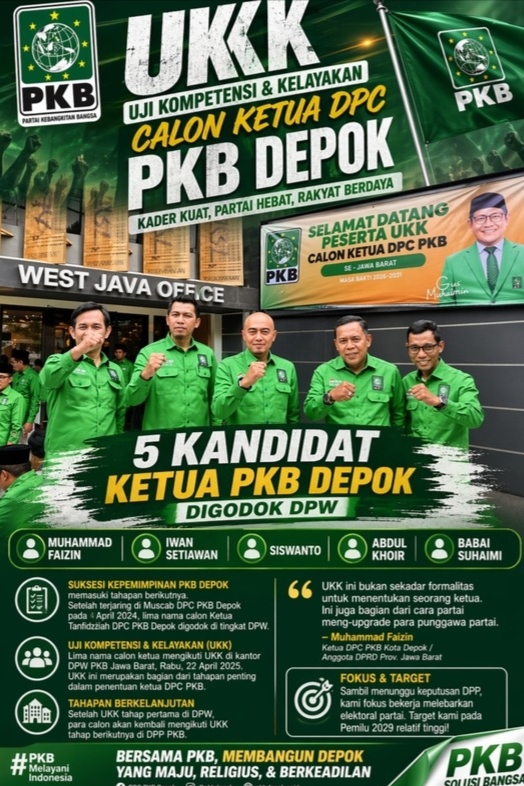
Depok (22/04/2026) – The contest for the leadership of the National Awakening Party (PKB) in Depok City has now escalated to the provincial level. Five candidates vying for the position of Chairman of the Tanfidziah of the Depok City PKB Branch Executive Board (DPC) officially underwent the first phase of the Competency and Feasibility Test (UKK) at the headquarters of the PKB West Java Regional Executive Board (DPW) on Wednesday (22/04/26).
This step implements party meritocracy following the initial screening during the Branch Conference (Muscab) held on April 4. The five candidates who traveled to Bandung are Muhammad Faizin, Iwan Setiawan, Siswanto, Abdul Khoir, and Babai Suhaimi.
Selection Escalates Towards the Central Level
Muhammad Faizin, one of the candidates who also serves as a member of the West Java Provincial House of Representatives, explained that this selection procedure is comprehensive and multi-layered. According to him, approval from the regional level is merely the entry point before the candidates face the examination team at the central level.
“This stage at the DPW is an integral part of the party’s formal mechanism to assess the capacity of the Tanfidziah chairman candidates. However, the process is not yet complete because all candidates are still required to participate in the second phase of the UKK at the PKB Central Executive Board (DPP),” Faizin emphasized.
Tool for Cadre Transformation
From an organizational perspective, the UKK is seen not merely as an administrative formality to select a single name. The Chairman of the PKB West Java DPW, Syaiful Huda, described this moment as a platform for mapping the strengths of the best cadres Depok has to offer.
Faizin added that this process has a dual function:
Capacity Validation: Testing the depth of each candidate’s leadership vision and mission.
Competency Acceleration: Serving as a means for the party to collectively upgrade its political figures.
“Whoever is later appointed by the DPP will bear a great responsibility, but the most important thing is how this process strengthens the overall quality of the cadres,” Faizin added.
Strategic Focus: 2029 Electoral Targets
Despite the ongoing internal competition, organizational solidarity remains the top priority. All candidates have affirmed their commitment to remaining united in strengthening their grassroots support base.
With the final decision now in the hands of the DPP, local-level administrators have chosen to stay focused on electoral work. This is considered crucial given that PKB has set significant vote acquisition targets for the upcoming 2029 General Election.
“Every candidate has an equal opportunity. While waiting for the final decision from the center, our focus remains on strengthening the party machinery in the field to ensure the 2029 electoral targets are achieved to the fullest,” Faizin concluded.
Depok
Depok is a city in West Java, Indonesia, known historically as a plantation area established by the Dutch East India Company (VOC) in the 18th century. It gained significance as one of the earliest areas outside Jakarta to develop a planned community, with a mix of European, Chinese, and indigenous influences. Today, Depok is a rapidly growing suburban city and a major educational hub, home to the University of Indonesia.
Bandung
Bandung, the capital of West Java, Indonesia, is a historic city known for its colonial-era architecture and cool mountain climate. It gained international recognition for hosting the 1955 Asia-Africa Conference, a pivotal event in the Non-Aligned Movement. Today, Bandung is a vibrant cultural and creative hub, often called “Paris of Java” for its art deco buildings and thriving fashion scene.
<h3 class
Depok
Depok is a city in West Java, Indonesia, known for its historical roots as a colonial-era plantation established by Cornelis Chastelein, a Dutch East India Company official, in the 17th century. Chastelein freed his slaves and granted them land, forming a unique Christian community that influenced the area’s cultural and religious diversity. Today, Depok is a rapidly growing suburban hub and a major educational center, home to the University of Indonesia.
Bandung
Bandung, the capital of West Java, Indonesia, is a city known for its cool climate and colonial-era architecture, earning it the nickname “Paris of Java.” Its history as a major tea plantation hub under Dutch rule is reflected in landmarks like the Art Deco buildings along Jalan Braga. Today, Bandung is a vibrant center for creative industries, culinary tourism, and university education.
West Java
West Java is a province on the Indonesian island of Java, known for its rich cultural heritage and natural beauty, including volcanoes and tea plantations. Historically, it was a center of the powerful Sunda Kingdom before coming under Dutch colonial rule in the 17th century. Today, it is home to the Sundanese people and features cultural sites like the ancient temple complex of Candi Cangkuang.
University of Indonesia
The University of Indonesia (UI) is a prestigious public university located in Depok, West Java, with its roots tracing back to 1849 as a Dutch colonial medical school. It was officially established as the University of Indonesia in 1950, becoming a key institution in the nation’s post-independence development. Today, UI is recognized as one of the leading universities in Indonesia, known for its academic excellence and significant contributions to research and culture.
Asia-Africa Conference
The Asia-Africa Conference, also known as the Bandung Conference, was a historic meeting held in Bandung, Indonesia, in April 1955. It brought together leaders from 29 newly independent Asian and African countries to promote economic and cultural cooperation and to oppose colonialism and neocolonialism. The conference laid the groundwork for the Non-Aligned Movement and symbolized the growing political voice of the Global South during the Cold War.
Non-Aligned Movement
The Non-Aligned Movement (NAM) is a forum of 120 developing countries that was formally established in 1961, primarily on the initiative of leaders such as Josip Broz Tito of Yugoslavia, Jawaharlal Nehru of India, Gamal Abdel Nasser of Egypt, Kwame Nkrumah of Ghana, and Sukarno of Indonesia. Its founding principle was to maintain independence from the two major Cold War power blocs—the United States and the Soviet Union—while promoting decolonization, peace, and economic development. Though its influence waned after the Cold War, NAM continues to advocate for the interests of the Global South.