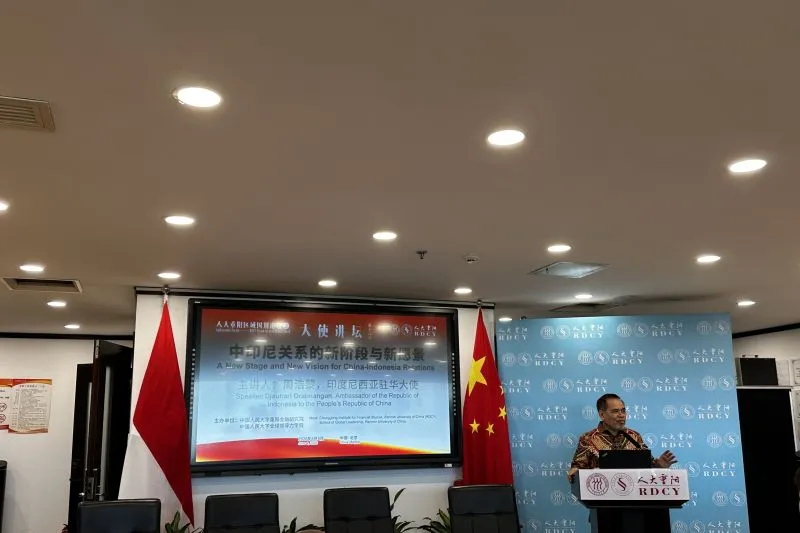
DEPOK (05/06/2026) – The architecture of bilateral relations between Indonesia and China has officially entered a new, more tactical phase focused on mastering future technologies. The Ambassador of the Republic of Indonesia to China and Mongolia, Djauhari Oratmangun, emphasized that the roadmap for future partnership between the two countries will be fully concentrated on four main pillars: artificial intelligence (AI) sovereignty, energy security, food security, and acceleration of human resource quality. This grand strategy was comprehensively presented at the 18th Ambassador Forum discussion titled “A New Stage and New Vision for China-Indonesia Relations,” organized by the Chongyang Institute for Financial Studies (RDCY) in collaboration with the School of Global Leadership at Renmin University in Beijing.
The artificial intelligence sector is targeted as the first vital instrument that can be integrated to optimize public service governance, from digitalization in healthcare, education, disaster mitigation, social protection guarantees, to smart city construction. Djauhari outlined that amid escalating global fiscal pressures and high macro societal demands, AI adoption becomes an absolute solution draft to ensure the government can still deliver excellent public services despite facing limited budget support resources. Strengthening this technological sovereignty is considered aligned with the second pillar: energy security. Given that every digital ecosystem, such as data centers and smart factories, requires reliable electricity supply, Indonesia, which controls about 40 percent of global geothermal potential and is the world’s largest palm oil producer, is in a strategic position to collaborate with China, which currently leads the global renewable energy landscape.
In the food security cluster as the third pillar, the dynamics of climate change threatening global agricultural productivity open up decarbonization opportunities through transfer of precision agriculture technology, smart irrigation systems, and AI-based mechanization. This step is considered highly contextual with Indonesia’s domestic draft, where the presence of the Free Nutritious Meal Program is projected to boost the national food demand curve and strengthen the local agricultural supply chain structure from upstream to downstream. To support these three technological pillars, the fourth focus is allocated to strengthening human resource capacity through joint research schemes, industrial apprenticeship programs, vocational education standardization, academic exchanges between universities, and development of cutting-edge technology curricula.
This substantive cooperative relationship moves on a very solid economic foundation over the past decade, where China has consistently maintained its position as Indonesia’s largest trading partner while ranking among the top three foreign investors. Throughout 2025, the accumulated bilateral trade value between the two countries reportedly reached 167 billion US dollars, with realized Chinese investment in Indonesia reaching 7.5 billion US dollars, a fiscal performance record showing a tripling of trade value and a 12-fold surge in investment growth over the past ten years. Iconic projects such as the Jakarta-Bandung High-Speed Railway as a pioneer of fast transportation in Southeast Asia, and the firmness of domestic nickel industry downstreaming policy to supply raw materials for global electric vehicle batteries, stand as authentic evidence of the success of this South-South diplomacy, also marked by the massive expansion of 16 Chinese electric vehicle brands in the Indonesian market.
Approaching the end of his tenure since first stationed in Beijing in 2018, Ambassador Djauhari stated that the greatest diplomatic legacy he wishes to leave after nearly eight years of service is strengthening the habit of dialogue at the elite leadership level of both countries. This diplomatic authority believes that no matter how strong the turbulence of future geopolitical challenges, the consistency of dialogue space will ensure that Indonesia-China relations continue to move rationally in facing differences, constructively in unraveling obstacles, and optimistically looking toward the future. Closing the discussion, which was also attended by senior researcher Luo Zhiqin and Executive Director of the Shanghai Southeast Asia Studies Center Luo Yongkun, Djauhari emphasized that the main parameter of the success of technology investment and economic growth must ultimately lead to human values and the expansion of better life opportunities for the wider community.
comments