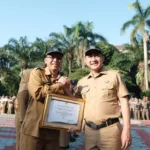
Despite being president, Prabowo tells students he still gets bullied.
President Prabowo Subianto admitted that he is still often bullied. This was stated while reviewing a community school at SRMP 17, Tabanan, Bali, on Sunday.
President Prabowo Subianto told community school students about how he still frequently receives bullying even though he is the President.
Prabowo’s confession about bullying was made while encouraging a community school student who also experiences bullying.
This was stated while reviewing a community school at SRMP 17, Tabanan, Bali, on Sunday.
During that occasion, the President gave motivational messages to the community school students.
The President asked students who are often teased or insulted not to be discouraged. He said that he himself was often teased in the past.
Even now as President, Prabowo admitted he still receives taunts.
Initially, the President received input from a community school student who is often the target of teasing by peers.
“Thank you earlier, who was it? Good. Gede Bagus, right. You were teased before. It’s okay. It’s okay to be teased. Not only you, I am often teased. Even now as president, I am still teased,” said the President.
The President advised that received taunts do not need to be repaid in kind. Taunts should be responded to with politeness and kindness.
“It’s okay, as long as your heart is steadfast. Our hearts are good; if we are teased, we respond with politeness. The more we are insulted, the more steadfast, the braver, the more polite you become. Be polite when insulted, do not be discouraged,” he said.
In this way, said the President, a person’s character will be tested, which will become a provision for achieving success one day.
According to the President, many successful people come from poor families.
“Many successful people come from very poor families. Many, but the children do not give up, the children do not despair, the children are always cheerful. Amid difficulties, look for the good; goodness will surely come. We believe that,” he concluded.
The President reviewed SRMP 17 Tabanan in the Sentra Mahatmiya Bali area, Banjar Anyar Village, Kediri District, Tabanan, on Sunday.
At the location, the President arrived around 11:40 a.m. local time.
SRMP 17
SRMP 17 refers to a specific archaeological site within the larger complex of the San Rock Art site in South Africa, known for its ancient San (Bushmen) rock paintings. These paintings, created by the indigenous San people over thousands of years, depict scenes of hunting, daily life, and spiritual beliefs, offering valuable insight into their culture and history. The site is part of the uKhahlamba-Drakensberg Park, a UNESCO World Heritage Site recognized for its outstanding rock art and natural beauty.
Tabanan
Tabanan is a regency in Bali, Indonesia, known for its lush rice terraces, traditional villages, and cultural heritage. Historically, it was one of the nine kingdoms of Bali, with a rich history of art and governance that persisted until the Dutch colonial conquest in the early 20th century. Today, Tabanan is famous for sites like the Tanah Lot temple and the Jatiluwih rice terraces, a UNESCO World Heritage site.
Bali
Bali is an Indonesian island known for its stunning beaches, terraced rice paddies, and vibrant Hindu culture, which sets it apart from the rest of the predominantly Muslim country. Its history dates back to the 9th century, with influences from Indian, Javanese, and Chinese civilizations, and it later became a Dutch colonial possession in the 19th century. Today, Bali is a major
SRMP 17
SRMP 17, or the “Sultanate of Rum Mint 17,” refers to a medieval Islamic coin minting site associated with the Sultanate of Rum, a Seljuk Turkish state in Anatolia during the 11th to 13th centuries. This location likely played a role in the economic and administrative systems of the sultanate, producing coins that facilitated trade and demonstrated political authority. Specific historical records about SRMP 17 are limited, but it is part of the broader numismatic heritage that sheds light on the region’s medieval history.
Tabanan
Tabanan is a regency in Bali, Indonesia, known for its lush rice terraces, traditional villages, and the iconic Tanah Lot sea temple. Historically, it was one of the eight Balinese kingdoms before Dutch colonization, and it retains a strong cultural heritage with ancient water temples and royal palaces. Today, Tabanan is celebrated for its agricultural beauty and as a center for Balinese arts and rituals.
Bali
Bali is a famous Indonesian island known for its stunning beaches, terraced rice paddies, and vibrant Hindu culture, which sets it apart from the rest of the predominantly Muslim country. Its history dates back to at least the 1st century CE, with influences from Indian Hinduism and Buddhism shaping its unique traditions, arts, and temple architecture. The island became a major tourist destination in the 20th century, but it has preserved its spiritual heritage through ceremonies, dance, and a deep connection to nature.
San Rock Art
San Rock Art refers to ancient paintings and engravings created by the San people (Bushmen) of Southern Africa, some dating back over 20,000 years. These artworks, found in caves and rock shelters across countries like South Africa, Zimbabwe, and Botswana, depict spiritual beliefs, hunting scenes, and daily life, offering a profound glimpse into early human culture. They are considered one of the world’s oldest and most significant records of human creativity and symbolic thought.
uKhahlamba-Drakensberg Park
uKhahlamba-Drakensberg Park, located in South Africa, is a UNESCO World Heritage Site renowned for its dramatic basalt cliffs, lush valleys, and rich biodiversity. The area holds significant cultural and historical importance, containing over 35,000 ancient San rock art paintings in more than 500 caves and shelters, dating back thousands of years. It also serves as a vital natural sanctuary and a popular destination for hiking, offering a blend of natural beauty and prehistoric heritage.
Tanah Lot temple
Tanah Lot is a iconic sea temple located on a rocky outcrop off the coast of Bali, Indonesia. It is one of the island’s most important Hindu shrines, believed to have been built by the 16th-century priest Dang Hyang Nirartha, who is said to have transformed the rock into a temple after being enchanted by its beauty. The temple is famous for its stunning sunset views and is a key part of Balinese mythology, serving as a guardian of the sea.
Jatiluwih rice terraces
The Jatiluwih rice terraces in Bali, Indonesia, are a stunning example of traditional Balinese irrigation and agriculture, with their intricate system dating back to the 9th century. Designated a UNESCO World Heritage site, they showcase the Subak cooperative water management system, which is deeply intertwined with local culture and spirituality. Visitors can explore the lush, green landscape while learning about the ancient farming techniques that have sustained the region for over a thousand years.
Sentra Mahatmiya Bali
Sentra Mahatmiya Bali is a cultural and spiritual center in Bali, Indonesia, known for preserving and promoting traditional Balinese arts, crafts, and religious practices. It serves as a hub for visitors to learn about the island’s rich heritage, including its history of Hindu-influenced rituals and craftsmanship passed down through generations. The site reflects Bali’s enduring commitment to maintaining its unique cultural identity amidst modernization.