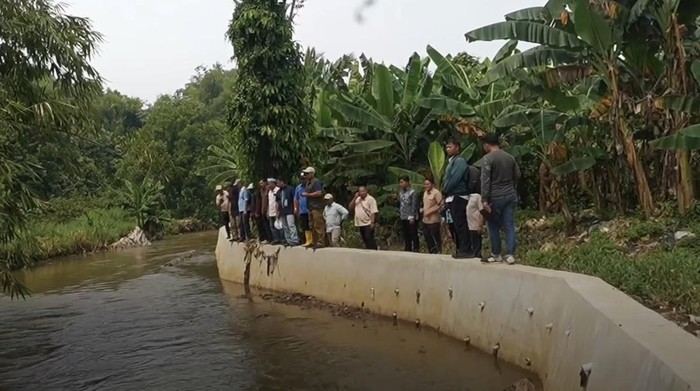
Jakarta – Flooding on Jalan Kampung Bulak Barat, Cipayung, has not receded for months. This has turned the area into a ‘dead village’. Depok Mayor Supian Suri stated that, in the short term, a bridge will be built at the location.
Supian initially apologized for the flooding experienced by residents of Kampung Bulak Barat. He said the flooding, which has persisted for years, is being addressed by first tackling the waste problem.
“I sincerely apologize to the residents of Kampung Benda who have frequently experienced flooding. This problem has been ongoing for years, so first I have to solve the main waste problem,” said Supian.
He said that by early 2028, waste will be processed into electrical energy. In the short term, to address the flooding, the Depok City Government will dredge the river and revitalize the bridge.
“God willing, in early 2028, pray that this process goes quickly, waste in Depok will be processed into electrical energy. In the short and near term, what are we going to do? I have just asked the Head of the Public Works Department to dredge this river. This year it must be fixed, the bridge must be raised,” he said.
“Yes, that is our effort, our endeavor. But once again, I am committed to answering the hopes of the residents, especially Kampung Benda, including Pasir Putih which we also checked on recently, including the RW 7 area up here, which also gets flooded when the water overflows,” he added.
Near the flood location, the road access is covered in mud and standing water. The flooding has caused the loss of road access, with only the bridge pillars visible.
Some residents were seen casting fishing nets to catch fish on the flooded bridge. However, some residents also dared to pass through the road on trail motorcycles.
Garbage was also seen piling up on the riverbank. The trash also clogged near the bridge pillars, causing the water to back up. Heavy equipment was visible on top of the pile of garbage.
Jakarta
Jakarta is the capital and largest city of Indonesia, located on the northwest coast of Java. Historically known as Sunda Kelapa, it was later renamed Batavia by the Dutch during the colonial era, becoming a major trading hub for the Dutch East India Company. After Indonesia’s independence, it was officially named Jakarta and has since grown into a bustling metropolis, blending modern skyscrapers with historic landmarks like the Old Town (Kota Tua).
Jalan Kampung Bulak Barat
Jalan Kampung Bulak Barat is a small, traditional street located in the Bulak area of Surabaya, Indonesia, known for its dense residential community and local market atmosphere. Historically, the area developed as a fishing and coastal settlement, with “Bulak” referring to a type of pond or marshy land that was gradually converted into housing. Today, it reflects Surabaya’s urban growth while retaining a close-knit, village-like character.
Cipayung
Cipayung is a district located in East Jakarta, Indonesia, known for its residential areas and the Cipayung Traditional Market. Historically, it developed as part of Jakarta’s urban expansion, transitioning from agricultural land into a densely populated suburb. The area also houses several educational institutions and serves as a gateway to the nearby Sentul City region.
<div class="my
Jakarta
Jakarta, the capital of Indonesia, is a sprawling metropolis on the northwest coast of Java with a history dating back to the 4th century as the port city of Sunda Kelapa. It later became the colonial stronghold of the Dutch East India Company under the name Batavia, and was renamed Jakarta after Indonesia’s independence in 1945. Today, it is a vibrant cultural and economic hub, blending historic landmarks like the old town of Kota Tua with modern skyscrapers.
Jalan Kampung Bulak Barat
Jalan Kampung Bulak Barat is a street located in the Bulak area of Surabaya, Indonesia. Historically, it was part of a coastal fishing village that developed into a residential neighborhood, reflecting the area’s transformation from a rural settlement to an urbanized district. Today, it serves as a local access road, connecting homes and small businesses within the community.
Cipayung
Cipayung is a district located in East Jakarta, Indonesia, known for its blend of urban and suburban characteristics. Historically, the area was part of the larger Batavia region during the Dutch colonial era and has since developed into a residential and educational hub. Today, Cipayung is recognized for sites like the Taman Mini Indonesia Indah cultural park, which showcases the nation’s diverse heritage.
Kampung Bulak Barat
Kampung Bulak Barat is a neighborhood located in the Bulak district of Surabaya, Indonesia, near the coast. Historically, it developed as a fishing village and residential area, reflecting the growth of Surabaya’s eastern suburbs. Today, it is known for its tight-knit community and proximity to local markets and the Kenjeran Beach area.
Kampung Benda
Kampung Benda is a traditional village located in Tangerang, Indonesia, known for its preservation of Betawi cultural heritage. Historically, it is believed to have been established during the colonial era, with many of its residents maintaining centuries-old customs, traditional architecture, and arts such as the “Burok” dance. The village serves as a living museum, offering visitors a glimpse into the authentic rural life and cultural traditions of the Betawi people.
Depok
Depok is a city in West Java, Indonesia, known historically as the site of a 17th-century plantation established by Cornelis Chastelein, a Dutch East India Company official. Chastelein freed the enslaved workers on his land and granted them land rights, leading to a unique Christian community and the development of “Depok Lama” (Old Depok). Today, it is a bustling satellite city of Jakarta with a mix of modern urban development and historical remnants from its colonial past.
Pasir Putih
Pasir Putih, meaning “White Sand” in Indonesian, is a famous beach located in Situbondo, East Java, known for its striking white sand and calm blue waters. Historically, it has been a popular local getaway and is often associated with the broader coastal culture of the region, though it lacks major ancient monuments. Today, it attracts visitors for swimming, relaxation, and enjoying the scenic views of the Bali Strait.
Surabaya
Surabaya is Indonesia’s second-largest city and the capital of East Java, known for its pivotal role in the country’s struggle for independence. Its name is famously tied to the Battle of Surabaya in November 1945, a fierce clash between Indonesian independence fighters and British forces that became a symbol of national resistance. Today, the city is a major industrial and commercial hub, blending a rich colonial history with modern urban development.