Critical Gaza Mission: 20,000 Cross-Domain Troops Prepared, Led by Experienced Multilateral Three-Star General
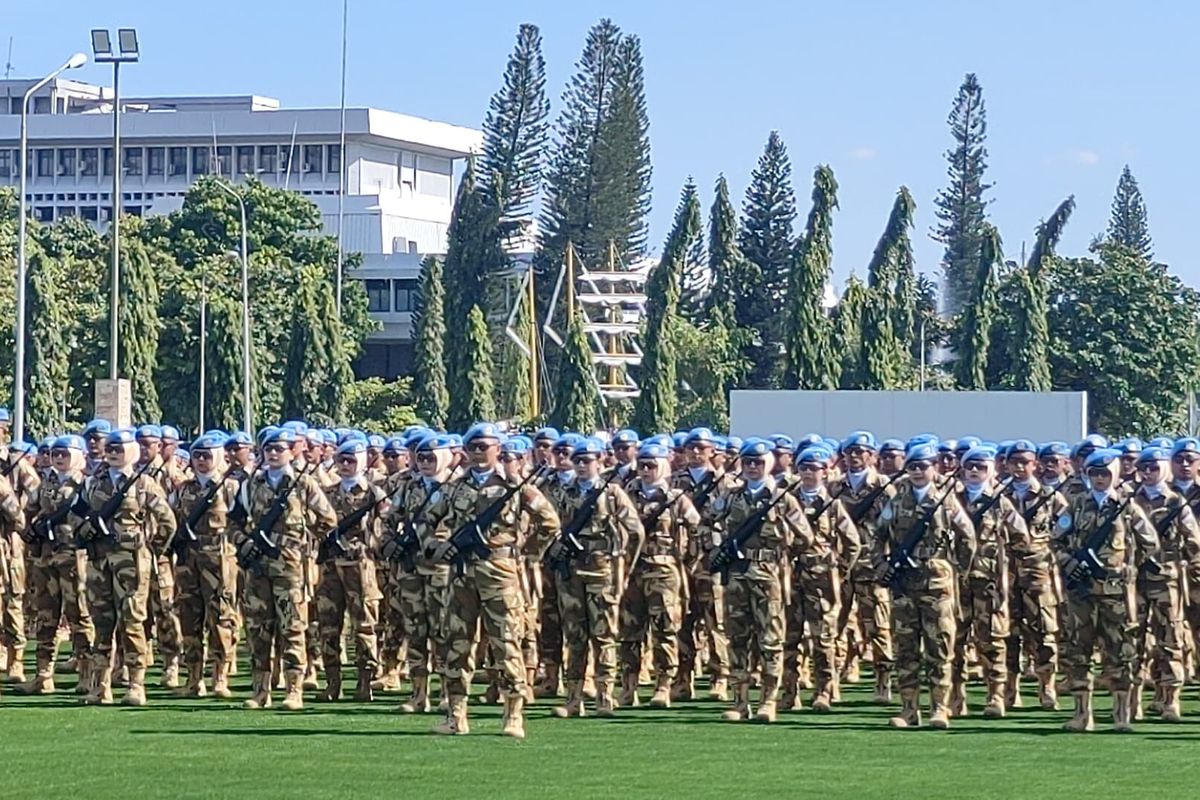
The Indonesian government, through the Ministry of Defense and the Indonesian National Armed Forces (TNI) Headquarters, is finalizing preparations for a large contingent of up to 20,000 troops for a peace and humanitarian mission in Gaza, Palestine. This involvement awaits the approval of President Prabowo Subianto following the establishment of a Gaza security mechanism by the UN Security Council.
Command Structure and Leadership Specialization
The complexity of this mission demands high-level leadership:
“The plan will be led by a three-star general,”
The appointment of a three-star senior officer is not without reason:
Operation Scale: This mission involves three composite brigades across service branches (Medical, Construction Engineering, Support), requiring a commander with sufficient authority and experience in joint operations.
Task Complexity: This mission is classified as a Military Operation Other Than War (MOOTW) with multidimensional task coverage—encompassing humanitarian, reconstruction, health, and civilian protection aspects.
International Coordination: A three-star rank is considered to facilitate coordination with the UN and other international elements, which is crucial for the mission’s success.
Troop Composition and Medical Logistics
Although the final numbers are still pending determination by TNI Headquarters, the initial projection of a 20,000-troop composition shows the dominance of the Army (TNI AD) in the Composite Brigade:
Military Branch
Projected Percentage
Projected Number of Troops
Army (TNI AD)
60%
Approximately 12,000 troops
Navy (TNI AL)
25%
Approximately 5,000 troops
Air Force (TNI AU)
15%
Approximately 3,000 troops
In addition to personnel, this mission is supported by a number of vital Main Weapon System Equipment:
Air Support: Helicopters and C-130 Hercules transport aircraft.
Medical Support:Two Hospital-type Indonesian Navy Ships (KRI).
The readiness of the Navy’s medical fleet was confirmed: “In principle, the three KRIs are ready to be deployed and to carry out humanitarian operations.”
Gaza
Gaza is a historic coastal city located in the Palestinian territories, with a rich history dating back over 3,000 years. It has been ruled by various empires, including the Egyptians, Philistines, Romans, and Ottomans. Today, it is part of the Gaza Strip and is known for its cultural heritage, as well as being a focal point in the Israeli-Palestinian conflict.
Palestine
Palestine is a historic and culturally significant region in the Eastern Mediterranean, located between the Jordan River and the Mediterranean Sea. It is home to sacred sites for Judaism, Christianity, and Islam, including Jerusalem, Al-Aqsa Mosque, and the Church of the Holy Sepulchre. The area has a complex history of rule by various empires and is the center of a long-standing political conflict over national self-determination and statehood.
UN Security Council
The United Nations Security Council is the primary body within the UN responsible for maintaining international peace and security. Established in 1945 following World War II, its founding mission was to prevent future large-scale conflicts. It is the only UN body with the authority to issue resolutions that member states are obligated to implement.
Indonesian National Armed Forces (TNI)
The Indonesian National Armed Forces (TNI) was established in 1945 during the Indonesian National Revolution to secure the country’s newfound independence from Dutch colonial rule. It evolved from guerrilla forces and has since played a central, and at times controversial, role in Indonesia’s political and social affairs. Today, it is a modern military organization responsible for the defense and territorial integrity of the Republic of Indonesia.
TNI AD
“TNI AD” stands for Tentara Nasional Indonesia – Angkatan Darat, which is the Indonesian National Army – Army. It is the land component of the Indonesian National Armed Forces, established during the Indonesian National Revolution in the late 1940s to secure the country’s independence. As an institution, it plays a central role in Indonesia’s national defense and has been significantly involved in the nation’s political and social development throughout its history.
TNI AL
“TNI AL” stands for Tentara Nasional Indonesia – Angkatan Laut, which is the Indonesian Navy. It was officially established on September 10, 1945, shortly after Indonesia’s proclamation of independence, to defend the new nation’s vast archipelago. The modern TNI AL plays a crucial role in safeguarding Indonesia’s maritime sovereignty and security.
TNI AU
“TNI AU” stands for Tentara Nasional Indonesia – Angkatan Udara, which is the Indonesian National Armed Forces – Air Force. It was officially established on April 9, 1946, during the Indonesian National Revolution, to defend the nation’s sovereignty. Today, it is a modern branch of the military responsible for the aerial defense of Indonesia.
C-130 Hercules
The C-130 Hercules is a military transport aircraft, not a place or cultural site. It was designed and first flown in 1954 by Lockheed Martin for the United States Air Force. Renowned for its durability and versatility, it has served for decades in various roles, including cargo and troop transport, aerial refueling, and humanitarian aid missions for numerous nations worldwide.