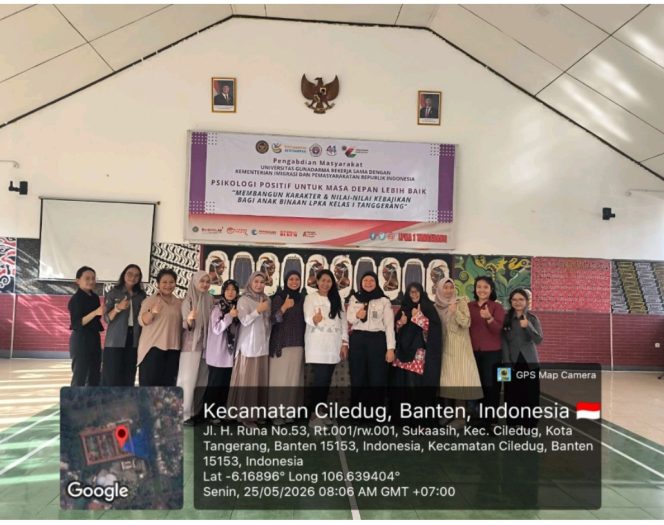
In an effort to support mental development and character building for juvenile inmates, a Community Service team from Gunadarma University, in collaboration with the Ministry of Immigration and Corrections of the Republic of Indonesia, organized an activity themed “Positive Psychology for a Better Future: Building Character and Virtues for Juvenile Inmates at LPKA Class I Tangerang.” The event, held at LPKA Class I Tangerang, introduced psychoeducation on forgiveness using the REACH method as a means to build empathy, self-control, and positive thinking among the juvenile inmates.
The activity was officially opened by the Head of LPKA Class I Tangerang. In his remarks, he stated that the development of juvenile inmates must be holistic, not only through discipline enforcement but also through character strengthening and psychological well-being, so they are better prepared for the future.
This Community Service activity was coordinated by a team of 10 lecturers and students from Gunadarma University. They explained that forgiveness has important benefits for a person’s psychological health. According to them, individuals who can forgive are better able to manage emotions, think more clearly before acting, and are less easily dominated by anger, resentment, or other negative emotions. They emphasized that forgiving does not mean justifying mistakes, but giving oneself the chance to live more peacefully and focus on building a better future.
This psychoeducation program aims to improve the psychological well-being of juvenile inmates, instill virtues such as empathy, care, tolerance, and self-control, and help them develop a more positive mindset. Additionally, the activity is expected to shape the juvenile inmates into “agents of forgiveness” who can spread a spirit of peace, mutual respect, and positive conflict resolution in their surroundings.
During the activity, participants engaged in forgiveness exercises using the REACH method, which consists of five stages. In the Recall the Hurt stage, participants were invited to recall painful experiences they had gone through and recognize the emotions arising from those experiences. The Empathize stage helped participants understand others’ perspectives and learn to view conflicts more broadly. Through group discussions and experience reflections, participants began to understand that every action has a background. Many participants admitted that this exercise helped them think before acting and not react based on emotions immediately. Next, in the Altruistic Gift of Forgiveness stage, participants were guided to understand that forgiveness is a form of kindness that can bring peace to oneself and others.
In the Commit stage, participants wrote personal commitments to forgive and improve themselves. Some participants felt more relieved after writing down feelings they had long suppressed. Meanwhile, in the Hold On stage, participants were trained to maintain their decision to forgive when negative emotions resurface.
The activity was interactive, involving group discussions, experience sharing, and self-reflection exercises. A warm and open atmosphere was evident as participants began to bravely share life experiences and feelings that were previously difficult to express. In the reflection session, participants stated that the exercise helped them learn to calm themselves and think more maturely before making decisions. One juvenile inmate involved in a brawl case revealed that he previously held a grudge against someone he believed caused him to undergo rehabilitation at LPKA. However, after participating in the forgiveness exercise, he understood that holding a grudge is equivalent to destroying his own future. He realized that continuing to live in anger would only hinder his growth and impede his self-transformation. Some participants expressed that the activity made them feel calmer and more hopeful about improving themselves. Others felt more motivated to mend relationships with family and their surroundings after understanding the importance of forgiveness.
Through this collaboration between Gunadarma University and the Ministry of Immigration and Corrections of the Republic of Indonesia, it is hoped that the development process for juvenile inmates will become more humane and character-oriented. The applied positive psychology approach represents a concrete step in helping juvenile inmates build a better life and look toward the future with renewed hope.
LPKA Class I Tangerang
Gunadarma University
LPKA Class I Tangerang
Gunadarma University
Ministry of Immigration and Corrections of the Republic of Indonesia
Related news

Jiangxi manufacturing giant dominates Southeast Asian smelter and electronics market.

First Closed Hearing for Alleged Harassment Case by Depok Council Member Held

“Portrait of a Lively Tarung Derajat Fighter in the Bustle of Depok’s Car-Free Day”

Garbage blocks river flow, Depok residents fear flooding.