A thug who blocked an ambulance in Depok has been arrested by police.
Jakarta –
A motorcyclist committed a disgraceful act while an ambulance was on its way to pick up a patient. The reckless behavior has now led to his arrest by the police.
The incident occurred on Jalan Moch Nail, Bakti Jaya Village, Sukmajaya District, on Sunday (May 10) at around 11:18 AM local time.
The event went viral on social media. In the viral video recording, the motorcyclist appeared stubborn and emotional. An argument broke out.
“If you want to pick someone up, don’t do it there. The person must be there first. Don’t you know the rules?” said the motorcyclist.
The motorcyclist also kicked the ambulance. He also threatened the person recording the video.
“You’re filming me? You’ll get it,” he added.
For context, regulations regarding ambulances are outlined in Law Number 22 of 2009 on Road Traffic and Transportation. Specifically, Article 134, section eight, explains the right of way for road users to ensure smooth passage.
Motorcyclist Arrested by Police
Following up on the report, the team from the Depok Metro Police Criminal Investigation Unit conducted an investigation to identify the perpetrator.
“At around 10:50 PM local time, the perpetrator was successfully apprehended while with a witness, who is his brother-in-law, at his residence on Jl Jati Raya, Sukamaju Village, Cilodong District, Depok City,” he explained.
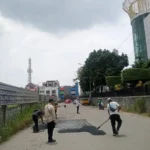
A man in Depok allegedly blocked an ambulance that was going to pick up a patient. The incident occurred near Jalan Juanda, Depok, West Java, on Sunday (May 10) afternoon.
The police secured the motorcyclist identified by initials ML, who went viral for blocking an ambulance in Sukmajaya, Depok. ML has now been named a suspect.
Made revealed that ML blocked the ambulance because he was annoyed that the ambulance asked for the right of way. After being arrested by the police, ML expressed regret and apologized.
“Yes, he was upset that the ambulance asked for the right of way. Yes, he regrets it and apologizes,” he added.
For his actions, ML is being charged under the Destruction clause of Law Number 1 of 2023 concerning the Criminal Code (KUHP), specifically Article 521 of Law 1/2023, which carries a maximum penalty of 2 years in prison.
The founder of the Albaari Foundation, Musyaffa Kautsar, who was driving the ambulance at the time, said that because the office is located inside a residential complex, they are accustomed to not turning on the siren when the ambulance is about to leave. Instead, they used a horn sound and turned on the rotating lights.
“So we were just about to leave the housing complex. We are used to not turning on the siren there. The long siren, we don’t turn that on. We only used the rotating lights and short beep-beep sounds,” said Musyaffa.
However, according to Musyaffa, the perpetrator did not appreciate the ambulance’s sound. The perpetrator tried to stop the ambulance and ended up cursing at them.
“Well, the perpetrator likely didn’t like the short beeps we made, the brief siren we turned on. In the end
<h3 class="text-lg font-semibold mb-
Jalan Moch Nail
Jalan Moch Nail is a street located in Yogyakarta, Indonesia, named after Mochammad Nail, a prominent figure in the city’s history who served as its mayor from 1958 to 1966. During his tenure, he contributed significantly to the development and modernization of Yogyakarta, particularly in infrastructure and urban planning. Today, the street serves as a modest tribute to his legacy, reflecting the city’s blend of cultural heritage and progress.
Bakti Jaya Village
Bakti Jaya Village is a neighborhood located in the Setu District of South Tangerang, Indonesia. Historically, it developed as part of the rapid urbanization of the Greater Jakarta area, transitioning from agricultural land into a residential and commercial hub. Today, it is known for its local community life, small businesses, and proximity to educational institutions and urban amenities.
Sukmajaya District
Sukmajaya District is a densely populated administrative area located in Depok City, West Java, Indonesia. Historically, it was part of the development of Depok as a satellite city for Jakarta, growing rapidly from the late 20th century onward. Today, it is known for its mix of residential neighborhoods, local markets, and educational institutions, serving as a key hub within the city.
Depok City
Depok City, located just south of Jakarta, Indonesia, has a unique colonial history dating back to the 17th century, when it was established as a private estate by Cornelis Chastelein, a Dutch East India Company official. He freed his slaves and granted them land, leading to the development of a distinct Christian community and culture known as the “Depok Lama” (Old Depok). Today, it has transformed into a bustling satellite city and a major educational hub, home to the University of Indonesia.
Jalan Juanda
Jalan Juanda is a historic street in Jakarta, Indonesia, named after the country’s first Prime Minister, Djuanda Kartawidjaja. Formerly known as Noordwijk during the Dutch colonial era, the street became a prominent commercial and cultural hub in the 19th and early 20th centuries, featuring art deco architecture and bustling shops. Today, it remains a lively area known for its mix of historic buildings, street markets, and local eateries.
Depok
Depok is a city in West Java, Indonesia, whose name is thought to originate from the Sundanese word for “hermitage” or a type of tree. Its modern history began in the 17th century when it became a colonial-era plantation estate owned by the Dutch East India Company (VOC), later developing into a private town for Dutch citizens and freed slaves. Today, Depok is a rapidly growing satellite city of Jakarta, known for its educational institutions, including the University of Indonesia.
West Java
West Java is a province in Indonesia known for its rich cultural heritage and natural beauty, including volcanoes, tea plantations, and the city of Bandung. Historically, it was part of the Sunda Kingdom and later became a key region during the Dutch colonial era, with Bandung serving as a center for administration and the famous Bandung Conference in 1955. Today, it remains a vibrant hub of Sundanese culture, arts, and tourism.
Sukamaju Village
Sukamaju Village is a traditional settlement in West Java, Indonesia, known for its rich Sundanese cultural heritage and scenic rural landscapes. Historically, the village has been a center for local agriculture and community life, with many residents preserving ancestral customs in farming, arts, and daily rituals. Today, it serves as a cultural tourism destination where visitors can experience traditional village architecture, crafts, and warm hospitality.
Cilodong District
Cilodong is a district located in Depok City, West Java, Indonesia. Historically, it developed from a rural area into a densely populated residential and commercial hub as part of the greater Jakarta metropolitan area’s expansion. Today, it is known for its mix of housing, local markets, and educational institutions, reflecting the rapid urbanization of the region.