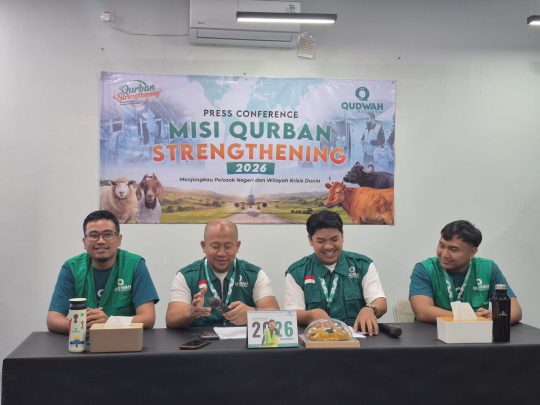
BEKASI CITY — Qudwah has launched its annual humanitarian program, the Qurban Strengthening Mission 1447 H/2026. This program focuses on reaching communities in areas with high humanitarian urgency, ranging from Palestine, Africa, the Middle East, Asia, to remote parts of Indonesia.
The President Director of Qudwah Indonesia, Lukman Hakim, stated that the theme “Qurban Strengthening 2026” was chosen as a commitment to providing qurban (sacrificial offerings) that can make a real impact on communities affected by conflict, poverty, and food crises.
“This year, we want qurban to be not just a ritual act of worship, but also a strengthener of hope for our brothers and sisters who are facing difficult situations in various parts of the world,” said Lukman Hakim in a press conference on Wednesday (May 20, 2026).
According to him, Qudwah Indonesia is now expanding the scope of its international qurban distribution. While the primary focus was previously on Palestine, in 2026, Qudwah Indonesia is strengthening its role as a global humanitarian organization by reaching more crisis regions worldwide.
“Today’s humanitarian response is not just about Palestine, but also about how to help other regions in need, including Indonesia,” he said.
Meanwhile, the Program Director of Qudwah Indonesia, Erwan Zaenal, explained that this year’s qurban program is divided into three main distribution clusters: Palestine, Global, and Africa.
“This year, Qudwah Indonesia presents the Qurban Strengthening 2026 Mission. We want this qurban to accompany and strengthen those in need in various regions of the world,” said Erwan Zaenal.
In the Palestine cluster, distribution will focus on Gaza, the West Bank, and Palestinian refugee areas in Egypt, Syria, Lebanon, and Jordan.
For the Gaza region, qurban aid will be sent in the form of ready-to-eat canned meat products produced at a Muslim-run slaughterhouse in India before being distributed to Gaza. Meanwhile, for the West Bank and Al-Quds regions, distribution will be carried out through the direct slaughter of sacrificial animals for the local community.
As for Palestinian refugees in Egypt, Syria, Lebanon, and Jordan, distribution will be in the form of frozen meat to ensure the aid can still reach communities amidst emergency humanitarian situations.
“Specifically in Egypt, we, along with the President Director of Qudwah Indonesia, will be present directly to perform the slaughter and distribution to Palestinian refugees,” said Erwan.
The second cluster is the Global cluster, which reaches various regions in Indonesia and countries in Asia and the Middle East. Distribution is carried out to disaster-affected areas in Aceh, East Nusa Tenggara, Solok, and the Sula Islands in North Maluku, which are classified as underdeveloped, frontier, and outermost (3T) regions.
The Deputy Head of Fundraising at Qudwah Indonesia, Gerdiansyah Winandi, stated that the Qudwah Indonesia team will travel directly to the Sula Islands to ensure qurban distribution reaches communities in remote areas.
“The Sula Islands present significant geographical challenges as they are an archipelago with limited transportation and logistics access. Consequently, community access to food is also quite difficult,” said Gerdiansyah Winandi.
According to him, Qudwah Indonesia will distribute and slaughter two cows in the area as part of the qurban distribution for communities in the 3T regions.
“Alhamdulillah, this year Qudwah Indonesia is present in the Sula Islands, carrying the trust of Indonesian donors. We will directly oversee the qurban process, from preparation to distribution to the community,” he said.
In addition to Indonesia, the global qurban program also reaches the Philippines, Thailand, and Yemen. According to Erwan, these regions are still facing humanitarian issues and food shortages that require collective attention.
Meanwhile, in the Africa cluster, qurban distribution will take place in Somalia, Sudan, Chad, and Burkina Faso, which have been facing problems of hunger, conflict, and limited access to food.
According to a report from the international food security body Integrated Food Security Phase Classification (IPC), approximately 1.6 million residents of Gaza, or 77 percent of the population, are experiencing extreme hunger. Meanwhile, a report from Save the Children states that