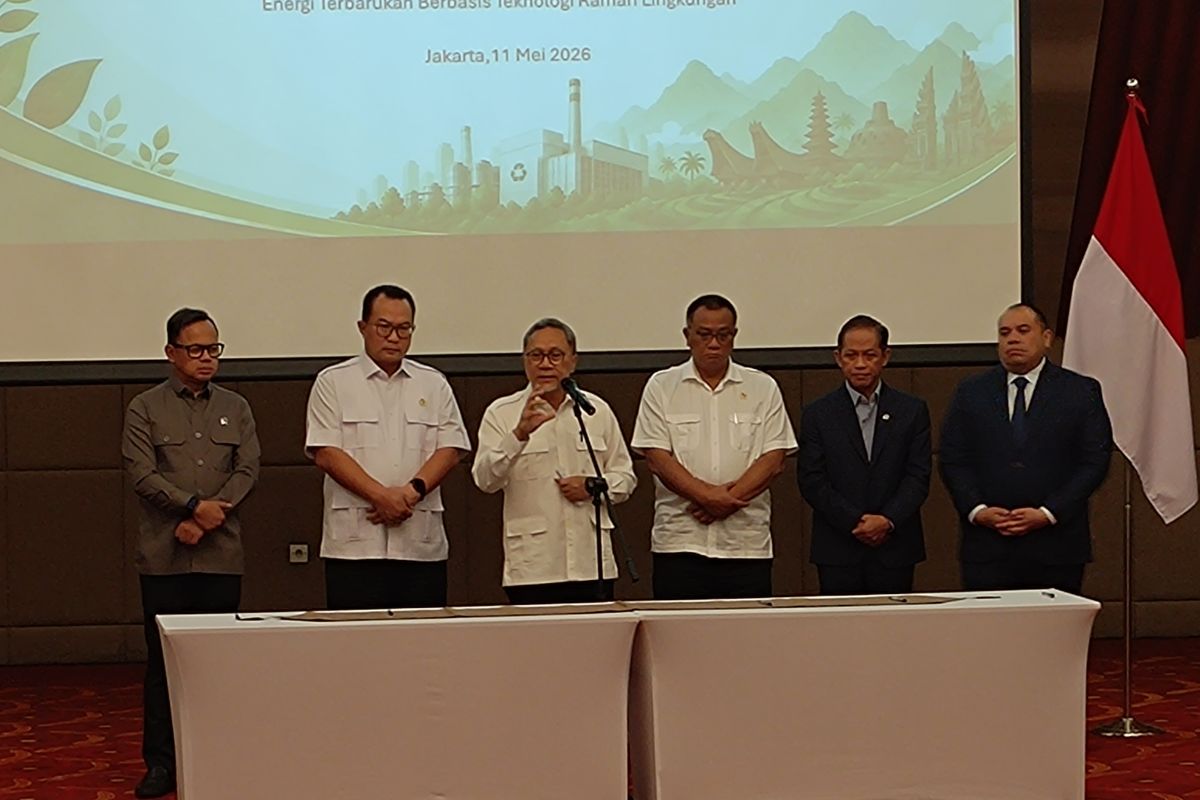
Jakarta – Indonesia’s sovereign wealth fund Danantara, through PT Danantara Investment Management, on Monday signed memoranda of understanding (MoUs) with several regional governments to accelerate waste-to-energy (WtE) plant development in six locations.
“Danantara has just signed MoUs with regional governments to accelerate WtE plant development in six locations: Lampung, Serang, Medan, Semarang, Bogor-Depok, and Bekasi,” Coordinating Minister for Food Affairs Zulkifli Hasan said in Jakarta on Monday.
He said the signing reflected a joint commitment by the central government, regional administrations, and Danantara to accelerate solutions to urban waste problems.
Zulkifli explained that the WtE projects are intended to address waste management problems, particularly in regions generating more than 1,000 tons of waste per day.
He said the government plans to develop WtE plants in 25 locations covering 62 districts and cities experiencing waste emergencies.
The minister emphasized that waste management is urgent because mounting waste piles have polluted the soil, water, and air while threatening public health.
Zulkifli said some waste piles in several regions had reached the height of 14 to 15-story buildings, highlighting the urgency of the problem.
“The waste must be converted into clean energy and electricity, without odor and without toxins,” he said.
The government aims to complete the projects in stages over the next three years, he added. Half of the projects are targeted for completion in 2027, while the remainder are expected to be finished by May 2028.
Meanwhile, Danantara Chief Investment Officer Pandu Sjahrir said accelerating the projects would require support from regional governments and the public as waste problems had become increasingly severe in many areas.
“These waste management projects are expected to require fundraising of up to US$5 billion, so this is no small amount,” he said.
He added that Danantara continued to monitor the progress of the projects together with the government to ensure completion targets are achieved.
The government has issued Presidential Regulation No. 109 of 2025 as the basis for accelerating waste management through WtE development.
Danantara initiated the tender process for the projects in November 2025 and announced winners for three locations — Greater Denpasar, Bekasi City, and Greater Bogor — in early March 2026.
Cooperation agreement documents for the three projects were signed on April 21, before Jakarta’s provincial government signed a separate MoU with Danantara on May 4.
Lampung
Lampung is a province on the southern tip of Sumatra, Indonesia, known for its strategic location along the Sunda Strait and its rich cultural heritage. Historically, it served as a gateway for trade and migration, with the Lampung people developing distinct traditions, including the iconic *Siger* headdress and *Tapis* woven cloth. The area also played a role in the spread of Hinduism and later Islam, and today it is famous for its natural attractions like Way Kambas National Park and the Krakatoa volcano.
Serang
Serang is the capital city of Banten Province in Indonesia, located on the western coast of Java. Historically, it was once part of the powerful Banten Sultanate, which played a key role in regional trade and Islamic expansion during the 16th and 17th centuries. Today, Serang serves as an administrative and economic hub, with nearby attractions like the Great Mosque of Banten and the remnants of the old sultan’s palace reflecting its rich cultural heritage.
<div class="my-4 p-4 rounded-lg shadow-md bg
Lampung
Lampung is a province on the southern tip of Sumatra, Indonesia, known for its strategic location along the Sunda Strait and its role as a gateway to Java. Historically, it was a key trading hub and a destination for Javanese migrants under the Dutch colonial transmigration program, which shaped its diverse culture. Today, Lampung is famous for its natural beauty, including Way Kambas National Park, and its unique traditional woven cloth called *Tapis*.
Serang
Serang is the capital city of Banten Province in Indonesia, located on the island of Java. Historically, it was an important center during the Banten Sultanate, which flourished as a major trading port from the 16th to the 19th centuries. Today, Serang is known for its cultural heritage, including the Great Mosque of Banten and the nearby Old Banten archaeological site, which reflect the region’s rich Islamic history.
Medan
Medan is the capital of North Sumatra, Indonesia, known for its diverse cultural heritage shaped by Malay, Batak, Chinese, and Indian influences. The city developed rapidly in the late 19th century as a major plantation hub under Dutch colonial rule, centered around tobacco, rubber, and palm oil. Today, landmarks like the Maimun Palace and the Great Mosque of Medan reflect its rich history as a trading and colonial center.
Semarang
Semarang is the capital city of Central Java, Indonesia, and a major port with a rich history shaped by Dutch colonial rule, Chinese immigration, and Javanese culture. Its Old Town, known as Kota Lama, features well-preserved 18th-century Dutch architecture, while landmarks like the Sam Poo Kong temple reflect the legacy of Chinese admiral Zheng He. The city played a key role in Java’s colonial trade and later became a center for Indonesia’s independence movement.
Bogor-Depok
Bogor-Depok refers to the corridor connecting the cities of Bogor and Depok in West Java, Indonesia, an area that has grown rapidly due to its proximity to Jakarta. Historically, Bogor was a colonial-era hill station and the site of the Bogor Botanical Gardens, established in 1817 by the Dutch, while Depok developed from a 17th-century plantation estate owned by the Dutch East India Company. Today, this region is a densely populated suburban hub, known for its educational institutions, commuter rail line, and blend of natural and urban landscapes.
Bekasi
Bekasi is a city in West Java, Indonesia, located east of Jakarta, with a history dating back to the 5th century as part of the Tarumanagara Kingdom. It later became a key site during the Dutch colonial era and played a significant role in Indonesia’s struggle for independence. Today, Bekasi is a rapidly growing satellite city and industrial hub, known for its urban development and cultural landmarks like the Bekasi Grand Mosque.
Greater Denpasar
Greater Denpasar is the capital region of Bali, Indonesia, encompassing the city of Denpasar and its surrounding urban areas. Historically, Denpasar grew from a small trading town into the island’s administrative and economic hub, particularly after the Dutch colonial era and Bali’s integration into Indonesia. Today, it is a bustling cultural and commercial center, known for its blend of modern development and traditional Balinese heritage.
Greater Bogor
Greater Bogor refers to the metropolitan area surrounding the city of Bogor in West Java, Indonesia, known for its cool climate and lush landscapes. Historically, Bogor was the capital of the Sunda Kingdom and later a key colonial retreat for Dutch officials, who built the famous Bogor Botanical Gardens in 1817. Today, the region is a rapidly growing urban hub, blending its royal and colonial heritage with modern development.