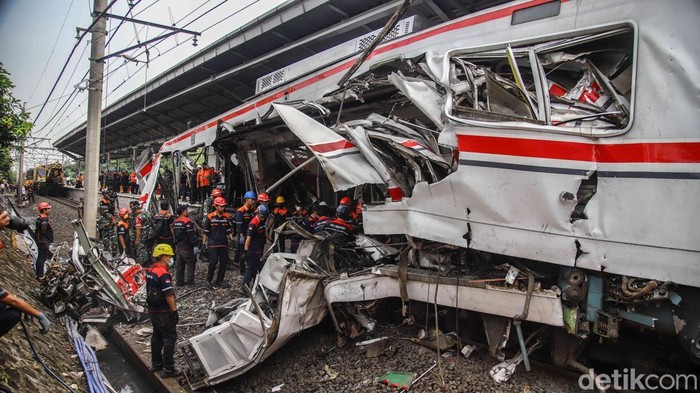
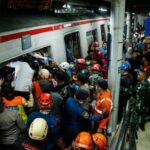
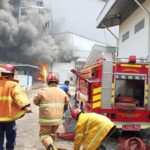
Jakarta – Police revealed that there are still five victims of the collision between a long-distance train and an electric rail train at East Bekasi Station who are being treated in hospitals. They still require medical care.
“Regarding the train accident in East Bekasi, there are still five victims undergoing treatment,” said the Head of Public Relations of the Jakarta Metro Police, Senior Commissioner Budi Hermanto, to reporters on Sunday (May 24, 2026).
Budi stated that the five victims are spread across four different hospitals. Meanwhile, other victims who were previously hospitalized have gradually returned to their homes.
“With details: 2 people at Primaya Hospital East Bekasi, 1 person at Bekasi Regency General Hospital, 1 person at Primaya Hospital West Bekasi, and 1 person at Eka Hospital Harapan Indah,” he said.
The Minister of Transportation, Dudy Purwagandhi, explained the full chronology of the accident between the electric rail train and the Argo Bromo Anggrek train at East Bekasi Station, which killed over a dozen people. Dudy revealed that the accident began when a taxi stalled at a level crossing.
The chronology of the accident was presented by Dudy during a working meeting with Commission V of the Indonesian House of Representatives on Thursday (May 21, 2026). Dudy also showed an illustrated video chronology of the accident that occurred on Monday (April 27).
Here is the chronology:
He explained that Commuter Line train 5568A arrived one minute early at Bekasi Station at 8:34 PM Western Indonesia Time. Subsequently, the Sawunggalih train 116B arrived at 8:35 PM at the same station, five minutes late from its schedule.
“The Sawunggalih train departed at 8:37 PM from Bekasi Station and passed East Bekasi Station at 8:39 PM,” said Dudy.
About 14 minutes later, a green taxi was reported to have stalled in the middle of the tracks in the East Bekasi area. At 8:48 PM, electric rail train 5181B on the Cikarang-Jakarta route passed and struck the stalled taxi.
According to Dudy, this incident triggered a crowd of residents around the location as many people stopped to see what happened.
“A crowd formed as residents came to see the accident or collision site,” he added.
On the opposite track (Jakarta-Cikarang route), electric rail train 5568A departed from Bekasi Station at 8:45 PM heading to East Bekasi Station. The train experienced an eight-minute travel delay.
The train heading to Cikarang arrived at East Bekasi Station at 8:49 PM. The train was already nine minutes late.
Train Stopped by Crowd Due to Taxi Struck by Train
Dudy said that at that time, electric rail train 5568A had briefly moved from East Bekasi Station. However, the train stopped due to a crowd of residents on the track ahead.
“The train had departed but then halted or stopped due to a crowd ahead watching the collision incident,” he said.
Then, Dudy mentioned that the Argo Bromo Anggrek train passed Bekasi Station at 8:51 PM, or three minutes ahead of schedule, at a speed of 108 kilometers per hour. The Argo Bromo Anggrek train then hit electric rail train 5568A around East Bekasi Station at approximately 8:52 PM.
“The collision occurred at 8:52 PM,” said Dudy.
This accident caused at least 16 deaths and 90 others injured. All victims were passengers of the electric rail train, while there were no casualties among the passengers of the Argo Bromo
East Bekasi Station
East Bekasi Station is a railway station located in Bekasi, West Java, Indonesia, serving the growing suburban area east of Jakarta. Originally built as part of the Dutch colonial railway expansion, it has been modernized over the years to accommodate the increasing number of commuters using the KRL Commuterline system. Today, it functions as a key transit hub connecting residents to Jakarta and other surrounding cities.
Jakarta Metro Police
The Jakarta Metro Police is the regional police force responsible for law enforcement in Jakarta, Indonesia. Its history dates back to the Dutch colonial era, evolving from the city’s early police structures to become a modern metropolitan command. Today, it oversees security and public order in the capital, handling everything from traffic management to major criminal investigations.
Primaya Hospital East Bekasi
Primaya Hospital East Bekasi is a modern healthcare facility located in Bekasi, Indonesia, offering a range of medical services to the local community. It is part of the Primaya Hospital network, which was established to provide high-quality, accessible healthcare across the country. The hospital reflects the region’s ongoing development and growing demand for advanced medical care in East Bekasi.
Bekasi Regency General Hospital
Bekasi Regency General Hospital (RSUD Bekasi) is a public healthcare facility located in Bekasi Regency, West Java, Indonesia. It was established to serve the medical needs of the growing population in the region, evolving over time to expand its services and capacity. The hospital plays a vital role in providing accessible healthcare to the local community, supporting both emergency and routine medical care.
Primaya Hospital West Bekasi
Primaya Hospital West Bekasi is a modern healthcare facility located in Bekasi, Indonesia, that provides comprehensive medical services to the local community. Established as part of the Primaya Hospital network, it aims to deliver quality care with advanced medical technology and a patient-centered approach. The hospital represents the region’s ongoing development in healthcare infrastructure, though specific historical details are limited.
Eka Hospital Harapan Indah
Eka Hospital Harapan Indah is a modern healthcare facility located in the Harapan Indah area of Bekasi, Indonesia. It is part of the Eka Hospital network, which was established to provide comprehensive medical services with international standards. The hospital is known for its advanced medical technology and specialized care, serving the growing population of the surrounding region.
Bekasi Station
Bekasi Station is a major railway station in Bekasi, West Java, Indonesia, serving as a key transit hub for commuters traveling to and from Jakarta. Originally built during the Dutch colonial era, it has undergone several renovations and expansions to accommodate increasing passenger traffic. Today, it is a vital part of the Greater Jakarta commuter rail system, connecting millions of people daily.
Indonesian House of Representatives
The Indonesian House of Representatives, known as Dewan Perwakilan Rakyat (DPR), is the lower house of the country’s legislative branch, established after Indonesia’s independence in 1945. Its modern role was shaped by the Reformasi era following the fall of President Suharto in 1998, which led to greater democratic powers and direct elections. The DPR is housed in the Nusantara Complex in Jakarta, a symbol of Indonesia’s evolving democracy.