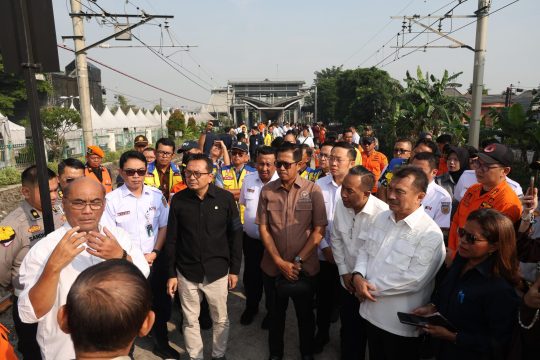
BEKASI CITY – A member of Commission V of the Indonesian House of Representatives from the PKB faction, Sudjatmiko, on Friday (05/22/2026), conducted a working visit by directly inspecting the location of the train accident tragedy in the Bekasi Timur Station area.
On that occasion, the PKB politician expressed full support for accelerating the construction of a flyover and reorganizing level crossings in the Bekasi and Bekasi Timur Station areas following the tragedy of the collision between the Argo Bromo Anggrek train and the Commuter Line train heading to Cikarang on April 27, 2026.
“The chain of accidents, starting with the Green SM taxi incident at a level crossing and ending with the collision of the Argo Bromo Anggrek train with the KRL heading to Cikarang, shows that the Bekasi area needs more modern and safer transportation engineering. The construction of the flyover can no longer be delayed,” said Sudjatmiko.
The density of vehicle traffic and the high frequency of train trips on the Bekasi line make the existence of level crossings a serious risk to public safety. He emphasized that Commission V of the Indonesian House of Representatives will push for budget support and policy oversight so that the construction of flyovers and underpasses at vulnerable points can be prioritized in the national transportation program.
“We must not wait for the next victim to fall. Bekasi is one of the busiest transportation hubs in Greater Jakarta. Safety infrastructure must be the state’s top priority,” he asserted.
He also called for a thorough evaluation of the signaling system, coordination of crossing security, and acceleration of the elimination of level crossings as mandated by national transportation safety.
Additionally, Sudjatmiko appreciated the quick work of Basarnas, BPBD, the police, medical personnel, and PT KAI staff who carried out the victim evacuation process in a short time under very difficult conditions.
“Transportation modernization is not only about speed but also about the safety of people’s lives. The state must be present to ensure that similar tragedies do not recur,” he concluded.