Bandung –
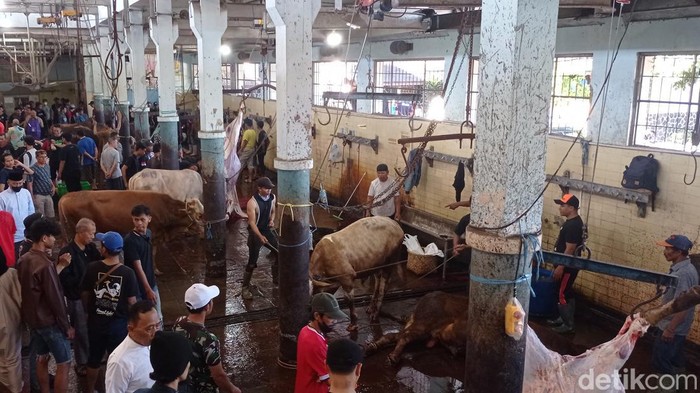
The observance of Eid al-Adha 1447 Hijri in Bandung City is still marked by findings of liver fluke in sacrificial animals. The Bandung City Food Security and Agriculture Office recorded hundreds of cases of liver fluke found during the post-mortem examination process, or examination after the slaughter of sacrificial animals.
Nevertheless, officials ensured that the infected liver portions were immediately separated and not distributed to the public for consumption.
The Head of Food Safety at the Bandung City Food Security and Agriculture Office stated that the post-mortem examination process is still ongoing because the slaughter of sacrificial animals at the slaughterhouse and in mosque and community environments is still taking place.
“The number of examinations has decreased compared to last year, but today it is still ongoing at the slaughterhouse and mosque committees in Bandung City,” he said.
He mentioned that overall, the number of animals examined in 2026 reached 2,163. This figure decreased by about 30 percent compared to the previous year, which reached more than 3,000.
“Indeed, overall, the number examined in 2026 reached 2,163, a decrease of about 30 percent. Last year, in 2025, it reached over 3,000,” he added.
From these examination results, the office still found cases of liver fluke in both cattle and sheep. This finding attracted the attention of officials because infected organs must be immediately discarded to maintain public food safety.
“From the post-mortem results, cases of liver fluke were still found. So in 2026, liver fluke was still found in 175 cattle and 86 sheep,” he revealed.
Although the number of cases is still quite high, he stated that the severity of liver fluke infection this year has decreased compared to before. Previously, up to two kilograms of liver from a single cow had to be discarded; now, the average is only about one kilogram.
“But the amount per animal has decreased. Previously, two kilograms per animal were discarded; now it’s one kilogram, and there were even cases where all of it was discarded,” he added.
According to him, this condition indicates an improvement in farming practices and treatment by breeders of their livestock. He assessed that breeders are beginning to pay attention to the health quality of the animals they raise.
“This means there is an effort by breeders to administer treatment. Usually, it also affects the heart or spleen. This year, there was a decrease, with zero cases in the spleen. This is the result of breeders’ efforts to improve their farming systems. If farming is done professionally, like in companies providing concentrate feed, it would definitely not be found. But these are cattle raised traditionally with grass feeding,” he explained.
He also outlined one of the causes of liver fluke infection in livestock: the habit of feeding grass cut in the morning when fluke eggs or larvae are still attached to the grass due to dew.
“The problem is grass cut in the morning, which is usually infected with fasciola fluke. It is better to cut grass after the sun is out, so the fluke goes into the ground first,” he continued.
The Bandung City Food Security and Agriculture Office also urged the public not to consume liver portions found with fluke. Infected organs must be immediately separated to prevent the risk of health problems.
“Our appeal to the public is that we have conducted supervision before and after slaughter. This is part of our effort to ensure sacrificial animals are safe, and we are present to provide safety to the community,” he concluded.
Bandung
<