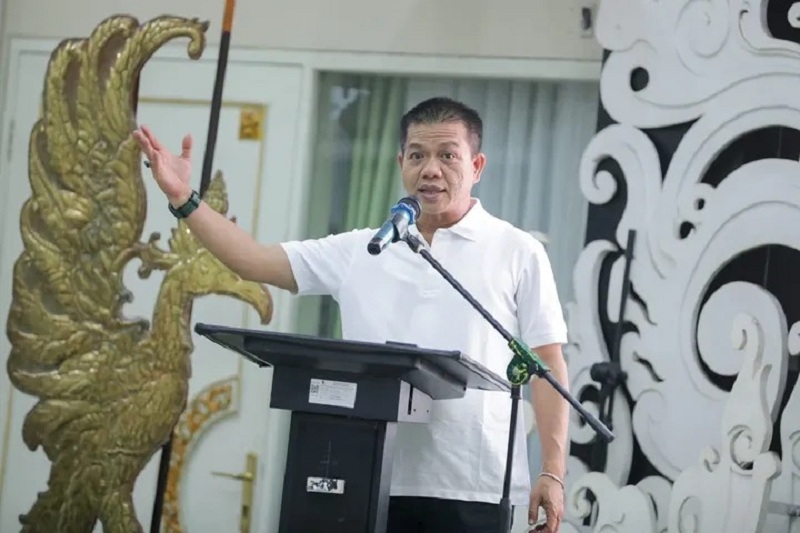
The Regent of Bandung emphasized that the future direction of development in Bandung Regency will be based on strengthening villages as the main foundation.
The statement was made in Soreang on Tuesday, April 21, 2026. According to him, village development is key to creating balanced growth while enhancing regional competitiveness.
The concept of “ngarawat lembur” places villages, the environment, and communities at the center of development. Meanwhile, “ngaronjatkeun jaman” is aimed at encouraging villages to adapt to the times.
Entering his second term of leadership with Deputy Regent Ali Syakieb since February 20, 2025, Dadang affirmed a development commitment focused on the needs of village communities.
Several macro achievements are cited as results of this approach. The Human Development Index (HDI) for Bandung Regency reached 75.58 points in 2025. The poverty rate dropped to 6.04 percent, while extreme poverty was successfully reduced to 0.5 percent.
Additionally, economic growth increased to 6.32 percent, showing a positive trend at the regional level.
In the public service sector, the regional government built five BEDAS regional general hospitals in various areas to bring healthcare access closer to village communities.
In the infrastructure sector, the condition of roads reached 65 percent in 2025 and is targeted to increase to 74 percent in 2026.
Various social programs have also been launched, such as renovating uninhabitable houses, building schools, and the BESTI and BIED scholarship programs to improve human resource quality.
However, challenges remain, especially in waste management, which reaches about 1,800 tons per day. To address this, the government is promoting the strengthening of TPST, TPS 3R, zero waste programs, and waste-to-energy processing.
Disaster mitigation efforts are also being carried out by distributing about 5.2 million seeds in priority areas as part of environmental restoration.
In governance, Bandung Regency has achieved an unqualified audit opinion nine times in a row and a Corruption Prevention Monitoring Center (MCP) score of 94 from the KPK.
Furthermore, the role of women is also being promoted as an important part of inclusive village development.
Concluding his statement, Dadang invited village communities to actively participate in protecting the environment, from waste management to river conservation, to realize a Bandung Regency that is advanced, excellent, and sustainable.

The celebration of Kartini Day, observed every April 21, is not just ceremonial but also a reminder that the struggle to open equal space for women must continue, including in the workplace.
Many companies are increasingly realizing that gender equality is not only about fairness but also contributes to better organizational performance. This commitment is demonstrated by PT Bank Rakyat Indonesia (Persero) Tbk or BRI, which continues to maintain a balanced composition of male and female employees.
BRI’s President Director Hery Gunardi revealed that BRI currently has 36,000 female employees, equivalent to 43 percent of the total 86,000 employees. This composition makes BRI an inclusive and conducive work environment for women to develop and optimize their potential.
“The presence of women in leadership positions provides a broader perspective in organizational decision-making processes. This also strengthens the company’s efforts to create a more diverse and inclusive work culture,” said Hery.
Not only in terms of numbers, but the role of women at BRI is also increasingly visible at the managerial level. Currently, 25.63 percent of BRI’s female employees hold managerial positions, from junior manager to senior management levels. To strengthen the capacity of women leaders, BRI also offers the BRILiaN Women Leaders Indonesia (BWLI) program. This program is designed as a platform for leadership development for women within the company.
Through BWLI, female employees receive intensive leadership skills development, expand their professional networks