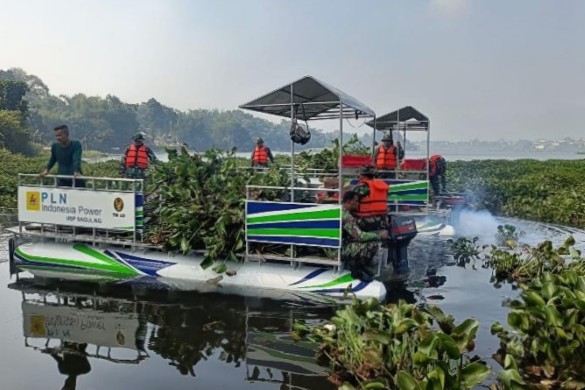
PLN Indonesia Power UBP Saguling is carrying out cleaning operations using a pontoon, conducted collaboratively with PJT II and the Citarum Harum Task Force Sector 4.
This effort is undertaken to maintain the reliability of power plant operations while supporting environmental management in the area.
Approximately 300 cubic meters are successfully removed each month using two transport boats (pontoons) to haul the aquatic plants from the reservoir area.
Senior Manager of PLN Indonesia Power UBP Saguling explained that this cleaning is a concrete step in maintaining operational smoothness and the surrounding environment.
“Uncontrolled growth of water hyacinth has the potential to disrupt water flow, operational access, and the process of utilizing water as the primary energy source for hydroelectric power plants,” he said.
He added that the reservoir plays a crucial role as the primary energy source for the power plant, so its condition must be continuously maintained. Therefore, collaborative efforts in preserving it are being maximized.
“Through collaboration with PJT II and Citarum Harum Sector 4, we hope that the handling of water hyacinth can run more optimally, sustainably, and provide benefits for both operations and the environment,” he said.
He further stated that this activity also represents synergy between agencies in maintaining the reservoir ecosystem. Collaboration between PLN Indonesia Power UBP Saguling, PJT II, and the Citarum Harum Task Force Sector 4.
“This proves that environmental management requires consistent and sustainable cooperation,” he said.
He mentioned that as a power plant based on new and renewable energy, it has an important role in supporting a reliable and environmentally friendly electricity supply.
“Efforts to keep the reservoir clean from obstacles like water hyacinth are an important part of the company’s operational preparedness,” he said.
Through this water hyacinth cleaning activity, PLN Indonesia Power UBP Saguling hopes that the reservoir condition can be maintained, plant operations run smoothly, and the benefits of clean energy from the plant can continue to be enjoyed by the community.