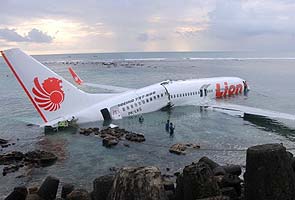
A plane missed the Bali runway and landed in the sea, injuring 45 people.
An Indonesian plane carrying more than 100 passengers broke in two after missing the runway at Bali airport Saturday and landing in the sea, leaving dozens injured but no fatalities.
The Boeing 737-800 was operated by budget airline Lion Air, a rapidly expanding carrier which recently sealed blockbuster orders for hundreds of new planes but which is banned from US and European airspace over safety concerns.
The domestic flight ended with passengers screaming in terror as the aircraft hit the water after missing the runway at the popular resort island’s Denpasar airport, despite fine weather.
The plane came to rest partially submerged in the water not far from the end of the runway, with inflatable slides deployed from the front exits and a gaping crack in the fuselage towards the rear.
Passengers in life jackets could be seen in the water.
“The plane was about to land when suddenly it fell into the sea. People on board panicked and began screaming,” a passenger named Dewi, who like many Indonesians goes by one name, said, her voice still shaking.
She received light head injuries and was taken to Denpasar hospital.
“There were 45 passengers who needed hospital treatment after being injured, but I cannot say whether their injuries were light or serious,” an airport spokeswoman said.
Bali is a hugely popular holiday destination, welcoming millions of foreign tourists from around the world every year.
Three foreigners were on board the Lion Air flight — a Frenchman, a Singaporean woman and a Singaporean man, according to the airport’s head of communications.
Transport ministry official Herry Bhakti initially said the plane overshot the runway, but later clarified his comments to say it landed straight in the water. Officials said they were still determining exactly why it ditched.
A Lion Air spokesman said the aircraft was arriving from the city of Bandung in West Java province with 101 passengers and seven crew members on board. The passengers included 95 adults, five children, and one baby.
He said the aircraft was relatively new, having started operating in 2012, and that the national transportation safety committee “will investigate the cause of the incident”.
“The plane broke into two pieces,” he said, adding that “judging from visual observation, the plane cannot be used any more”.
Lion Air, a little-known carrier launched 13 years ago with just one plane, has in recent times struck two of the world’s largest aircraft orders in a staggering $46 billion bet on Indonesia’s air transport boom.
France announced last month that Indonesia’s fastest-growing airline had agreed to buy 234 medium-haul A320 jets worth $23.8 billion (18.4 billion euros) from European aerospace giant Airbus.
That came after Lion Air astounded the industry with a $22.4 billion deal for 230 Boeing 737 airliners, inked in 2011 during a visit to Indonesia by US President Barack Obama.
But experts have raised concerns that the airline’s rapid growth could put safety at risk, with some pointing out that there is a lack of qualified pilots in Indonesia to fly the fast-increasing number of planes.
Lion Air is banned from European Union and US airspace, while in Indonesia it has a poor reputation for safety and reliability.
Between 2004 and 2006, it suffered a series of six accidents, in which no one died, and which all involved planes overshooting the runway or missing it entirely.
Founded in 1999 by brothers Kusnan and Rusdi Kirana, who are ranked the 33rd richest Indonesians with collective wealth of $900 million, Lion Air is the first private airline in Indonesia, a sprawling archipelago nation.
Its 72 destinations are mostly in Indonesia, and the furthest it flies is to Saudi Arabia — a route mostly packed with domestic workers and construction labourers.
Bali
Bali is an Indonesian island known for its stunning beaches, terraced rice paddies, and vibrant Hindu culture, which sets it apart from the rest of the predominantly Muslim archipelago. Its history dates back to ancient times, with influences from Indian traders and the Majapahit Empire, before becoming a Dutch colony in the 19th and early 20th centuries. Today, Bali is a world-famous tourist destination that blends traditional ceremonies, arts, and temples with modern resorts and wellness retreats.
Denpasar airport
Denpasar Airport, officially known as I Gusti Ngurah Rai International Airport, is the main gateway to Bali, Indonesia. Originally built in the 1930s as a small airstrip by the Dutch colonial government, it was later expanded and renamed after a Balinese national hero who fought against Dutch rule. Today, it serves as a major hub for tourism, connecting millions of visitors annually to the island’s cultural and natural attractions.
Bandung
Bandung, the capital of West Java, Indonesia, is a vibrant city known for its colonial architecture and cool climate. Historically, it became a hub for Dutch planters and intellectuals in the early 20th century, and it gained global recognition as the host of the 1955 Asia-Africa Conference, a landmark event for post-colonial solidarity. Today, Bandung is a major cultural and economic center, famous for its fashion industry, art deco buildings, and nearby volcanic landscapes.
West Java
West Java is a province in Indonesia known for its rich cultural heritage and natural beauty, including the bustling capital city of Bandung and the ancient Sundanese kingdoms that once thrived there. Historically, it was a center of the powerful Sunda Kingdom before coming under Dutch colonial rule in the 17th century, which influenced its architecture and tea plantations. Today, it remains a vibrant region blending traditional art forms, such as angklung music, with modern development.
Indonesia
Indonesia is a Southeast Asian archipelago nation with over 17,000 islands, known for its immense cultural and biological diversity. Its history includes powerful Hindu-Buddhist kingdoms like Srivijaya and Majapahit, followed by centuries of Dutch colonization until independence was proclaimed in 1945. Today, it is the world’s largest Muslim-majority country, with a rich blend of indigenous traditions and global influences.
European Union
The European Union (EU) is a unique political and economic union of 27 European countries, established to foster peace, prosperity, and cooperation after the devastation of World War II. Its origins trace back to the 1951 European Coal and Steel Community, which aimed to integrate key industries to prevent future conflicts, evolving through treaties like the 1992 Maastricht Treaty to create a single market and a shared currency, the euro. Today, the EU governs common policies on trade, agriculture, and regional development, while promoting freedom of movement for people, goods, services, and capital across its member states.
United States
The United States is a large and diverse country in North America, originally founded as thirteen British colonies that declared independence in 1776. Its history includes westward expansion, the Civil War over slavery, and its rise to a global superpower in the 20th century. Today, it is known for its cultural influence, economic power, and iconic landmarks like the Statue of Liberty and the Grand Canyon.
Saudi Arabia
Saudi Arabia is a Middle Eastern country known for its vast deserts, rich oil reserves, and deep Islamic heritage. It is the birthplace of Islam, home to the holy cities of Mecca and Medina, and was unified as a modern state in 1932 by King Abdulaziz Al Saud. The country has a long history as a center of trade and pilgrimage, and in recent years has undergone significant social and economic reforms under its Vision 2030 plan.