
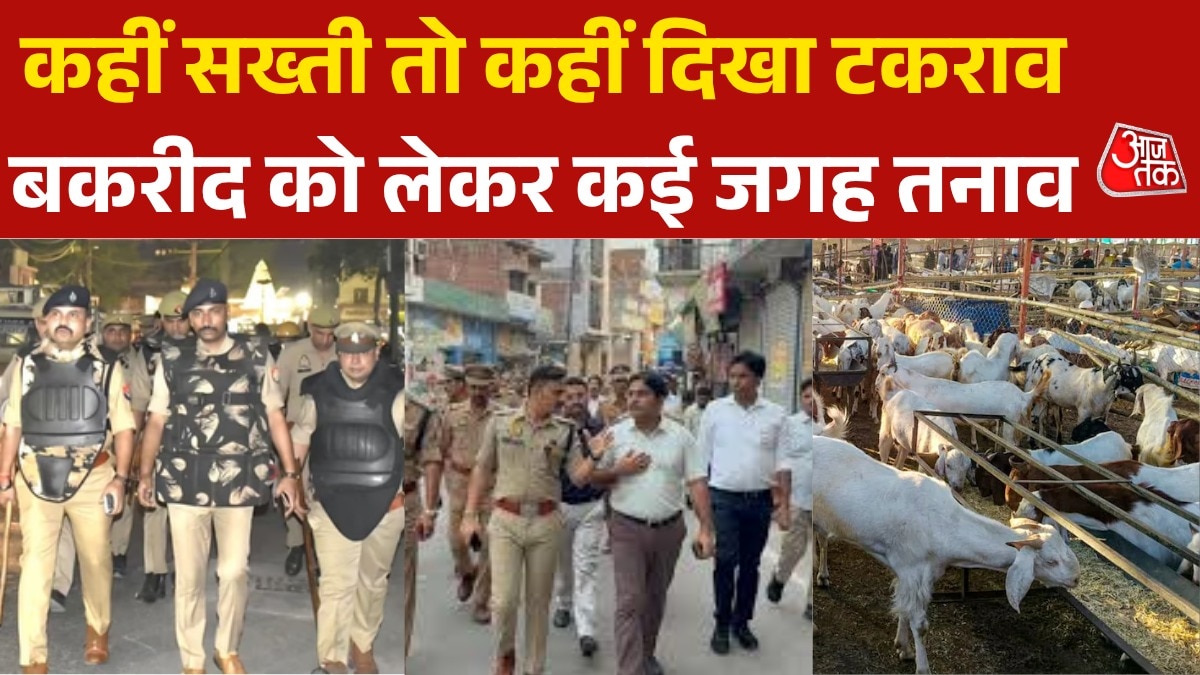
From Lucknow to Sambhal-Mumbai… Police alert city by city before Bakrid
Disputes are increasing in different parts of the country ahead of the Bakrid festival. In Uttar Pradesh, the government is strict, and it has already been stated that if rules are broken, strict action will be taken… Therefore, the police administration is also on alert mode. Watch this report.
TOPICS:
Latest
Lucknow
Lucknow, the capital of the Indian state of Uttar Pradesh, is renowned for its rich Mughal and Nawabi history, particularly as the seat of the Nawabs of Awadh in the 18th and 19th centuries. The city flourished as a center of culture, poetry, and refined etiquette, epitomized by landmarks like the Bara Imambara and the Rumi Darwaza. Today, it remains famous for its enduring “Ganga-Jamuni tehzeeb” (syncretic culture), as well as its distinctive cuisine, including kebabs and biryani.
Sambhal
Sambhal is a historic city in Uttar Pradesh, India, with a rich past dating back to ancient times, believed to have been founded by King Sambh, a descendant of the Pandavas from the Mahabharata. It gained prominence during the Mughal era, particularly under Emperor Babur, who built the famous Jama Masjid there in 1526. Today, Sambhal is known for its religious diversity and historical landmarks, including ancient temples and mosques.
Mumbai
Mumbai, formerly known as Bombay, is a major port city on India’s west coast and the country’s financial and entertainment capital. Originally a collection of seven islands inhabited by fishing communities, it was colonized by the Portuguese and later ceded to the British, who developed it into a key trading hub. Today, it is a bustling metropolis known for landmarks like the Gateway of India and the Bollywood film industry.
New Delhi
New Delhi, the capital of India, was officially inaugurated in 1931 as the imperial capital of British India, designed by British architects Edwin Lutyens and Herbert Baker. It replaced Calcutta as the center of British rule and features grand boulevards and iconic buildings like the Rashtrapati Bhavan and India Gate. Since India’s independence in 1947, New Delhi has served as the seat of the national government, blending its colonial history with modern Indian culture.
Uttar Pradesh
Uttar Pradesh is a culturally and historically rich state in northern India, known as the heartland of ancient Indian civilization. It was home to major kingdoms like the Maurya and Gupta empires, and later became a center of Mughal power, with cities like Agra and Fatehpur Sikri showcasing iconic landmarks such as the Taj Mahal. Today, it remains a vital hub for Hindu pilgrimage, including the sacred city of Varanasi along the Ganges River.
Bara Imambara
Bara Imambara is a historic architectural complex located in Lucknow, India, built in<div
Bara Imambara
Bara Imambara, located in Lucknow, India, is a grand 18th-century architectural complex built in 1784 by Nawab Asaf-ud-Daula as a famine relief project. It is famous for its massive central hall, one of the largest arched halls in the world without external pillars, and its intricate labyrinth, known as Bhool Bhulaiya. The site serves as a significant cultural and religious landmark, particularly during the Muslim month of Muharram.
Rumi Darwaza
Rumi Darwaza, also known as the Turkish Gate, is a magnificent 18th-century gateway located in Lucknow, India. It was built in 1784 by Nawab Asaf-ud-Daula, the ruler of Awadh, as part of a famine relief project to provide employment for the poor. The 60-foot-tall structure, inspired by the Sublime Porte in Istanbul, is a prime example of Awadhi architecture blending Mughal and Turkish styles.
Jama Masjid
Jama Masjid is one of the largest and most famous mosques in India, located in Old Delhi. It was built by the Mughal emperor Shah Jahan between 1644 and 1656, and its construction involved over 5,000 workers. The mosque features grand red sandstone and white marble architecture, with three imposing gates, two 40-meter-high minarets, and a vast courtyard that can hold thousands of worshippers.
Gateway of India
The Gateway of India is a historic arch-monument built in Mumbai in 1924, commemorating the 1911 visit of King George V and Queen Mary. It was designed in the Indo-Saracenic style and later served as the ceremonial exit for the last British troops to leave India in 1948, marking the end of colonial rule. Today, it stands as a prominent tourist attraction and symbol of Mumbai’s heritage.
Rashtrapati Bhavan
Rashtrapati Bhavan is the official residence of the President of India, located in New Delhi. Designed by British architect Edwin Lutyens, its construction began in 1912 and was completed in 1929, originally serving as the Viceroy’s House during British colonial rule. After India’s independence in 1947, it became the presidential palace, symbolizing the country’s democratic heritage and architectural grandeur.
India Gate
India Gate is a prominent war memorial located in New Delhi, India, built to honor the 70,000 Indian soldiers who died in World War I and the Third Anglo-Afghan War. Designed by Sir Edwin Lutyens and completed in 1931, its structure resembles a triumphal arch and bears the names of over 13,000 fallen soldiers. Today, it stands as a symbol of national pride and is a popular gathering spot for locals and tourists alike.
Taj Mahal
The Taj Mahal is a stunning white marble mausoleum located in Agra, India, built between 1632 and 1653 by Mughal Emperor Shah Jahan in memory of his beloved wife, Mumtaz Mahal. It is considered a masterpiece of Mughal architecture, blending Persian, Islamic, and Indian styles, and is renowned for its symmetrical design and intricate decorative details. Today, it stands as a UNESCO World Heritage Site and one of the most iconic symbols of love in the world.
Fatehpur Sikri
Fatehpur Sikri is a historic city in Uttar Pradesh, India, founded by the Mughal Emperor Akbar in 1571 as the empire’s capital. It was built to honor the Sufi saint Salim Chishti, who predicted the birth of Akbar’s heir, and served as the political and cultural hub of the Mughal Empire for about 14 years. Abandoned due to water shortages, it remains a well-preserved UNESCO World Heritage Site, showcasing stunning Indo-Islamic architecture.
Related news

ISKCON temple in Mumbai receives bomb threat; police and bomb squad investigate, security increased.
Threat to blow up Mumbai's ISKCON temple with a bo...

Devoleena Bhattacharjee’s son turns one year old!
Devoleena Bhattacharjee's Son Turns 1 Year Old!
S...

Same price, less space: Why has the size of your dream home shrunk?
In recent years, a new trend has been observed in ...
Mumbai real estate sees a major shift toward nature and space, driven by new investments in the city’s peripheral markets.
The focus is gradually shifting from compact, high...
Maharashtra to Expand Homes in Dharavi Redevelopment Project Up to 753 sq ft Under New Policy
The government is going to increase the size of ho...