The Maharashtra government also collected over ₹1,051 crore in stamp duty revenue during the month, reflecting sustained housing demand across the city.
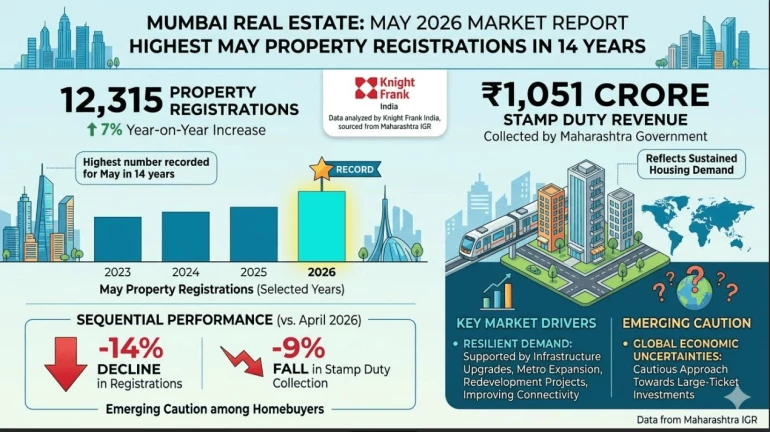
Mumbai’s residential real estate market continued its strong run in May 2026, registering 12,315 property transactions, a 7% year-on-year increase, making it the highest number of registrations recorded for the month of May in the last 14 years.
The Maharashtra government also collected over ₹1,051 crore in stamp duty revenue during the month, reflecting sustained housing demand across the city.
According to data from the Maharashtra Department of Registrations and Stamps (IGR) analysed by Knight Frank India, the latest figures surpassed the previous May peak recorded in 2025. However, on a sequential basis, registrations declined by 14% compared to April 2026, while stamp duty collections fell 9% month-on-month, indicating a degree of caution among homebuyers amid global economic uncertainties.
Industry stakeholders believe the strong annual growth reflects sustained end-user demand, supported by infrastructure upgrades, metro expansion, redevelopment-led supply and improving connectivity across the Mumbai Metropolitan Region. Experts also highlight a cautious approach adopted by homebuyers towards large-ticket investments.
While Mumbai’s residential market has continued to demonstrate resilience with the highest-ever registrations for the month of May in the last 14 years, the month-on-month decline of 14% in registrations reflects growing caution among homebuyers. A closer look at the data reveals an emerging trend that warrants attention. While registrations have increased, stamp duty collections have declined by 1% year-on-year, indicating a shift in the transaction mix and suggesting that the average value of transactions has moderated. This has directly impacted revenue collections for the State Exchequer.
Moreover, stamp duty collections have witnessed a downward trend over the last three months, pointing towards increasing caution among buyers amid prevailing economic uncertainties and geopolitical developments. The underlying demand for homeownership remains strong, supported by infrastructure growth and Mumbai’s long-term economic fundamentals. Nevertheless, continued government support through policy interventions, incentives for homebuyers, rationalization of development costs, and accelerated infrastructure investments will be critical to sustaining market momentum. Without timely measures to stimulate demand and strengthen buyer confidence, the market could witness a phase of stagnation in the coming months.
The May 2026 registration numbers reaffirm that buyer sentiment in Mumbai remains extremely positive. Crossing 12,000 registrations for the month and setting a 14-year record highlights the strength of genuine end-user demand across key micro-markets. Buyers today are making informed decisions driven by lifestyle aspirations, infrastructure upgrades, and long-term wealth creation. While stamp duty collections have moderated slightly, the volume growth indicates that demand remains broad-based across segments. We are witnessing increasing traction from both first-time homebuyers and upgraders who continue to capitalize on improved connectivity and the city’s robust economic prospects.
The latest registration figures underline the strength of affordable and mid-income housing demand in Mumbai. Despite market fluctuations, homeownership continues to remain a key aspiration for Indian families, and buyers are increasingly recognizing the value of entering the market early. The sustained growth in registrations demonstrates that housing demand is being supported by a combination of infrastructure development, improved accessibility, and confidence in the long-term appreciation potential of real estate. Going forward, continued focus on affordable housing policies and redevelopment initiatives will be critical to maintaining this momentum.
The strong registration performance in May 2026 reflects not only healthy real estate demand but also the changing expectations of urban investors. Today’s consumers are increasingly seeking integrated communities that offer wellness, sustainability, technology, and superior living experiences alongside traditional location advantages. The fact that Mumbai has recorded its highest May registrations in over a decade signals confidence in the city’s long-term growth story. As infrastructure projects continue to reshape connectivity across the region, we expect demand to remain robust, particularly for projects that combine quality construction with future-ready living environments.
The record-breaking property registrations recorded in May 2026 demonstrate the enduring appeal of Mumbai’s residential market. Buyers today are prioritizing quality developments, superior amenities, and locations that offer seamless connectivity to business districts and social infrastructure. The sustained demand despite a high base effect from last year indicates that housing remains a priority for consumers. We believe the luxury and premium housing segments, in particular, are benefiting from evolving lifestyle preferences while infrastructure investments across the Mumbai Metropolitan Region continue to create new growth corridors and unlock value for homebuyers.
Mumbai’s record May registrations highlight the strong fundamentals underpinning the residential real estate sector. The