Will help come from around the world for Bangladeshi Hindus? Mohan Bhagwat explains what will happen when Hindus decide to ‘fight’!
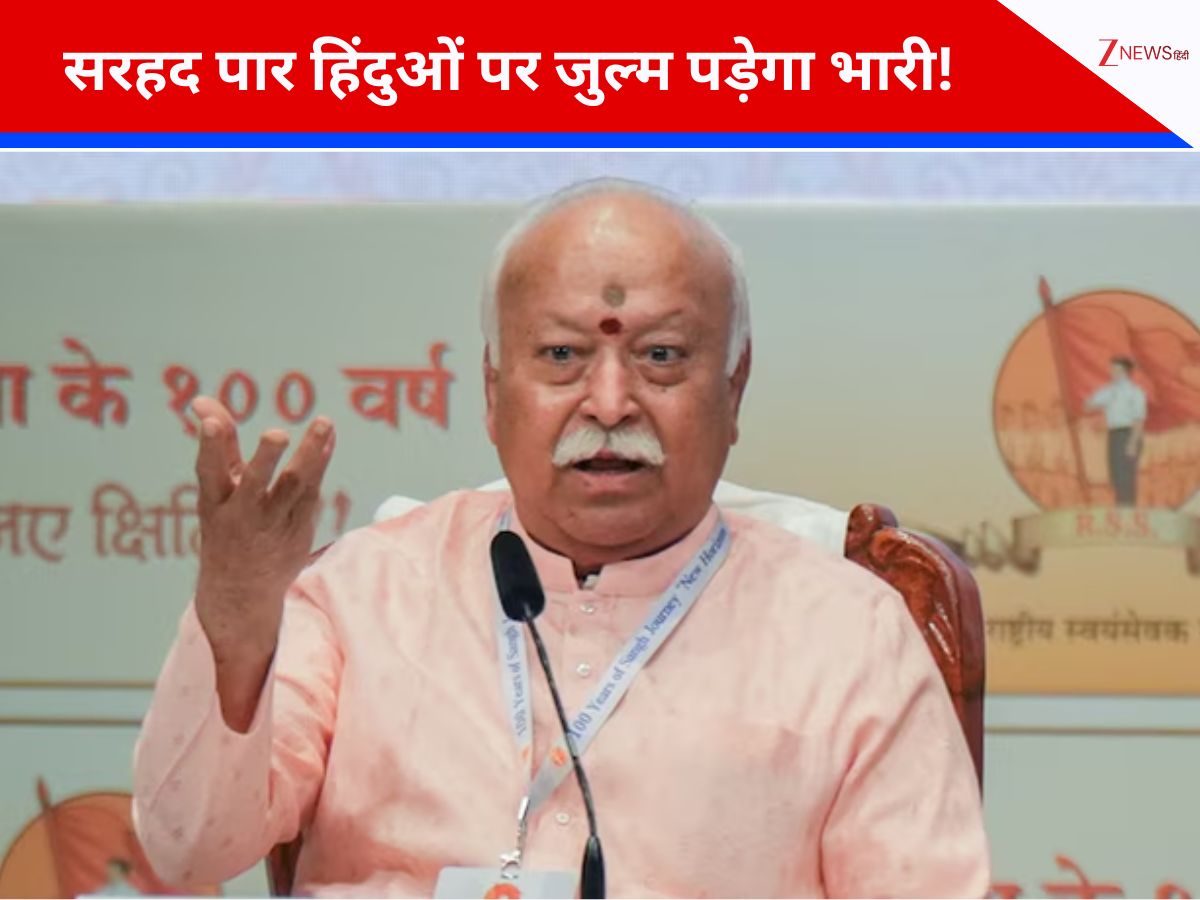
Mohan Bhagwat on Bangladesh: Amid the ongoing turmoil in India’s neighboring country Bangladesh, the chief of the Rashtriya Swayamsevak Sangh (RSS) has made a significant statement. The RSS chief’s statement regarding violence against Hindus in Bangladesh has stirred reactions on both sides of the border. During an event in Mumbai, Mohan Bhagwat clearly stated that the 12.5 million Hindus in Bangladesh should not consider themselves alone. He not only gave a message of unity but also clarified that if the Hindu community there chooses the path of struggle for their rights, the entire Hindu power of the world will stand behind them as a shield.
The Sarsanghchalak of the Rashtriya Swayamsevak Sangh (RSS), Mohan Bhagwat, had arrived at a lecture series organized in Mumbai on the occasion of the Sangh’s centenary year. During this, he said that there are approximately 12.5 million Hindus in Bangladesh. If they decide to stay there and fight for their rights, Hindus from all over the world will come forward to help them.
It should be noted that since the fall of Sheikh Hasina’s government in Bangladesh, reports of violence against Hindus have been continuously emerging in Bangladesh. Crowds have targeted Hindu businessmen, laborers, and students, a matter over which India has expressed concern from time to time.
Bhagwat also spoke on population and illegal infiltration
Speaking on the country’s internal issues, Mohan Bhagwat also expressed concern about changing demographics. He said that previous governments did not take necessary steps in this direction. He cited declining birth rates and illegal infiltration as major reasons behind it. Bhagwat also said that the current government is now working in this direction and positive results will be seen soon.
Those trying to break India will themselves break
Speaking on India’s unity, Mohan Bhagwat warned that India can no longer be weakened. He made it clear that those who try to break India will themselves break.
RSS chief also spoke on casteism
Mohan Bhagwat also responded to questions raised about the RSS’s functioning and said that there is no discrimination based on caste in the Sangh. Any person, regardless of which caste they belong to, can become the Sarsanghchalak. Being a Brahmin is not a mandatory qualification.
The Sarsanghchalak of the Sangh cannot be a Brahmin, cannot be a Kshatriya, cannot be from any other caste, yes, whoever becomes it will be a Hindu. – Dr. Mohan Bhagwat
During this, Bhagwat said that the Sangh does not take money from any corporate entity. It runs on the support of its volunteers.
On challenges in Muslim-majority areas, he said that the Sangh avoids confrontation. Even if someone uses abusive language, we do not react so that the controversy does not escalate.
The Sangh is not against anyone
Earlier, on the first day of the lecture series, Mohan Bhagwat said from the stage that the RSS is not against anyone nor does it desire power. He said that the Sangh’s objective is only to unite society.
Mumbai Vyakhyanmala Day 2 Session2 100 Year of Sangh Journey New Horizons
Bangladesh
Bangladesh is a South Asian country formed in 1971 after its independence war from Pakistan. Historically, it is part of the Bengal region, with a rich cultural heritage spanning ancient kingdoms, Mughal rule, and British colonialism. It is renowned for its vibrant arts, the world’s largest river delta (the Sundarbans), and its significant contributions to literature and music, particularly through figures like Rabindranath Tagore.
India
India is a vast South Asian country with one of the world’s oldest continuous civilizations, dating back over 5,000 years to the Indus Valley. Its long and complex history is marked by the rise of major religions like Hinduism and Buddhism, successive empires, Mughal rule, and British colonization before gaining independence in 1947. Today, it is a densely populated and diverse republic renowned for its rich cultural heritage, numerous languages, and historic sites like the Taj Mahal.
Mumbai
Mumbai, formerly known as Bombay, is a major port city on India’s west coast and the financial capital of the country. Its modern history began in the 17th century when it was transferred from Portuguese to British control, rapidly developing into a hub for trade and commerce. Today, it is a vibrant metropolis famous for its Bollywood film industry, colonial-era architecture like the Chhatrapati Shivaji Terminus, and iconic landmarks such as the Gateway of India.
Rashtriya Swayamsevak Sangh (RSS)
The Rashtriya Swayamsevak Sangh (RSS) is a prominent Hindu nationalist volunteer organization founded in 1925 by Keshav Baliram Hedgewar in Nagpur, India. It was established to promote Hindu cultural unity and self-defense during British colonial rule, evolving into a major socio-cultural and ideological force that has significantly influenced Indian politics and society.
Hindus
“Hindus” refers to the followers of Hinduism, one of the world’s oldest major religions originating in the Indian subcontinent over 4,000 years ago. It is not a single place but a global religious and cultural tradition, with its history, practices, and sacred sites deeply intertwined with the diverse civilizations of South and Southeast Asia.
Sheikh Hasina’s government
“Sheikh Hasina’s government” refers to the administrations led by Prime Minister Sheikh Hasina of Bangladesh, who has served multiple terms since 1996, with her current continuous tenure beginning in 2009. It is known for its focus on economic development, mega-infrastructure projects, and digitalization, while also facing international scrutiny over democratic governance and human rights. Historically, her leadership is deeply connected to Bangladesh’s founding Awami League party and the legacy of her father, the nation’s first president, Sheikh Mujibur Rahman.
Brahmin
“Brahmin” refers not to a specific place, but to a social class within the traditional Hindu varna (caste) system of India. Historically, Brahmins have been priests, scholars, and teachers, responsible for preserving sacred texts like the Vedas and performing religious rituals. Their role and status have evolved over millennia, deeply influencing the religious, social, and cultural history of the Indian subcontinent.
Kshatriya
“Kshatriya” refers not to a specific place or cultural site, but to one of the four principal social classes (varnas) in traditional Hindu society of India. Historically, the Kshatriyas were the warrior and ruling class, responsible for protection, governance, and justice. Their legacy is deeply embedded in ancient Indian epics like the Mahabharata and Ramayana, which chronicle the ideals and duties of this class.

)