Suvendu government takes action against infiltrators, opens first detention center in Bengal; 9 Bangladeshis held.
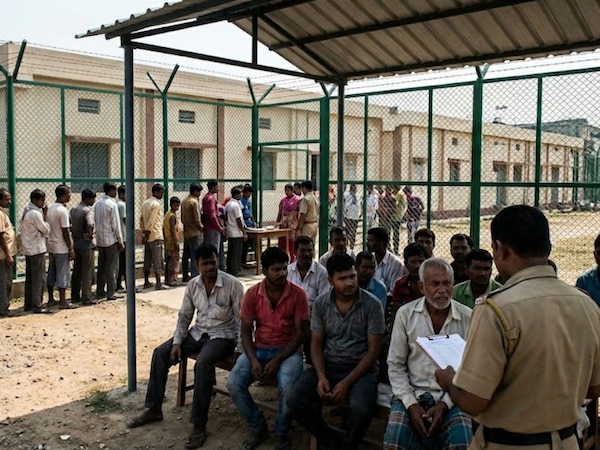
AI Generated Image
DNA Analysis: In Delhi, some privileged people have taken over the rights of common citizens. Meanwhile, in West Bengal, infiltrators are looting the country’s resources. However, the new government of Bengal has accelerated its campaign to send infiltrators back home. Today, the first phase of the detention center in Bengal has begun.
The government led by Shubhendu Adhikari has started the holding centers announced for infiltrators in Bengal. The first holding center has been built in Malda. A building located in Chandan Park, Malda, has been made Bengal’s first holding center. Currently, 9 Bangladeshi infiltrators are being held here.
Stringent security arrangements including CCTV
In the context of the deportation process for infiltrators in India, both detention centers and holding centers are used. A holding center differs from a detention center in that infiltrators are kept here only temporarily. At this center in Malda, Bangladeshis will be kept under CCTV surveillance. For the security of the holding center, 12 police personnel, along with home guards and civic volunteers, have been deployed.
Order issued two days ago
In an order issued two days ago, the Home Department of the Bengal government directed all districts to set up holding centers for suspected foreign nationals and infiltrators awaiting deportation. And it has been started today. Bengal has a total of 23 districts, and these holding centers will be established in all districts within the next few days.
In the order issued on May 23, the district administration was asked to set up such centers where captured suspected foreigners can be held.
Suspected foreigners can be kept in such a center for a maximum of 30 days.
During this time, their documents, identity, and citizenship will be verified.
After identification is complete, they will be handed over to security agencies for deportation to their country. The final decision will be made by the district magistrate or a senior officer.
This entire process is being carried out under the Immigration and Foreigners Act 2025.
Home Ministry issued guidelines regarding infiltrators
The Home Ministry issued these guidelines regarding infiltrators a year ago, i.e., in May 2025. However, the Bengal government had refused to implement them. But with the change in government, implementation has begun.
Shubhendu Adhikari ordered strict enforcement of the detect, delete, and deport policy against illegal infiltrators. Following this, the action has been initiated. That is, on one side, fencing is being done at the border to prevent infiltrators from entering India. On the other side, the process of expelling infiltrators who have already entered the country has begun.
Delhi
Delhi, the capital of India, is a historic city that has been continuously inhabited for millennia, serving as the seat of power for numerous empires, including the Mughals and the British Raj. Its rich history is reflected in iconic landmarks like the Red Fort, Qutub Minar, and Humayun’s Tomb, alongside bustling modern neighborhoods. Today, Delhi is a vibrant metropolis that seamlessly blends ancient traditions with contemporary culture.
West Bengal
West Bengal is a culturally rich state in eastern India, known for its history as the center of British colonial power from Calcutta (now Kolkata). It played a pivotal role in India’s independence movement and the Bengal Renaissance, a period of social and cultural reform. The state is famous for its diverse heritage, including the Sundarbans mangrove forest, Durga Puja festivals, and the literary works of Rabindranath Tagore.
Delhi, the capital of India, has a rich history spanning over a millennium, having served as the seat of power for numerous empires, including the Delhi Sultanate and the Mughal Empire. It is a vibrant cultural hub, blending ancient landmarks like the Qutub Minar and Red Fort with modern architecture and bustling markets. Today, Delhi stands as a dynamic metropolis that reflects India’s diverse heritage and rapid urbanization.
West Bengal
West Bengal, located in eastern India, is a state rich in cultural heritage and history, once the capital of British India under Calcutta (now Kolkata). It was a major center of the Indian independence movement and the Bengal Renaissance, fostering literature, art, and social reform. Today, it is known for its diverse traditions, including the famous Durga Puja festival, the Sundarbans mangrove forest, and the Darjeeling Himalayan tea plantations.
Malda
Malda is a historic city in the Indian state of West Bengal, known for its rich cultural heritage and as the former capital of the Bengal Sultanate during the medieval period. It was once the site of the powerful kingdom of Gauda, and today features significant ruins such as the ancient mosque complex of Adina and the massive brick-built monument of Firoz Minar. The city is also famous for its production of mangoes and silk, particularly the renowned Malda mango variety.
Chandan Park
Chandan Park is a historic public park located in Kolkata, India, originally developed during the British colonial era as a recreational space for the elite. It is named after the nearby Chandi Temple, and the area was once part of a sprawling garden estate. Today, the park serves as a popular gathering spot for locals, offering green space and a tranquil escape from the city’s bustle.
Sundarbans
The Sundarbans is the world’s largest mangrove forest, spanning the delta of the Ganges, Brahmaputra, and Meghna rivers in Bangladesh and India. Designated a UNESCO World Heritage Site, it is renowned for its unique ecosystem and as the habitat of the endangered Bengal tiger. Historically, the area has been shaped by centuries of tidal flooding and forest management, with parts of it reserved as protected forest reserves during British colonial rule.
Kolkata
Kolkata, the capital of West Bengal, is a vibrant cultural hub known for its colonial architecture, literary heritage, and artistic traditions. Founded in 1690 by the British East India Company, it served as the capital of British India until 1911, playing a pivotal role in India’s independence movement. Today, it remains famous for its rich history, festivals like Durga Puja, and as the birthplace of iconic figures such as Rabindranath Tagore and Mother Teresa.
Red Fort
The Red Fort is a historic fortification in Delhi, India, built in the mid-17th century by the Mughal emperor Shah Jahan as the palace of his new capital, Shahjahanabad. It served as the main residence of the Mughal emperors for nearly 200 years and is a UNESCO World Heritage Site, known for its iconic red sandstone architecture. Today, it is a major tourist attraction and the site where the Prime Minister of India addresses the nation on Independence Day.
Qutub Minar
Qutub Minar is a UNESCO World Heritage Site located in Delhi, India, and is the world’s tallest brick minaret, standing at 73 meters. Construction began in 1193 under Qutb-ud-din Aibak, the founder of the Delhi Sultanate, to commemorate his victory over the last Hindu kingdom in Delhi, and was later completed by his successors. The tower is a masterpiece of Indo-Islamic architecture, adorned with intricate carvings and verses from the Quran.