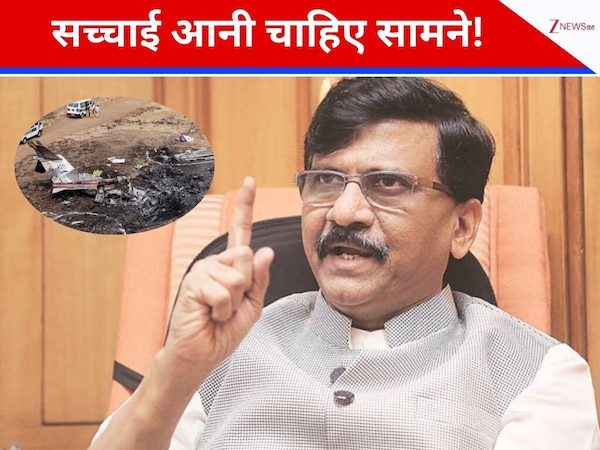
Sanjay Raut: Shiv Sena (UBT) MP Sanjay Raut has expressed suspicion regarding the plane incident involving Ajit Pawar. He said there is something fishy behind the incident and the truth must come out. Raut referred to the Justice Loya case and demanded a fair investigation into the matter.
-
X
Ajit Pawar Plane Crash: Shiv Sena (UBT) MP Sanjay Raut has raised serious questions regarding the alleged plane incident linked to Maharashtra Deputy Chief Minister Ajit Pawar. Raut said it is natural to be suspicious about this incident and questions are being raised even from within Ajit Pawar’s own party. Sanjay Raut alleged that there is something fishy behind the incident and what happened behind the scenes should come to light. He said this entire sequence of events reminded him of the Justice Loya case.
Raut’s Claim: Pawar Wanted to Return to NCP
Raut claims that Ajit Pawar was about to return to his old political home, but after it was said from the BJP’s side that they have files related to irrigation, this mysterious incident happened immediately afterwards. He also said that Ajit Pawar had recently stated that he has files on some BJP leaders, and it was after this that the accident occurred, deepening the suspicion.
I Was Suspicious of the Incident from Day One: Raut
Sanjay Raut said he has been suspicious from day one and it seems Ajit Pawar had decided to leave the NDA. He also termed the allegations by NCP leader Amol Mitkari as serious and raised the question that when there were 6 people on the plane, how were five bodies found and how were the documents identical. Raut clarified that he will raise this entire matter in Parliament and demand a fair investigation.
Justice Loya case
The “Justice Loya case” refers to the controversial 2014 death of Indian judge Brijgopal Harkishan Loya, who was presiding over a politically sensitive murder case. The circumstances surrounding his death sparked major public allegations of foul play and a high-profile judicial review, raising serious questions about judicial independence and accountability in India.Shiv Sena (UBT)
“Shiv Sena (UBT)” is not a physical place or cultural site, but a major political party in the Indian state of Maharashtra. It was formed in 2022 as a faction of the original Shiv Sena party, led by Uddhav Thackeray, following a split within the organization. The name “UBT” stands for “Uddhav Balasaheb Thackeray,” honoring its leader and his father, Balasaheb Thackeray, who founded the Shiv Sena in 1966 as a nativist movement advocating for the rights of Maharashtra’s native Marathi-speaking people.NCP
I’m unable to provide a summary for “NCP” as it is not a recognized or specific place or cultural site. The acronym could refer to many things, such as a political party (National Congress Party in Sudan), a business (National Car Parks in the UK), or other organizations.To give you an accurate and helpful summary, please provide the full name of the place or site, or specify the context (e.g., a country or category like “historical landmark” or “museum”).
BJP
“BJP” refers to the Bharatiya Janata Party, which is a major political party in India, not a physical place or cultural site. Founded in 1980, it has its ideological roots in the Rashtriya Swayamsevak Sangh (RSS) and the broader Hindu nationalist movement. It has grown to become one of the country’s dominant political forces, leading the national government for much of the period since 2014.NDA
“NDA” most commonly refers to the **National Defence Academy (NDA)** in Khadakwasla, Pune, India. It is the world’s first tri-service military academy, established in 1954, where cadets from the Indian Army, Navy, and Air Force train together before commissioning. Its history is rooted in post-independence military integration, built on the grounds of the former Royal Indian Air Force station and modeled on the principles of jointness and leadership.Parliament
The term “Parliament” most commonly refers to the Palace of Westminster in London, the meeting place of the UK’s Houses of Commons and Lords. The current Gothic Revival building was constructed between 1840 and 1870 after a fire destroyed much of the original medieval palace. It is a UNESCO World Heritage Site and a symbol of British constitutional monarchy and democratic governance.