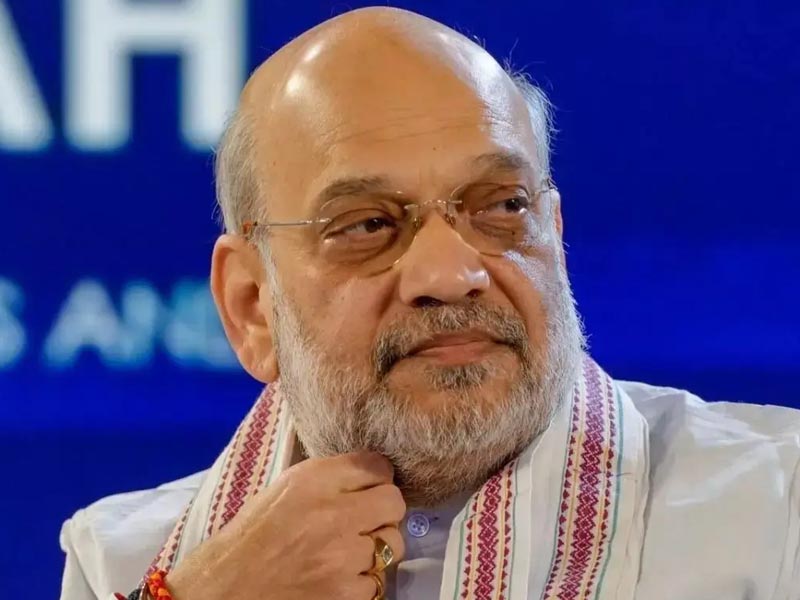
The central government has formed a committee to investigate ‘abnormal’ changes in population composition.
On Tuesday, while announcing the formation of this committee, the Union Home Minister said, “Due to infiltration and abnormal changes in population composition, concerns are arising for the present and future of the country. On Independence Day, the Prime Minister had also announced the formation of a high-level committee to examine changes in population composition for this issue.”
The Home Minister did not explain the basis for this claim of ‘abnormal’ changes in population composition, as no census has been conducted during this government’s tenure. The Modi government postponed the 2021 census citing COVID-19. Yet, elections were held in multiple states during that time. However, the Sample Registration System, operated by the Registrar General under the Home Ministry, has reported that the country’s fertility rate has dropped to 1.9 percent.
The Home Minister stated that this committee, under retired Justice Prakash Prabhakar Naolekar, will include the Census Commissioner. Retired IAS officers Durgashankar Mishra, Balaji Srivastava, and Dr. Shamika Ravi will be part of the high-level committee. The Joint Secretary of the Foreigners Division of the Union Home Ministry will serve as the committee’s member secretary.
Although formed under the guise of population composition, the committee’s real goal is to present various data regarding infiltration. Notably, the BJP has politically highlighted this issue in its election campaigns in West Bengal and Assam.
After coming to power in West Bengal, the BJP has ordered the establishment of detention centers or holding centers in all districts. In districts like Murshidabad and Malda, several individuals have been detained in holding centers. However, they are not being produced before the legal system under the Foreigners Act as per law.
By forming the high-level committee, the Home Minister said it will examine where and how population composition has changed due to illegal infiltration and abnormal reasons.
He stated that it will also investigate whether population growth in social and religious segments is abnormal. Along with analyzing the causes, the committee will also recommend solutions.
Following the Prime Minister’s speech on the formation of the high-level committee on population composition, the CPI(M) had raised questions. It was said that the purpose of this step is actually another strategy to create hatred against the religious minority Muslims.
Notably, a report on fertility rates stated that in demographic science, the ‘replacement level’ is considered 2.1. That is, when an average of slightly more than two children are born per couple, one generation is numerically replaced by the next. In India’s case, that rate has now fallen below this level. A more significant matter is that most states in the country have already fallen below this threshold.
The exceptions are only six states in northern and central India. These states are: Bihar, Uttar Pradesh, Madhya Pradesh, Rajasthan, Jharkhand, and Chhattisgarh.
Although the Muslim population share is higher in Kerala and West Bengal than in these six states, the fertility rate is lower. And in these six states of the Hindi belt, the BJP has been in power at various times. Hindutva politics has also been primarily cultivated in these states.
Among these six states, Bihar still has the highest fertility rate, between about 2.9 and 3.2. In Uttar Pradesh, it is between 2.6 and 2.9, in Madhya Pradesh about 2.7, in Rajasthan between 2.5 and 2.7, in Jharkhand 2.5, and in Chhattisgarh 2.4.
West Bengal
West Bengal, a state in eastern India, is renowned for its rich cultural heritage, including the iconic city of Kolkata, once the capital of British India. Its history is marked by the Bengal Renaissance, a period of social and intellectual reform in the 19th and early 20th centuries, and it played a pivotal role in India’s independence movement. The region is also famous for its diverse traditions, such as Durga Puja, Bengali literature, and the Sundarbans mangrove forest.
Assam
Assam, a state in northeastern India, is renowned for its rich cultural heritage, lush tea gardens, and the mighty Brahmaputra River. Historically, it was the seat of the powerful Ahom Kingdom, which ruled for nearly 600 years until the British annexation in the 19th century. Today, Assam is celebrated for its vibrant festivals like Bihu, unique silk production, and the iconic Kaziranga National Park, a UNESCO World Heritage site.
Murshidabad
Murshidabad is a historic city in West Bengal, India, which served as the capital of Bengal under the Nawabs in the 18th century. It rose to prominence after Nawab Murshid Quli Khan moved the capital there in 1704, becoming a center of political power, trade, and culture. The city is known for landmarks like the Hazarduari Palace and the Katra Mosque, and it played a key role in the lead-up to British colonial rule, particularly after the Battle of Plassey in 1757.
Malda
Malda, located in the Indian state of West Bengal, is a historic city that served as the capital of the Bengal Sultanate during the medieval period. It is home to the ancient ruins of Gour and Pandua, which feature impressive mosques and monuments like the Adina Mosque and the Qutb Shahi Mosque, reflecting the region’s rich Islamic architectural heritage. Today, Malda is known for its mango orchards and as a gateway to exploring the remnants of Bengal’s pre-Mughal history.
Bihar
Bihar, located in eastern India, is one of the country’s oldest inhabited regions with a rich history dating back to ancient kingdoms like Magadha. It was a major center of power, learning, and culture, notably as the birthplace of Buddhism and Jainism, and home to the famous ancient university of Nalanda. Today, Bihar is known for its historical sites such as Bodh Gaya, where Buddha attained enlightenment, and its vibrant cultural traditions.
Uttar Pradesh
Uttar Pradesh is a culturally and historically rich state in northern India, known as the heartland of ancient Indian civilization. It was home to major ancient kingdoms like Kosala and Magadha, and later became a center of the Mughal Empire, with cities like Agra and Fatehpur Sikri showcasing iconic architecture such as the Taj Mahal. The state also holds deep religious significance as the birthplace of both Lord Rama in Ayodhya and Lord Krishna in Mathura, and as the site of Varanasi, one of the world’s oldest continuously inhabited cities.
Madhya Pradesh
Madhya Pradesh, located in central India, is known as the “Heart of India” due to its rich history and cultural heritage. The region was home to ancient kingdoms like the Mauryas and Guptas, and later flourished under the Rajput and Mughal rulers, leaving behind magnificent temples, forts, and monuments. Today, it is famous for UNESCO World Heritage sites such as Khajuraho’s erotic temples and Sanchi’s Buddhist stupas, alongside its diverse wildlife in national parks like Kanha and Bandhavgarh.
Rajasthan
Rajasthan, located in northwestern India, is a state renowned for its vibrant culture, majestic forts, and vast Thar Desert. Its history is deeply rooted in the Rajput kingdoms, which flourished from the 6th century onward, leaving behind a legacy of heroic tales and stunning architecture like the Amber Fort and Mehrangarh Fort. Today, Rajasthan is a major tourist destination, celebrated for its colorful festivals, traditional music, and desert landscapes.