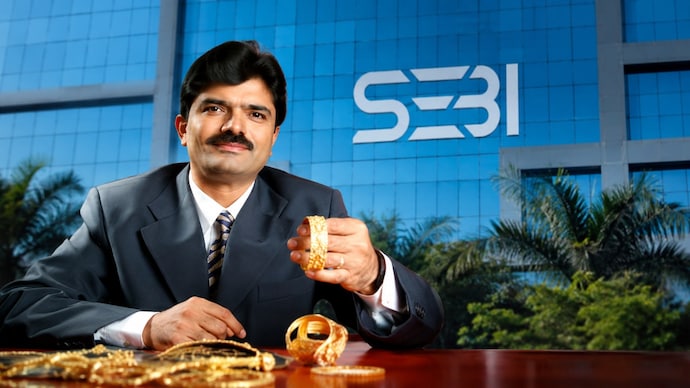
1,50,00,00,00,00,000! This is not a phone number. The country’s stock market regulator, the Securities and Exchange Board of India (SEBI), has accused Rajesh Exports Limited, a company of gold trader Rajesh Mehta, who is very close to Modi, of embezzling this amount of money.
The main victim of this 15 lakh crore rupee embezzlement is again the state-owned life insurance company LIC. Rajesh Exports has had a bad reputation in the market for a long time. When no one wanted to invest in this ‘suspicious’ company, LIC stood by it like a ‘staff for the blind’. This ‘model’ is not new. Since the beginning of the Modi government’s rule, the central BJP government has tried to revive failing companies using the state-owned corporation’s own funds, i.e., the public’s savings. Sometimes it was the State Bank of India, sometimes Punjab National Bank or LIC—these entities have acted as oxygen cylinders whenever companies owned by Modi’s billionaire friends got into trouble. In many cases, the oxygen cylinder didn’t even work; although the public’s savings managed to keep various companies alive for a few days, they eventually went bankrupt—Nirav Modi, Mehul Choksi, and Anil Ambani are examples of this. Some have survived, like Gautam Adani.
What will happen to Rajesh Mehta is not yet clear. SEBI has disclosed the details of the financial misappropriation in its interim report. They have been accused of irregularities, showing fake revenue records, and not cooperating with SEBI’s investigation. The report alleges that the company’s Managing Director, Rajesh Mehta, was involved in the fraud.
Meanwhile, as soon as the news came out, the shares of ‘Rajesh Exports’ crashed. As the market opened, the company’s share price fell by about 5 percent to hit 103 rupees. Over the past year, the price of this share has fallen by nearly 40 percent.
Opposition parties have raised questions about the central government’s role in this financial embezzlement. Party spokesperson Jairam Ramesh said that during the Modi era, state-owned companies’ money is being siphoned off through continuous fraud. Despite this experience, why did LIC buy shares of Rajesh Exports? On whose instructions, linked to the central government, were these shares purchased? Why did this fraudulent company get loans from state-owned banks? Everything should be investigated.
The information that has come to light in SEBI’s report is astonishing. SEBI claims that between the financial years 2020-21 and 2024-25, ‘Rajesh Exports’ presented a discrepancy or false information of about 15.15 lakh crore rupees in its consolidated revenue. This amount is approximately 99.80 percent of the total revenue the company showed during that specific period!
The report states that 97 to 99 percent of the company’s total income came from its foreign associate companies, especially ‘Valkambi SA’. But after examining ‘Valkambi’s own audited financial reports, SEBI found that the huge income shown at the main group level was only a fraction of what actually existed there. SEBI alleges that instead of showing the actual income from gold processing, the company misled investors by showing the total value of all gold transactions as revenue. They could not provide any proper invoices, customer details, or accounting documents to support this.
SEBI’s report said that Rajesh Exports showed sales of 11,487 crore rupees and purchases of 11,488 crore rupees with a company named ‘Affluence Shares and Stocks Private Limited’. However, that particular company completely denied any such transaction. Furthermore, without the permission of the audit committee, 339 crore rupees of the company were sent to the personal account of the owner, Rajesh Mehta, which he allegedly used for derivative trading. Due to this fraud, small investors and general shareholders have lost about 12,726 crore rupees.
SEBI has also recommended to the National Financial Reporting Authority to examine the role of the company’s statutory auditors in this matter. Meanwhile, the Life Insurance Corporation is in trouble over this fraud. It holds about 10.80 percent of the shares in this company. The corporation has not bought or sold any shares since September 2023. Recently, as the price of Rajesh Exports’ shares has plummeted, the value of these shares held by the corporation has decreased massively. At the beginning of 2026, the value of the Life Insurance Corporation’s holding in Rajesh Exports was