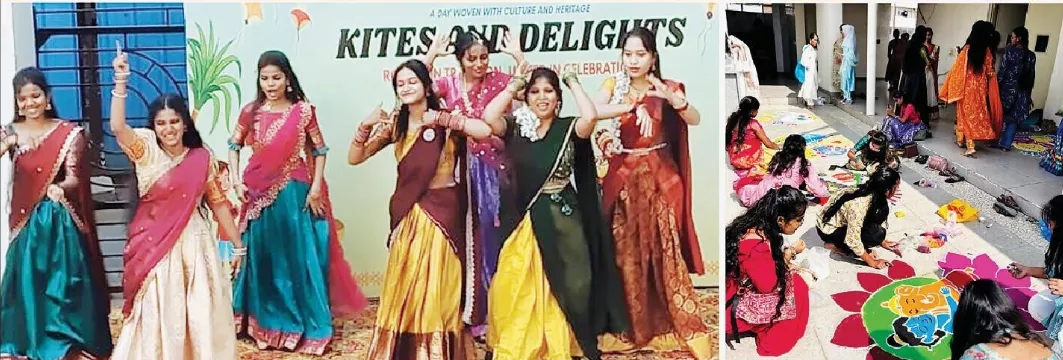
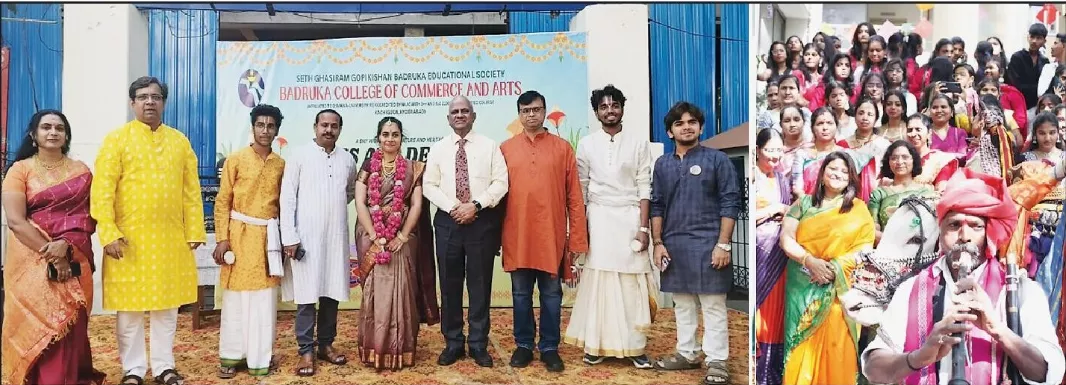
Hyderabad, The Pongal festival titled ‘Kites and Delights’ was celebrated today at Badruka College of Commerce and Arts in Kachiguda. According to information received, the event was filled with a spirit of tradition, unity, and joy.
The occasion expressed gratitude towards nature and respect for the rich cultural heritage through various activities. The main highlight of the event was the authentic celebration of Pongal traditions, which included bringing the Basavanna into the college campus, preparing Pongal, and lighting the Bhogi Mantalu, among others. These traditional practices enabled students to experience the true essence of the festival.
Various cultural programs and competitions were organized to encourage student participation and creative expression. These included dance performances, engaging open mic sessions, and various Pongal-related activities. Among these, the Art Club organized a creative kite-making competition. The Management Club heightened the participants’ enthusiasm through entertaining activities and a treasure hunt.
The Literary Club captivated the audience with open mic performances and informative speeches highlighting the cultural significance of Pongal. The Theater Club’s dance performance and a unique Harikatha presentation were special attractions of the program. An award distribution ceremony was also held on the occasion. The college’s newsletter was officially released during the event. The Pongal celebration saw the encouragement of students by the college’s dignitaries.
Pongal
Pongal is not a place or cultural site, but a major multi-day harvest festival celebrated primarily in the Indian state of Tamil Nadu. It is dedicated to the Sun God (Surya) and marks the beginning of the sun’s northward journey (Uttarayan). The festival’s history is ancient, with roots in the Dravidian agrarian tradition, and its name comes from the ceremonial dish of sweet rice boiled with milk, which is prepared as an offering.
Basavanna
Basavanna, also known as Basaveshwara, was a 12th-century Indian philosopher, statesman, and poet who was a key figure in the Lingayat faith. He is not a place but a revered person whose teachings and social reforms, which challenged caste discrimination and ritualism, are central to the culture of Karnataka. His legacy is honored at many temples and institutions across the region, most notably the “Basavanna” statue in the legislative assembly complex in Bengaluru.
Bhogi Mantalu
“Bhogi Mantalu” is a traditional South Indian festival, not a physical place, marking the first day of the four-day Pongal harvest celebrations. It involves the ritual burning of old household items and agricultural waste in a bonfire, symbolizing the destruction of the old and impure to welcome new beginnings. This practice has roots in agrarian history and is dedicated to the Hindu rain god, Indra, to ensure prosperity for the coming year.
Badruka College of Commerce and Arts
Badruka College of Commerce and Arts is a private educational institution located in Hyderabad, India. It was founded in 1950 by the Badruka Educational Society, established by the philanthropist Kotha Satyanarayana Badruka, with the aim of providing quality commerce and arts education. Over the decades, it has grown into a well-regarded college affiliated with Osmania University.
Kachiguda
Kachiguda is a historic neighborhood in Hyderabad, India, best known for the Kachiguda Railway Station, which opened in 1916 during the Nizam’s rule. It served as a major terminus for the Nizam’s Guaranteed State Railway and remains a key transportation hub, reflecting the area’s development as a commercial and residential center in the early 20th century.
Harikatha
Harikatha is a traditional Indian performing art that combines storytelling, music, and moral discourse, primarily centered on Hindu religious epics and Puranic lore. Originating in ancient times, it became a highly structured oral tradition in the 16th century, notably popularized by saints in Maharashtra and Tamil Nadu to convey spiritual teachings to the masses. It remains a vibrant form of cultural and religious expression in South India, performed by a solo narrator-singer (kathakar) who dramatizes stories to educate and entertain.