Changes are coming to the country through the great yajna.
Hyderabad — Yagya Shiromani Praharji Maharaj stated that due to the 100 (Shata) Gayatri Purashcharan Mahayagya performed by Brahmins at Mahatirtha Pushkar with the intention of universal welfare, remarkable changes have occurred in the country and will continue to occur.
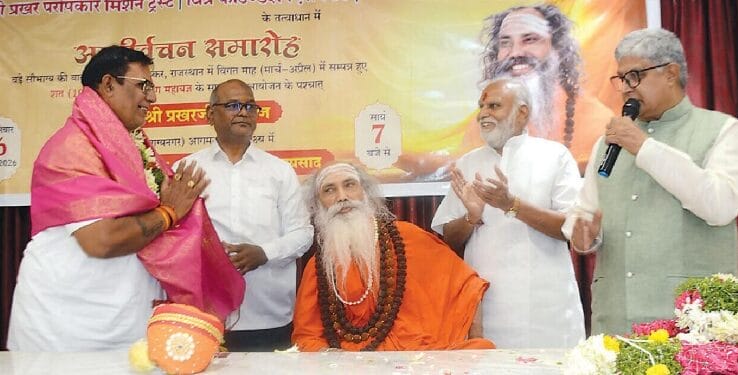
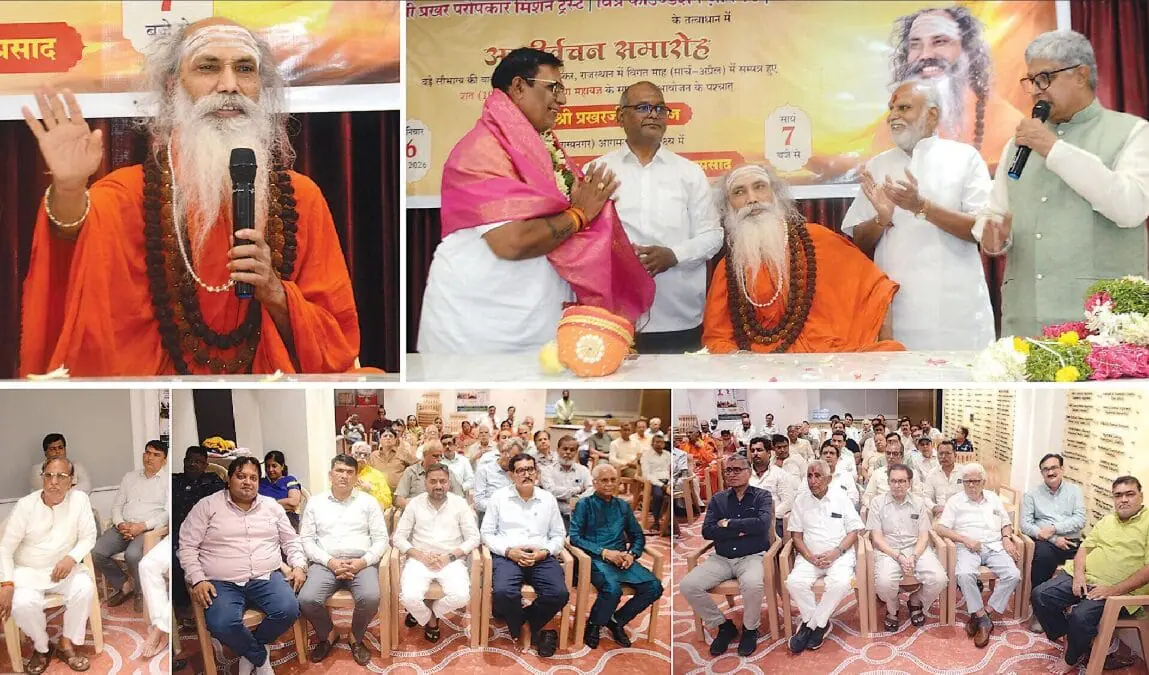
At the honor ceremony for Yagya Shiromani Praharji Maharaj organized by the Shri Prahar Paropakari Mission Trust, Vipra Foundation Zone 16, Akhil Bharatvarshiya Brahmin Mahasabha, and the entire Vipra Brahmin community at the Agarwal Samaj Hall located in Raghav Ratna Tower on Chirag Ali Lane here, various Brahmin associations grandly honored the Maharaj for the success of the yagya and received his blessings. Expressing gratitude to everyone, the Maharaj said that currently, the Brahmin community in the country is divided. There is major discrimination at the state level, so there is a need to unite the Brahmin community across the country. If they remain united, they will be able to progress.
2000 Vipra Scholars Chanted Mantras in the 200-Kunda Yagya
The Maharaj said that with the intention of universal welfare, the 43-day 100 (Shata) Gayatri Purashcharan Mahayagya was successfully completed last month (March-April) at Rajasthan Brahmateerth Pushkar. In this 200-Kunda Mahayagya, 2000 Vipra scholars chanted thirty crore Gayatri mantras and performed the yagya. This great yagya was conducted solely with the financial support of the Brahmin community, in which all Brahmins generously provided full cooperation. This yagya has been completed historically and has made history. Various resolutions were taken in this yagya, primarily including bringing peace to terrorism and separatism spread across the world, eliminating enemies of Sanatan Dharma, and several other resolutions.
The result of this yagya was that the Bharatiya Janata Party government came to power in West Bengal with a massive majority, and in Kolkata, where cows were being slaughtered, that slaughter stopped, and even the Muslim community themselves began to promote not slaughtering cows. The Maharaj said that the yagya brought changes in the lives of Brahmins living in Pushkar. The practice of performing trikala sandhya (three daily prayers) has started in Brahmin homes. The Maharaj said that very good results of this yagya will come in the future. We express gratitude to the Brahmins who contributed to this work. Conducting the program, Harinarayan Vyas said that under the guidance of Swami Shri Praharji Maharaj, the 43-day 100 (Shata) Gayatri Purashcharan Mahayagya was successfully completed last month (March-April) at Rajasthan Brahmateerth Pushkar. The program concluded with Mahaprasad (holy food).
Participation of Various Brahmin Organizations in the Honor Ceremony
Present on the occasion were Agarwal Samaj Vice President CA Hargovind Prasad, Joint Minister Pratik Narsaria, along with Akhil Bharatiya Brahmin Mahasabha President Haridas Sharma, Harinarayan Vy
Mahatirtha Pushkar
Mahatirtha Pushkar is a highly sacred Hindu pilgrimage site located in Rajasthan, India, centered around the holy Pushkar Lake. According to legend, the lake was created by a lotus flower dropped by Lord Brahma, and the town is home to one of the world’s few temples dedicated to him. Its history as a major spiritual destination spans thousands of years, drawing pilgrims to bathe in its sacred waters during the annual Pushkar Camel Fair.
Agarwal Samaj Hall
Agarwal Samaj Hall is a community center typically associated with the Agarwal community, a prominent business and trading caste in India. These halls often serve as venues for social gatherings, weddings, and cultural events, reflecting the community’s emphasis on unity and tradition. While specific historical details vary by location, many such halls were established in the 20th century to support the diaspora’s social and religious activities.
Raghav Ratna Tower
Raghav Ratna Tower is a prominent cultural and architectural landmark located in the city of Jabalpur, Madhya Pradesh, India. It was built in the early 20th century by the Gond king Raja Raghavendra Rao, and the tower is named after him, reflecting the region’s royal heritage. The structure stands as a symbol of the Gond dynasty’s influence and is a popular tourist attraction known for its historical significance and distinctive design.
Chirag Ali Lane
Chirag Ali Lane is a historic street located in the heart of Hyderabad, India, named after Chirag Ali Shah, a revered 18th-century Sufi saint. The lane is known for its old-world charm, lined with traditional shops, eateries, and residential buildings that date back to the Nizam era. It remains a vibrant cultural hub, reflecting the city’s rich Islamic heritage and bustling daily life.
Rajasthan Brahmateerth Pushkar
Rajasthan Brahmateerth Pushkar is a sacred Hindu site located in Pushkar, Rajasthan, believed to be the spot where Lord Brahma performed a holy yajna (sacrificial ritual). According to legend, this is where Brahma dropped a lotus flower, creating the Pushkar Lake, and the site is considered one of the most important pilgrimage destinations in India. The Brahmateerth ghat, with its ancient temples and spiritual significance, attracts devotees who come to bathe in its purifying waters.
West Bengal
West Bengal, a state in eastern India, has a rich history as the epicenter of British colonial rule in India, with Kolkata serving as the capital of British India until 1911. It is renowned for its vibrant cultural heritage, including the Bengali Renaissance, which fostered literature, art, and social reform in the 19th and early 20th centuries. Today, the state is famous for its diverse landscapes, from the Sundarbans mangrove forest to the Himalayan foothills of Darjeeling.
Kolkata
Kolkata, the capital of West Bengal, is a vibrant city known for its rich colonial history as the former capital of British India. Founded in 1690 by the British East India Company, it served as a major center of trade, culture, and the Indian independence movement. Today, it is celebrated for its artistic heritage, iconic landmarks like the Victoria Memorial, and its unique blend of tradition and modernity.