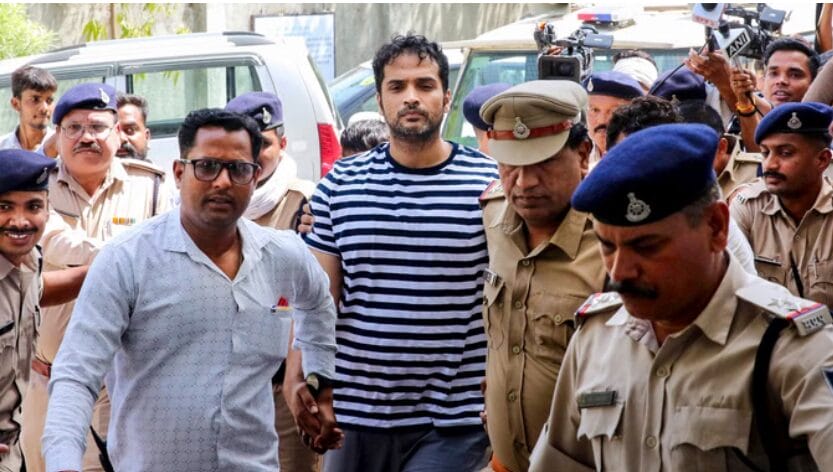
Bhopal, A major update emerged on Wednesday in the high-profile Twisha Sharma case in the state capital Bhopal. The Delhi team of the Central Bureau of Investigation (CBI), which took over the investigation from the Bhopal police, took Twisha Sharma’s husband Samarth Singh into remand on Wednesday. After undergoing a medical examination in the afternoon, the Bhopal police presented Samarth Singh in the Bhopal district court. A team of CBI officers was present in court with a lawyer.
The CBI lawyer informed the court that the investigation of the case is now being conducted by the CBI. The CBI has also taken possession of diaries, other evidence, documents, and digital devices related to this case. The remand of the accused is now required for further interrogation. On the CBI’s application, the court sent Samarth Singh on remand until May 29 for further questioning. The CBI will now interrogate Samarth Singh. In the interrogation of Samarth Singh so far, several contradictory statements have emerged that do not match the statements or claims of his mother. In such a situation, the CBI will now sit Twisha’s husband and main accused Samarth Singh and mother-in-law Giribala Singh together for face-to-face interrogation to verify the statements made earlier. Giribala Singh is out on anticipatory bail, and a hearing is ongoing in the High Court today on a petition filed to cancel her anticipatory bail. A decision is expected by evening.
When did Twisha die?
It is known that 31-year-old Twisha Sharma died on the night of May 12, after around 10 PM, at her in-laws’ residence in Bagmugalia Extension under Katara Hills police station area. The in-laws claimed it was a suicide by hanging. Due to two marks found on her neck, Twisha’s family, residents of Noida, are alleging murder. Twisha’s mother-in-law, Giribala Singh, is a retired District and Sessions Judge and also the chairperson of the Bhopal District Consumer Forum Bench-2. Her husband Samarth Singh is a lawyer. Twisha Sharma was a former actress and model. Due to the case being high-profile and on the demand of the family, the government has handed over the investigation to the CBI.
Digital documents will be examined
To strengthen the investigation, the CBI has already taken possession of Samarth Singh’s mobile phone, laptop, call detail records (CDR), and other important documents from the local police. However, the complete call details have not yet been received by the police. The CBI is now meticulously analyzing these digital and documentary evidences. The CBI will interrogate Samarth Singh on every aspect while keeping him in Bhopal. Twisha’s second post-mortem was conducted by a team from Delhi AIIMS. The report has not been received yet. If any new revelations emerge from that post-mortem report, the CBI will conduct further investigation based on it.
CBI recreated the incident, also did videography
After taking Samarth Singh into remand, the CBI reached his house in Bagumalia Extension and took him directly to the roof of the house to recreate the incident. The CBI also conducted full videography of the recreation. After this, Samarth Singh was questioned at the house regarding the events following Twisha’s death involving mother-in-law Giribala Singh and others, and videography was also done. The CBI also meticulously inspected Twisha’s room and other parts of the house that had been sealed by the police, and video recorded the entire proceedings.
Case registered under these sections
The CBI has registered a case under sections 80(2) (dowry death), 85 (cruelty by husband or his relatives), and 3(5) (common intention) of the Indian Justice Code, along with sections of the Dowry Prohibition Act. Twisha’s family has alleged that since the marriage, the in-laws were not satisfied with the dowry and she was