Another petition has been filed in the Supreme Court regarding the Bhojshala complex dispute.
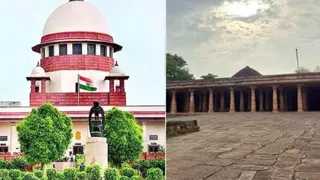
New Delhi: A new petition has been filed in the Supreme Court challenging the Madhya Pradesh High Court’s order that declared the disputed Bhojshala complex in Dhar district as the temple of Goddess Saraswati. The High Court had also stated that the central government and the Archaeological Survey of India (ASI) can decide on the administration and management of the Bhojshala complex.
The Hindu community considers Bhojshala as the temple of Goddess Saraswati, while the Muslim community calls the 11th-century monument the Kamal Maula Mosque. The disputed complex, located in Dhar district of Madhya Pradesh, is protected by the ASI. A person named Zebran Ansari has challenged the High Court’s May 15 order. Earlier, the mosque’s caretaker, Moinuddin, had challenged the High Court’s order.
The Hindu side had already filed a caveat in the Supreme Court, stating that no order should be passed on any appeal against the High Court’s order in the Bhojshala complex dispute without hearing its side. The caveat, filed by Jitendra Singh ‘Vishen’ through advocate Barun Kumar Sinha, said, ‘No order should be passed in the said case without informing me.’ Vishen was the sixth petitioner in this case, on which a bench of the Indore High Court delivered its verdict.
The High Court also quashed the ASI’s April 7, 2003 order that allowed Muslims to offer prayers inside the Bhojshala complex every Friday. The High Court further stated that the Muslim community can approach the Madhya Pradesh government for separate land allocation in the district for constructing a mosque.
Ordered a scientific survey of the disputed complex
In its much-awaited verdict, the High Court said that evidence of a Sanskrit teaching center and a temple of Goddess Saraswati was found in the Bhojshala complex. The High Court delivered its verdict on five petitions and one writ appeal related to this case. The High Court had stated, ‘The religious character of the disputed Bhojshala-Kamal Maula Mosque has been established as a temple of Goddess Saraswati.’
Citing the ASI’s scientific survey report and other available documents on the disputed monument, the court had said that the structure belongs to King Bhoja of the Paramara dynasty, a Rajput state that ruled the Malwa region of present-day central India between the 9th and 14th centuries.
Muslims were allowed to offer prayers every Friday
The High Court had said that if the Maulana Kamaluddin Welfare Society, which is a party in this case on behalf of the Muslim side, applies for land allocation for the construction of a mosque in Dhar district, the state government may consider it according to legal provisions. After the Bhojshala dispute, the ASI issued an order on April 7, 2003, allowing Hindus to worship in the complex every Tuesday and Muslims to offer prayers every Friday.
The Hindu side challenged this order in court, demanding exclusive rights to worship in the complex. A petitioner from the Jain community claimed that the complex was a medieval Jain temple and gurukul (traditional teaching center). After the High Court’s order, the ASI conducted a scientific survey of the monument in 2024 and stated in its report of over 2,000 pages that a massive structure from the reign of the Paramara kings of Dhar predated the mosque, and the current disputed structure was built using old parts of the temple. The High Court had ordered the ASI to conduct a scientific survey of the disputed complex on March 11, 2024.
Supreme Court
The Supreme Court of the United States is the highest federal court, established by Article III of the Constitution in 1789. It holds the power of judicial review, allowing it to declare laws unconstitutional, and its decisions shape American law and society. The iconic neoclassical building in Washington, D.C., was completed in 1935, symbolizing the judiciary’s role as a co-equal branch of government.
<
Supreme Court
The Supreme Court of the United States is the highest federal court, established by Article III of the Constitution in 1789. It holds the power of judicial review, allowing it to declare laws unconstitutional, and its landmark decisions have shaped American law and society for centuries. The current neoclassical building in Washington, D.C., completed in 1935, symbolizes the judiciary’s role as a co-equal branch of government.
Bhojshala complex
The Bhojshala complex, located in Dhar, Madhya Pradesh, is a historic site originally built as a Sanskrit university in the 11th century by the Paramara king Raja Bhoja. It features a unique blend of Hindu and Islamic architectural elements, as it was later converted into a mosque by the Delhi Sultanate ruler Alauddin Khilji. Today, the complex is a protected monument and a subject of cultural and religious significance, with both Hindu and Muslim communities claiming it as a sacred site.
Dhar district
Dhar district, located in the Malwa region of Madhya Pradesh, India, has a rich history dating back to the 9th century when it served as the capital of the Paramara dynasty. It was later ruled by various Islamic sultanates and the Marathas, and is known for landmarks like the Dhar Fort and the Bhojshala complex, a medieval site associated with King Bhoja. Today, it remains a culturally significant area with a blend of Hindu and Islamic architectural heritage.
Goddess Saraswati temple
The Goddess Saraswati Temple is a revered Hindu shrine dedicated to Saraswati, the goddess of knowledge, music, arts, and wisdom. While many such temples exist across India, one notable example is in Basara, Telangana, believed to be one of the oldest Saraswati temples, with origins tracing back to the 6th century CE during the Chalukya dynasty. It attracts thousands of devotees, especially students and scholars, who seek blessings for academic success and creative inspiration.
Kamal Maula Mosque
The Kamal Maula Mosque, located in Dhar, Madhya Pradesh, India, was built in the early 14th century by Kamal al-Din, a general under the Delhi Sultanate ruler Alauddin Khalji. It was constructed using materials repurposed from a destroyed Jain temple, reflecting the region’s layered history of religious and architectural transitions. The mosque is notable for its Indo-Islamic architecture, including a large prayer hall and intricately carved pillars.
Archaeological Survey of India
The Archaeological Survey of India (ASI) is a premier government agency responsible for archaeological research and the conservation of the nation’s cultural heritage. Founded in 1861 by Alexander Cunningham, often called the “Father of Indian Archaeology,” it operates under the Ministry of Culture. The ASI manages over 3,600 ancient monuments, archaeological sites, and remains of national importance, including iconic World Heritage sites like the Taj Mahal and Ajanta Caves.
Paramara dynasty
The Paramara dynasty ruled parts of central India, primarily the Malwa region, from the 9th to the 14th centuries. They are best known for their patronage of art and culture, with King Bhoja (c. 1010–1055 CE) being the most famous ruler, who commissioned the construction of the Bhojeshwar Temple and authored several scholarly works. The dynasty’s power declined after repeated invasions from the Delhi Sultanate and neighboring kingdoms, eventually collapsing in the early 1300s.
Madhya Pradesh High Court
The Madhya Pradesh High Court is the highest judicial body in the Indian state of Madhya Pradesh, with its principal seat in Jabalpur. Established on January 2, 1936, as the Nagpur High Court under the Government of India Act, 1935, it was later renamed the Madhya Pradesh High Court in 1956 following the state’s reorganization. The court also has permanent benches in Indore and Gwalior to ensure broader access to justice across the state.